Custom CNC Milling: A Complete Guide for Precision Manufacturing
Custom CNC milling has become one of the most important manufacturing technologies in modern industrial production. From aerospace brackets and automotive housings to medical implants and robotics components, CNC milling allows manufacturers to create highly accurate parts with repeatable quality and excellent efficiency.
Unlike standard machining services, custom CNC milling focuses on producing unique components according to customer drawings, CAD files, material requirements, and tolerance specifications. This flexibility makes CNC milling essential for both prototyping and large-scale production.
What Is Custom CNC Milling and How It Works
Custom CNC milling is a subtractive manufacturing process where rotating cutting tools remove material from a workpiece based on programmed instructions.
The machine receives commands from CAM software generated from CAD models. The spindle rotates cutting tools at high speed while the machine table moves along multiple axes.
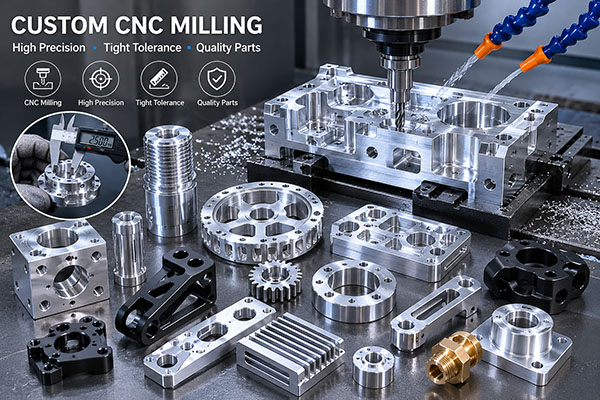
Basic CNC Milling Workflow
| Step | Description |
|---|---|
| CAD Design | Engineers create 3D part models |
| CAM Programming | Toolpaths and machining strategies generated |
| Material Setup | Raw material fixed onto machine table |
| Machining | Cutting tools remove material |
| Inspection | Final dimensions verified |
| Surface Finishing | Optional post-processing |
Modern CNC milling machines can achieve tolerances as tight as ±0.005 mm depending on machine capability and material stability.
Types of CNC Milling Machines (3/4/5 Axis)
Different CNC milling configurations determine machining capability and production efficiency.
3-Axis CNC Milling
3-axis machines move in X, Y, and Z directions. These are suitable for:
- Flat surfaces
- Simple pockets
- Basic drilling operations
- Standard mechanical parts
3-axis milling is cost-effective but limited when machining complex geometries.
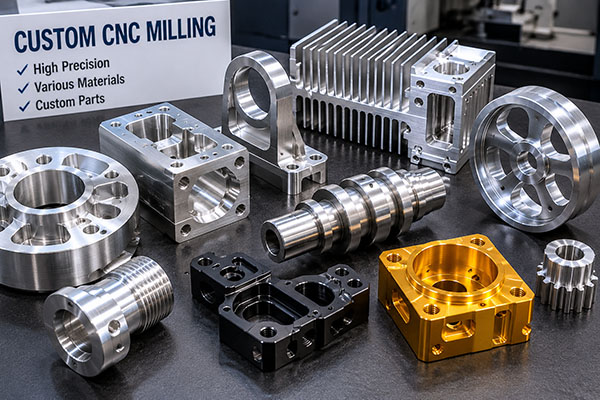
4-Axis CNC Milling
4-axis machines add rotational movement around one axis.
Advantages include:
- Machining multiple sides in one setup
- Reduced fixture changes
- Better positional accuracy
5-Axis CNC Milling
5-axis machining enables simultaneous movement along five directions.
Benefits include:
- Complex aerospace geometries
- Deep cavity machining
- Improved surface finish
- Reduced setup time
- Shorter tooling requirements
Comparison Table
| Feature | 3 Axis | 4 Axis | 5 Axis |
|---|---|---|---|
| Complexity Capability | Low | Medium | High |
| Setup Frequency | High | Medium | Low |
| Production Efficiency | Medium | High | Very High |
| Cost | Low | Medium | High |
| Surface Quality | Standard | Better | Excellent |
Common Materials Used in CNC Milling
Material selection directly affects machining speed, tool wear, cost, and final part performance.
Aluminum
Aluminum is one of the most popular CNC milling materials because it offers:
- Excellent machinability
- Lightweight properties
- Corrosion resistance
- Fast cutting speeds
Popular grades include:
- 6061 Aluminum
- 7075 Aluminum
- 5052 Aluminum
Stainless Steel
Stainless steel provides strength and corrosion resistance but is more difficult to machine.
Common grades:
- 304 Stainless Steel
- 316 Stainless Steel
- 17-4 PH Stainless Steel
Titanium
Titanium is widely used in aerospace and medical industries.
Challenges include:
- High heat generation
- Slow cutting speeds
- Expensive tooling
Engineering Plastics
Custom CNC milling also supports plastics such as:
- POM (Delrin)
- PTFE
- Nylon
- PEEK
- ABS
CNC Milling Tolerances and Precision Standards
Tolerance capability is one of the biggest advantages of CNC milling.
Typical CNC Milling Tolerances
| Manufacturing Type | Typical Tolerance |
|---|---|
| Standard Milling | ±0.1 mm |
| Precision Milling | ±0.02 mm |
| Ultra Precision Milling | ±0.005 mm |
Tolerance depends on:
- Machine rigidity
- Tool quality
- Material thermal expansion
- Operator experience
- Fixture stability
For aerospace and medical applications, geometric tolerances such as flatness, concentricity, and perpendicularity are equally important.
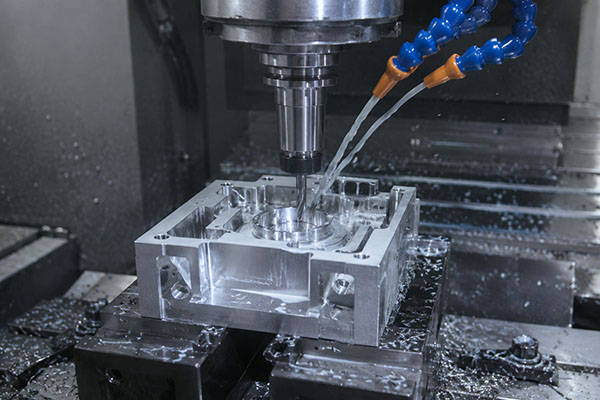
Surface Finishing Options for Milled Parts
Surface finishing affects appearance, durability, and corrosion resistance.
Common CNC Surface Finishes
| Finish Type | Application |
|---|---|
| Anodizing | Aluminum corrosion protection |
| Sandblasting | Matte texture |
| Powder Coating | Decorative protection |
| Polishing | Mirror finish |
| Bead Blasting | Uniform appearance |
| Black Oxide | Steel protection |
Surface Roughness
Surface roughness is measured using Ra values.
| Finish Quality | Typical Ra |
|---|---|
| Rough Machining | 3.2 μm |
| Fine Machining | 1.6 μm |
| Precision Polishing | 0.4 μm |
CAD/CAM Programming in Custom CNC Milling
Modern CNC machining heavily depends on CAD and CAM systems.
Popular CAD Software
- SolidWorks
- Fusion 360
- AutoCAD
- CATIA
- Siemens NX
CAM Software Functions
CAM systems generate:
- Toolpaths
- Cutting parameters
- Feed rates
- Spindle speeds
- Collision simulation
Simulation is critical because it reduces:
- Tool crashes
- Material waste
- Programming errors
Prototype vs Mass Production Milling
Custom CNC milling supports both rapid prototyping and mass production.
Prototype Manufacturing
Advantages:
- Fast iteration
- Design verification
- Reduced product development risk
Typical lead time:
- 1–7 days
Production Manufacturing
Advantages:
- Stable repeatability
- Lower unit cost
- Automation integration
Production optimization often includes:
- Dedicated fixtures
- Tool life management
- Statistical process control
Tooling Selection and Cutting Parameters
Tool selection strongly impacts machining quality and productivity.
Common Milling Tools
| Tool Type | Usage |
|---|---|
| End Mills | General cutting |
| Ball Nose Cutters | 3D contours |
| Face Mills | Flat surfaces |
| Drill Bits | Hole machining |
| Chamfer Tools | Edge finishing |
Critical Cutting Parameters
- Spindle speed (RPM)
- Feed rate
- Depth of cut
- Step-over
- Coolant flow
Incorrect cutting parameters may cause:
- Tool breakage
- Chatter vibration
- Poor surface finish
- Excessive heat
Design for Manufacturability (DFM) in CNC Milling
Good DFM practices reduce machining cost and improve production efficiency.
Important DFM Guidelines
Avoid Deep Narrow Cavities
Deep cavities require long tools, which increase vibration risk.
Use Standard Hole Sizes
Standard drill sizes reduce machining time and tooling cost.
Maintain Proper Corner Radius
Internal sharp corners are difficult to machine.
Recommended:
- Corner radius ≥ tool radius
Reduce Excessively Tight Tolerances
Unnecessary precision increases cost significantly.
CNC Milling Cost Factors and Quotation Logic
Many buyers misunderstand CNC milling pricing.
Main Cost Factors
| Factor | Cost Impact |
|---|---|
| Material Type | High |
| Machining Time | Very High |
| Tolerance Requirements | High |
| Surface Finish | Medium |
| Quantity | Major Influence |
| Complexity | Very High |
Example Cost Logic
A simple aluminum bracket may require:
- 15 minutes machining time
- Standard tolerance
- Minimal finishing
Meanwhile, a titanium aerospace component may require:
- 6+ hours machining
- Multiple setups
- Specialized tooling
- CMM inspection
The price difference can exceed 20×.
Complex Geometry and Multi-Axis Machining
Multi-axis CNC milling allows manufacturers to machine advanced geometries impossible with conventional equipment.
Examples of Complex Parts
- Turbine blades
- Aerospace housings
- Medical implants
- Robotics joints
- Mold cavities
Advantages of Multi-Axis Machining
- Better accuracy
- Reduced repositioning
- Improved tool access
- Higher efficiency
- Better surface consistency
Industries That Use Custom CNC Milling
Custom CNC milling serves nearly every advanced manufacturing industry.
Aerospace
Requirements:
- Tight tolerances
- Lightweight materials
- High reliability
Automotive
Applications:
- Engine components
- Transmission housings
- EV battery structures
Medical
Applications:
- Surgical tools
- Orthopedic implants
- Precision instruments
Electronics
Applications:
- Heat sinks
- Enclosures
- Connector housings
Quality Control and Inspection Processes
Quality control is critical in precision manufacturing.
Common Inspection Equipment
| Equipment | Purpose |
|---|---|
| CMM | Dimensional inspection |
| Micrometer | Precision measurement |
| Height Gauge | Vertical dimensions |
| Surface Tester | Roughness verification |
| Optical Comparator | Contour inspection |
Inspection Standards
Many CNC manufacturers comply with:
- ISO 9001
- AS9100
- IATF 16949
First Article Inspection (FAI) is commonly required for aerospace and medical projects.
CNC Milling vs CNC Turning vs CNC Routing
CNC Milling
Best for:
- Complex geometries
- Prismatic parts
- Multi-surface machining
CNC Turning
Best for:
- Cylindrical components
- Shafts
- Bushings
CNC Routing
Best for:
- Wood
- Plastics
- Soft materials
- Large panels
Future Trends in Smart CNC Manufacturing
The CNC industry is rapidly evolving through automation and digital manufacturing.
Emerging Trends
AI-Assisted Machining
AI can optimize:
- Toolpaths
- Tool wear prediction
- Process stability
Automation Systems
Factories increasingly use:
- Robotic loading systems
- Automatic pallet changers
- Lights-out manufacturing
Digital Twin Technology
Virtual machining simulations help manufacturers predict production outcomes before machining starts.
Real-Time Monitoring
IoT sensors monitor:
- Spindle vibration
- Temperature
- Tool wear
- Machine health
Why Xavier Is a Reliable Partner for Custom CNC Milling
When selecting a CNC machining supplier, technical capability alone is not enough. Consistent quality, engineering communication, production stability, and fast lead times are equally important.
Xavier focuses on high-precision custom CNC milling services for global industrial customers. From rapid prototyping to complex multi-axis production machining, Xavier supports aluminum, stainless steel, titanium, brass, and engineering plastics with strict quality control standards.
Key advantages include:
- Advanced 3/4/5-axis CNC machining capability
- Experienced engineering support
- Fast quotation response
- Stable tolerance control
- Flexible low-volume and mass production
- Multiple surface finishing options
- International export experience
For companies seeking reliable custom CNC milling solutions, Xavier can help reduce production risks while improving machining efficiency and product consistency.
We are an integrated manufacturer specializing in CNC machining services, mainly focused on custom CNC machining and precision manufacturing of various metal parts. We support CNC machining aluminum, CNC machining PEEK, and CNC machining stainless steel for robotics components, aerospace parts, marine hardware, automotive components, medical devices, and other precision parts. As a professional CNC machining aluminum manufacturer, we provide high-volume CNC machining PEEK services. Contact us today for competitive CNC machining stainless steel pricing.
Some of the images and text in this article are collected and compiled from the internet. If there is anything inappropriate, please contact us for processing.