Zinc vs Nickel Plating: Differences, Performance, and Industrial Applications
Metal plating is a critical surface finishing technique used in CNC machining, automotive manufacturing, and industrial hardware production. Among dozens of coating options, zinc plating and nickel plating are two of the most widely used electroplating technologies for improving corrosion resistance, wear performance, and appearance.
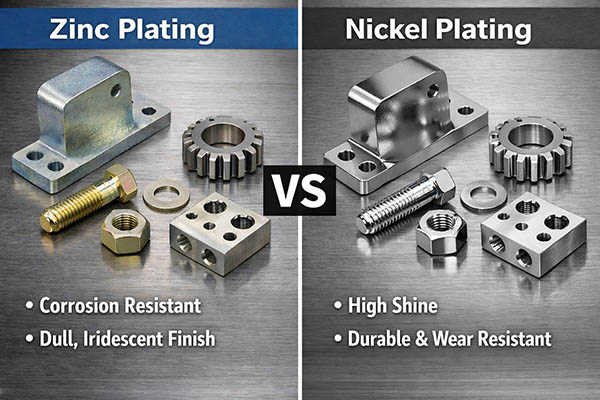
Although they may look similar at first glance, their corrosion mechanisms, hardness, cost structure, and applications differ significantly. Zinc plating is typically used for cost-effective sacrificial corrosion protection, while nickel plating provides superior hardness, wear resistance, and decorative finish quality.
This guide explains the key differences between zinc plating and nickel plating using engineering comparisons, data tables, and real manufacturing examples.
What Is Zinc Plating?
Electrochemical Protection Mechanism
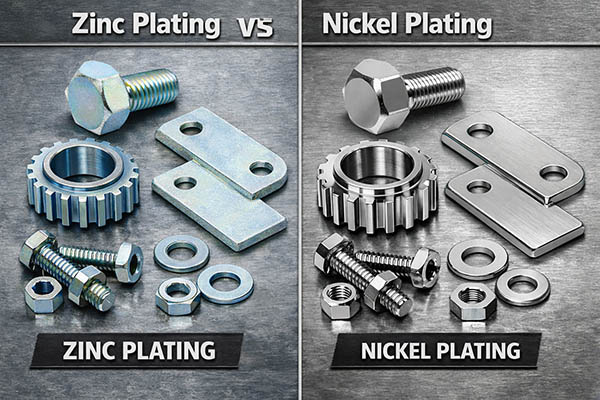
Zinc plating is an electroplating process in which a thin layer of zinc is deposited onto a metal substrate such as steel, iron, or brass. The primary function of zinc plating is corrosion protection through sacrificial action.
Zinc acts as a galvanic anode, meaning it corrodes first before the base metal, thereby protecting the underlying component from rust and oxidation.
This property makes zinc plating extremely popular in industries where steel parts are exposed to moisture, air, or mild chemicals.
Typical Zinc Plating Thickness
| Application | Typical Coating Thickness |
|---|---|
| Hardware fasteners | 5–8 μm |
| Automotive parts | 8–12 μm |
| Outdoor structural parts | 12–25 μm |
Thicker coatings provide longer corrosion resistance but increase cost and dimensional tolerance challenges.
Common Zinc Plating Types
| Zinc Coating Type | Features |
|---|---|
| Clear/Blue Zinc | Standard corrosion protection |
| Yellow Zinc (Chromate) | Improved corrosion resistance |
| Black Zinc | Decorative + moderate protection |
| Zinc-Nickel Alloy | High corrosion resistance |
Zinc plating is one of the most widely used coatings in industrial production, accounting for a large percentage of electroplated components globally.
Typical examples include:
- Automotive bolts
- Steel brackets
- CNC machined fasteners
- Electrical hardware
What Is Nickel Plating?
Barrier Protection Mechanism
Nickel plating works differently from zinc plating. Instead of sacrificial protection, nickel forms a dense barrier layer that isolates the substrate from environmental corrosion.
This barrier coating prevents moisture, oxygen, and chemicals from reaching the base metal.
Nickel Plating Types
| Nickel Plating Type | Key Characteristics |
|---|---|
| Electrolytic Nickel | Decorative finish |
| Electroless Nickel (ENP) | Uniform thickness |
| Sulfamate Nickel | Engineering build-up |
| Bright Nickel | Highly reflective finish |
Electroless nickel plating is widely used in precision engineering because it can deposit uniform coatings even on complex geometries, which is essential for CNC-machined parts.
Typical Nickel Hardness
Nickel coatings can reach 150–400 HV hardness, making them far more wear-resistant than zinc coatings.
This is why nickel plating is often used for components exposed to friction or mechanical stress.
Zinc vs Nickel Plating: Core Performance Differences
The following table summarizes the engineering differences between the two coatings.
| Parameter | Zinc Plating | Nickel Plating |
|---|---|---|
| Protection Mechanism | Sacrificial corrosion protection | Barrier protection |
| Typical Hardness | 100–150 HV | 150–400 HV |
| Corrosion Resistance | Good for atmospheric environments | Excellent in harsh environments |
| Cost | Low | Medium to high |
| Surface Appearance | Matte to dull silver | Bright, polished metallic |
| Wear Resistance | Moderate | High |
| Heat Resistance | ~100°C | Up to 200°C or more |
| Thickness Range | 5–25 μm | 2–50 μm |
In most manufacturing projects, the choice between these coatings depends on budget, environmental exposure, and mechanical requirements.
Corrosion Resistance Comparison
Corrosion resistance is one of the most important factors when selecting a plating finish.
Zinc Plating Corrosion Protection
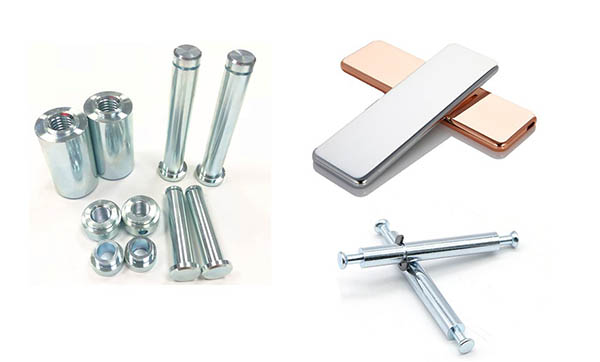
Zinc plating protects steel by corroding first, preventing rust formation on the substrate. This mechanism is extremely effective in outdoor environments with moderate moisture.
Typical salt spray test results:
| Coating | Salt Spray Resistance |
|---|---|
| Standard Zinc | 96–240 hours |
| Zinc + Chromate | 200–500 hours |
| Zinc-Nickel Alloy | 720–1000+ hours |
Higher performance coatings like zinc-nickel alloys dramatically extend corrosion protection.
Nickel Plating Corrosion Protection
Nickel plating relies on a dense metallic barrier. If the coating is scratched, the substrate can become exposed. However, nickel plating still performs extremely well in environments involving:
- chemical exposure
- high humidity
- high temperature
Nickel plating is widely used in marine components, electronics, and aerospace parts.
Hardness and Wear Resistance
Nickel plating significantly outperforms zinc plating in mechanical durability.
| Property | Zinc Plating | Nickel Plating |
|---|---|---|
| Hardness | Low | High |
| Wear resistance | Moderate | Excellent |
| Friction durability | Low | High |
This is why nickel plating is often used on:
- gears
- molds
- hydraulic components
- aerospace parts
In CNC machining environments, nickel coatings are often applied to precision shafts, bushings, and sliding parts.
Electrical Conductivity and Electronics Applications
Electrical conductivity also differs between the coatings.
Nickel plating is commonly used in electronics because it offers:
- stable conductivity
- good solderability
- strong EMI shielding
Applications include:
- PCB connectors
- RF enclosures
- electrical contacts
Zinc plating, by contrast, can form zinc oxide layers over time, which may increase electrical resistance. Therefore, it is more commonly used for structural or mechanical parts rather than electrical connectors.
Cost Comparison and Manufacturing Economics
Cost is often the deciding factor in large-scale manufacturing.
| Coating | Relative Cost | Typical Use |
|---|---|---|
| Zinc Plating | Low | Mass-produced hardware |
| Nickel Plating | Medium to high | High-performance parts |
Zinc plating remains the most economical solution for industries such as:
- automotive hardware
- construction components
- general mechanical assemblies
Nickel plating, although more expensive, is justified when wear resistance or long-term durability is critical.
Industry Applications
Automotive Industry
Zinc plating dominates automotive fasteners and brackets because it provides affordable corrosion protection.
Examples:
- suspension bolts
- chassis brackets
- engine mounting hardware
Aerospace Industry
Nickel plating is preferred for critical aerospace parts due to its durability and high-temperature resistance.
Examples:
- hydraulic actuator components
- landing gear parts
- fuel system hardware
Electronics Industry
Nickel plating is widely used in:
- connector housings
- circuit board contacts
- EMI shielding enclosures
When to Choose Zinc vs Nickel Plating
Choose zinc plating when:
- cost efficiency is critical
- components are exposed to moderate corrosion
- parts are mass-produced hardware
Choose nickel plating when:
- high wear resistance is required
- surface appearance matters
- parts must withstand harsh environments
A good example is CNC-machined fasteners: a standard steel bolt may use zinc plating, while a precision shaft in industrial equipment may require electroless nickel plating.
Xavier Manufacturing Recommendation
For CNC-machined components, the choice of plating directly impacts durability, corrosion resistance, and product quality.
At Xavier, we work closely with customers to determine the most suitable surface finishing process based on the material, mechanical load, and environmental conditions of each part. cnc machining service
Our CNC machining services support multiple surface finishes including:
- Zinc plating for high-volume cost-efficient hardware
- Electroless nickel plating for precision engineering parts
- Customized plating thickness for demanding industrial environments
If your project requires high-precision CNC machining with professional surface finishing, Xavier provides a reliable solution from prototype to mass production.
Some of the images and text in this article are collected and compiled from the internet. If there is anything inappropriate, please contact us for processing.