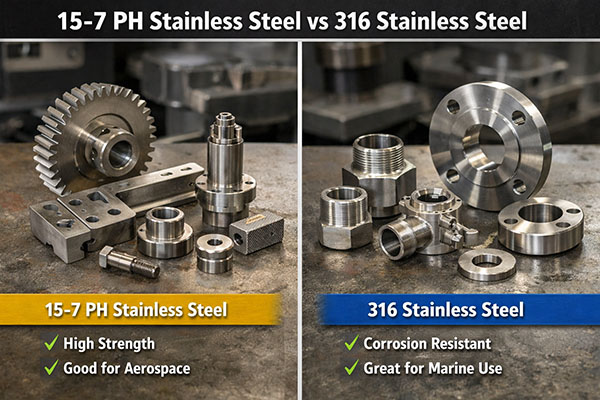
15-7 PH Stainless Steel vs 316 Stainless Steel: Strength, Corrosion Resistance, and CNC Machining Comparison
When engineers select stainless steel for aerospace parts, marine equipment, or CNC machined components, two alloys often appear in the discussion: 15-7 PH stainless steel and 316 stainless steel. Although both are corrosion-resistant stainless steels, they belong to different metallurgical families and deliver very different performance characteristics.
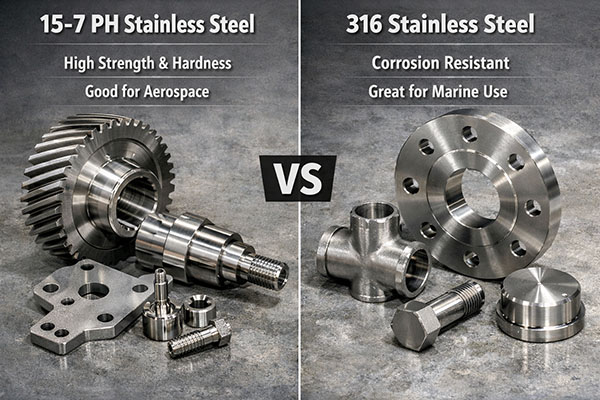
15-7 PH is a precipitation-hardening stainless steel designed for extremely high strength, while 316 is an austenitic stainless steel optimized for corrosion resistance and formability.
Understanding the differences between these materials is critical when designing CNC-machined parts, aerospace components, springs, or marine hardware.
Below are 10 key technical aspects that engineers typically evaluate when comparing these two alloys.
Chemical Composition Differences
The chemical composition of a stainless steel alloy largely determines its corrosion resistance, strength, and heat treatment capability.
| Element | 15-7 PH Stainless Steel | 316 Stainless Steel |
|---|---|---|
| Chromium | 14–16% | 16–18% |
| Nickel | 6.5–7.75% | 10–14% |
| Molybdenum | ~2–3% | 2–3% |
| Aluminum | 0.75–1.5% | None |
| Copper | Present | Usually none |
| Carbon | ≤0.07% | ≤0.08% |
The key difference is aluminum content in 15-7 PH, which allows precipitation hardening during heat treatment. This process dramatically increases strength and hardness.
In contrast, 316 stainless steel relies on nickel and molybdenum for corrosion resistance, especially in chloride environments such as seawater or chemical plants.
Practical implication:
- Aerospace springs → 15-7 PH
- Marine valves → 316 stainless steel
Stainless Steel Category and Metallurgical Structure
The two materials belong to completely different stainless steel families.
| Alloy | Metallurgical Family | Structure |
|---|---|---|
| 15-7 PH | Precipitation-hardening stainless steel | Semi-austenitic |
| 316 | Austenitic stainless steel | Fully austenitic |
Precipitation-hardening alloys like 15-7 PH gain strength through heat treatment, whereas austenitic alloys like 316 cannot be hardened by heat treatment.
Instead, 316 maintains strength through solid solution strengthening and cold working.
This fundamental difference affects:
- mechanical strength
- machining characteristics
- heat treatment processes
Tensile Strength Comparison
Mechanical strength is one of the most important reasons engineers choose precipitation-hardening stainless steels.
| Property | 15-7 PH | 316 |
|---|---|---|
| Tensile Strength | ~1000 MPa | ~550 MPa |
| Yield Strength | ~900 MPa | ~450 MPa |
15-7 PH offers nearly double the tensile and yield strength of 316 stainless steel after precipitation hardening.
Engineering Example
Aerospace fasteners must withstand high cyclic loads. Using 316 stainless steel would require:
- thicker sections
- heavier parts
15-7 PH allows lighter yet stronger structural components, making it ideal for:
- aircraft springs
- aerospace brackets
- precision mechanical assemblies
Hardness and Wear Resistance
Hardness influences wear resistance and fatigue life in mechanical components.
Typical hardness ranges:
| Alloy | Typical Hardness |
|---|---|
| 15-7 PH (aged condition) | 38–45 HRC |
| 316 stainless steel | 15–22 HRC |
Because of precipitation hardening, 15-7 PH develops much higher hardness, which improves resistance to:
- wear
- deformation
- cyclic fatigue
However, this also means harder machining and higher tool wear during CNC operations.
Corrosion Resistance in Marine and Chemical Environments
Corrosion resistance is where 316 stainless steel dominates.
316 contains higher nickel and molybdenum, which significantly improve resistance to:
- chloride corrosion
- pitting corrosion
- crevice corrosion
These properties make 316 stainless steel ideal for:
- marine equipment
- chemical tanks
- pharmaceutical equipment
- food processing machinery
The molybdenum content specifically improves resistance to chloride-induced pitting corrosion.
In comparison, 15-7 PH provides only moderate corrosion resistance, making it better suited for structural rather than chemical environments.
Heat Treatment and Precipitation Hardening
15-7 PH stainless steel is famous for its precipitation hardening capability.
Typical heat treatment process:
- Solution annealing
- Cooling transformation
- Aging treatment
During aging, aluminum forms fine precipitates within the microstructure, increasing strength dramatically.
316 stainless steel cannot undergo this process because it lacks the necessary alloying elements.
Instead, 316 can only be:
- annealed
- cold-worked
This difference is why 15-7 PH is often chosen for high-performance mechanical components.
Temperature Resistance and High-Temperature Performance
Both alloys perform well in elevated temperatures, but they behave differently.
| Property | 15-7 PH | 316 |
|---|---|---|
| Strength retention | Excellent | Moderate |
| Max recommended temp | ~482°C | ~870°C oxidation resistance |
15-7 PH maintains higher mechanical strength at elevated temperatures, making it suitable for aerospace mechanical components.
316 offers better oxidation resistance at higher temperatures but loses strength faster.
CNC Machining and Manufacturing Considerations
From a CNC machining perspective, the two alloys behave very differently.
| Property | 15-7 PH | 316 |
|---|---|---|
| Machinability | Moderate | Difficult (gummy) |
| Tool wear | High after aging | Moderate |
| Work hardening | Moderate | Severe |
| Weldability | Limited | Excellent |
316 stainless steel tends to work harden quickly, causing tool wear during CNC turning and milling.
15-7 PH is usually machined in solution-annealed condition, then heat-treated afterward to achieve full strength.
This workflow is common in precision aerospace manufacturing.
Typical Applications of Each Alloy
15-7 PH Applications
- Aerospace springs
- Aircraft structural components
- Diaphragms
- High-strength fasteners
- Precision mechanical parts
316 Applications
- Marine equipment
- Chemical processing equipment
- Food and pharmaceutical machinery
- Medical devices
- Pumps and valves
The material choice ultimately depends on whether the application prioritizes strength or corrosion resistance.
Cost and Material Availability
In most global markets:
- 316 stainless steel is widely available and cheaper
- 15-7 PH is more specialized and expensive
Reasons include:
- complex heat treatment requirements
- aerospace-grade supply chains
- lower global production volume
For CNC parts with strict corrosion requirements but moderate strength needs, 316 is usually the more economical choice.
Quick Comparison Table
| Property | 15-7 PH Stainless Steel | 316 Stainless Steel |
|---|---|---|
| Stainless Family | Precipitation hardening | Austenitic |
| Strength | Very high | Moderate |
| Corrosion Resistance | Moderate | Excellent |
| Hardness | High | Low |
| Heat Treatment | Yes | No |
| Weldability | Limited | Excellent |
| Typical Industries | Aerospace | Marine / Chemical |
Why Many Engineers Choose Xavier for Precision Stainless Steel Machining
Selecting the right alloy is only half of the engineering challenge. The other half is manufacturing precision components without compromising material performance. 15 7 ph stainless steel vs 316
At Xavier, our CNC machining team specializes in advanced stainless steel alloys including:
- 15-7 PH
- 17-4 PH
- 316 / 316L
- duplex stainless steels
Our engineering capabilities include:
- multi-axis CNC machining
- precipitation-hardening heat treatment coordination
- aerospace-grade dimensional tolerances
- corrosion-resistant surface finishing
Whether your project requires high-strength aerospace components or corrosion-resistant marine hardware, Xavier’s engineering team can help you select the optimal stainless steel and manufacture it with precision.
Some of the images and text in this article are collected and compiled from the internet. If there is anything inappropriate, please contact us for processing.