
Different Kinds of Bearings: Types, Applications, and How to Choose the Right One
Bearings are used in almost every type of rotating or moving machinery. From electric motors and pumps to automotive transmissions, CNC machine tools, robots, conveyors, and industrial gearboxes, a bearing provides controlled movement while carrying a specific mechanical load.
Although many bearings look similar from the outside, their internal designs can be very different. A deep groove ball bearing, for example, is designed around relatively small rolling elements and is often selected for high-speed rotation. A cylindrical roller bearing uses line contact and can support substantially higher radial loads. A tapered roller bearing is designed to handle combined radial and axial loads, while a thrust bearing is primarily intended to support forces acting along the shaft axis.
Understanding these differences is important because choosing a bearing only by its bore diameter or outside dimensions can result in premature wear, excessive heat, vibration, or even mechanical failure.
The major distinction between rolling bearings is based on the rolling element, load direction, and internal geometry. Ball bearings generally provide good speed capability with light-to-moderate loads, while roller bearings normally provide greater load capacity. Bearings can also be designed specifically for radial loads, axial loads, or a combination of both.
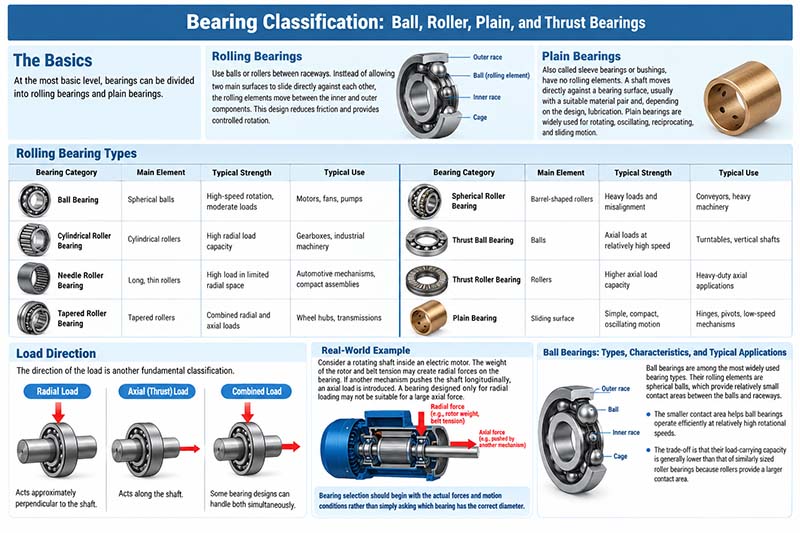
Bearing Classification: Ball, Roller, Plain, and Thrust Bearings
At the most basic level, bearings can be divided into rolling bearings and plain bearings.
Rolling bearings use balls or rollers between raceways. Instead of allowing two main surfaces to slide directly against each other, the rolling elements move between the inner and outer components. This design reduces friction and provides controlled rotation.
Plain bearings, also called sleeve bearings or bushings, have no rolling elements. A shaft moves directly against a bearing surface, usually with a suitable material pair and, depending on the design, lubrication. Plain bearings are widely used for rotating, oscillating, reciprocating, and sliding motion.
For rolling bearings, the next major distinction is between ball bearings and roller bearings.
| Bearing category | Main element | Typical strength | Typical use |
|---|---|---|---|
| Ball bearing | Spherical balls | High-speed rotation, moderate loads | Motors, fans, pumps |
| Cylindrical roller bearing | Cylindrical rollers | High radial load capacity | Gearboxes, industrial machinery |
| Needle roller bearing | Long, thin rollers | High load in limited radial space | Automotive mechanisms, compact assemblies |
| Tapered roller bearing | Tapered rollers | Combined radial and axial loads | Wheel hubs, transmissions |
| Spherical roller bearing | Barrel-shaped rollers | Heavy loads and misalignment | Conveyors, heavy machinery |
| Thrust ball bearing | Balls | Axial loads at relatively high speed | Turntables, vertical shafts |
| Thrust roller bearing | Rollers | Higher axial load capacity | Heavy-duty axial applications |
| Plain bearing | Sliding surface | Simple, compact, oscillating motion | Hinges, pivots, low-speed mechanisms |
The direction of the load is another fundamental classification. A radial load acts approximately perpendicular to the shaft, while an axial or thrust load acts along the shaft. Some bearing designs can handle both simultaneously.
For example, consider a rotating shaft inside an electric motor. The weight of the rotor and belt tension may create radial forces on the bearing. If another mechanism pushes the shaft longitudinally, an axial load is introduced. A bearing designed only for radial loading may not be suitable for a large axial force.
This is why bearing selection should begin with the actual forces and motion conditions rather than simply asking which bearing has the correct diameter.
Ball Bearings: Types, Characteristics, and Typical Applications
Ball bearings are among the most widely used bearing types. Their rolling elements are spherical balls, which provide relatively small contact areas between the balls and raceways.
The smaller contact area helps ball bearings operate efficiently at relatively high rotational speeds. The trade-off is that their load-carrying capacity is generally lower than that of similarly sized roller bearings because rollers provide a larger contact area.
Deep Groove Ball Bearings
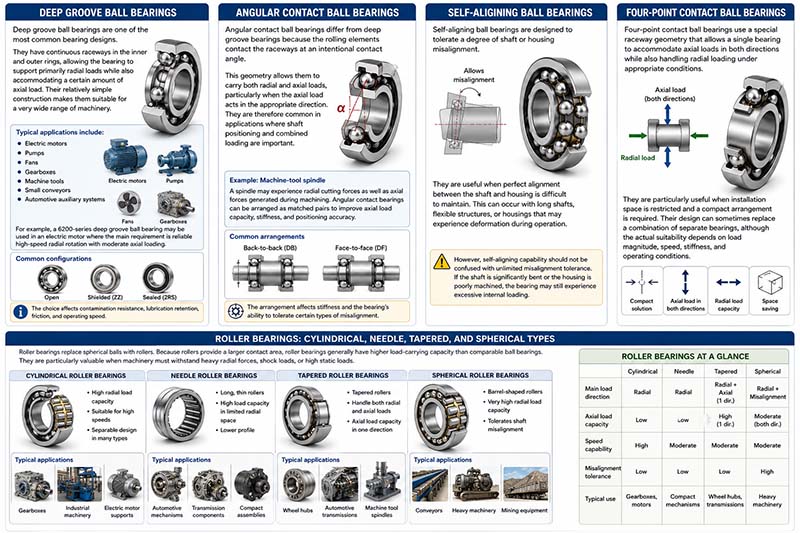
Deep groove ball bearings are one of the most common bearing designs.
They have continuous raceways in the inner and outer rings, allowing the bearing to support primarily radial loads while also accommodating a certain amount of axial load. Their relatively simple construction makes them suitable for a very wide range of machinery.
Typical applications include:
- Electric motors
- Pumps
- Fans
- Gearboxes
- Machine tools
- Small conveyors
- Automotive auxiliary systems
For example, a 6200-series deep groove ball bearing may be used in an electric motor where the main requirement is reliable high-speed radial rotation with moderate axial loading.
Open, shielded, and sealed configurations are commonly available. The choice affects contamination resistance, lubrication retention, friction, and operating speed.
Angular Contact Ball Bearings
Angular contact ball bearings differ from deep groove bearings because the rolling elements contact the raceways at an intentional contact angle.
This geometry allows them to carry both radial and axial loads, particularly when the axial load acts in the appropriate direction. They are therefore common in applications where shaft positioning and combined loading are important.
Machine-tool spindle assemblies are a good example. A spindle may experience radial cutting forces as well as axial forces generated during machining. Angular contact bearings can be arranged as matched pairs to improve axial load capacity, stiffness, and positioning accuracy.
Common arrangements include back-to-back and face-to-face configurations. The arrangement affects stiffness and the bearing’s ability to tolerate certain types of misalignment.
Self-Aligning Ball Bearings
Self-aligning ball bearings are designed to tolerate a degree of shaft or housing misalignment.
They are useful when perfect alignment between the shaft and housing is difficult to maintain. This can occur with long shafts, flexible structures, or housings that may experience deformation during operation.
However, self-aligning capability should not be confused with unlimited misalignment tolerance. If the shaft is significantly bent or the housing is poorly machined, the bearing may still experience excessive internal loading.
Four-Point Contact Ball Bearings
Four-point contact ball bearings use a special raceway geometry that allows a single bearing to accommodate axial loads in both directions while also handling radial loading under appropriate conditions.
They are particularly useful when installation space is restricted and a compact arrangement is required. Their design can sometimes replace a combination of separate bearings, although the actual suitability depends on load magnitude, speed, stiffness, and operating conditions.
Roller Bearings: Cylindrical, Needle, Tapered, and Spherical Types
Roller bearings replace spherical balls with rollers. Because rollers provide a larger contact area, roller bearings generally have higher load-carrying capacity than comparable ball bearings. They are particularly valuable when machinery must withstand heavy radial forces, shock loads, or high static loads.
Cylindrical Roller Bearings
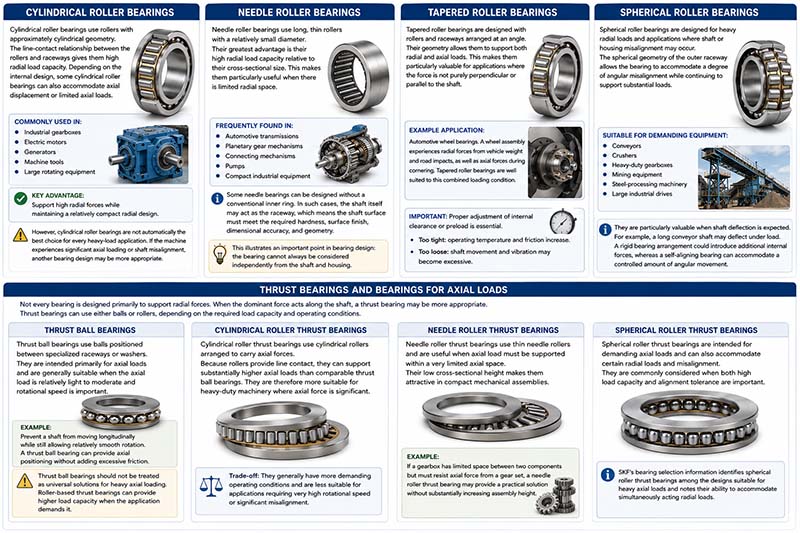
Cylindrical roller bearings use rollers with approximately cylindrical geometry.
The line-contact relationship between the rollers and raceways gives them high radial load capacity. Depending on the internal design, some cylindrical roller bearings can also accommodate axial displacement or limited axial loads.
They are commonly used in:
- Industrial gearboxes
- Electric motors
- Generators
- Machine tools
- Large rotating equipment
A key advantage is their ability to support high radial forces while maintaining a relatively compact radial design.
However, cylindrical roller bearings are not automatically the best choice for every heavy-load application. If the machine experiences significant axial loading or shaft misalignment, another bearing design may be more appropriate.
Needle Roller Bearings
Needle roller bearings use long, thin rollers with a relatively small diameter.
Their greatest advantage is their high radial load capacity relative to their cross-sectional size. This makes them particularly useful when there is limited radial space.
For example, suppose a mechanical assembly has a 25 mm shaft but very little room around the shaft for a large bearing housing. A conventional roller bearing may require more radial space, whereas a needle bearing can provide substantial radial load capacity within a smaller envelope.
Needle bearings are frequently found in:
- Automotive transmissions
- Planetary gear mechanisms
- Connecting mechanisms
- Pumps
- Compact industrial equipment
Some needle bearings can be designed without a conventional inner ring. In such cases, the shaft itself may act as the raceway, which means the shaft surface must meet the required hardness, surface finish, dimensional accuracy, and geometry.
This illustrates an important point in bearing design: the bearing cannot always be considered independently from the shaft and housing.
Tapered Roller Bearings
Tapered roller bearings are designed with rollers and raceways arranged at an angle.
Their geometry allows them to support both radial and axial loads. This makes them particularly valuable for applications where the force is not purely perpendicular or parallel to the shaft.
Automotive wheel bearings are a classic example. A wheel assembly can experience radial forces from vehicle weight and road impacts while simultaneously experiencing axial forces during cornering. Tapered roller bearings are well suited to this combined loading condition.
Tapered roller bearings also require careful control of internal clearance or preload. If the bearing is installed too tightly, operating temperature and friction can increase. If it is too loose, shaft movement and vibration may become excessive.
Spherical Roller Bearings
Spherical roller bearings are designed for heavy radial loads and applications where shaft or housing misalignment may occur.
The spherical geometry of the outer raceway allows the bearing to accommodate a degree of angular misalignment while continuing to support substantial loads.
This makes spherical roller bearings suitable for demanding equipment such as:
- Conveyors
- Crushers
- Heavy-duty gearboxes
- Mining equipment
- Steel-processing machinery
- Large industrial drives
They are particularly valuable when shaft deflection is expected. For example, a long conveyor shaft may deflect under load. A rigid bearing arrangement could introduce additional internal forces, whereas a self-aligning bearing can accommodate a controlled amount of angular movement.
Thrust Bearings and Bearings for Axial Loads
Not every bearing is designed primarily to support radial forces.
When the dominant force acts along the shaft, a thrust bearing may be more appropriate. Thrust bearings can use either balls or rollers, depending on the required load capacity and operating conditions.
Thrust Ball Bearings
Thrust ball bearings use balls positioned between specialized raceways or washers.
They are intended primarily for axial loads and are generally suitable when the axial load is relatively light to moderate and rotational speed is important.
For example, a rotating mechanism may need to prevent a shaft from moving longitudinally while still allowing relatively smooth rotation. A thrust ball bearing can provide axial positioning without adding excessive friction.
However, thrust ball bearings should not be treated as universal solutions for heavy axial loading. Roller-based thrust bearings can provide higher load capacity when the application demands it.
Cylindrical Roller Thrust Bearings
Cylindrical roller thrust bearings use cylindrical rollers arranged to carry axial forces.
Because rollers provide line contact, they can support substantially higher axial loads than comparable thrust ball bearings. They are therefore more suitable for heavy-duty machinery where axial force is significant.
The trade-off is that they generally have more demanding operating conditions and are less suitable for applications requiring very high rotational speed or significant misalignment.
Needle Roller Thrust Bearings
Needle roller thrust bearings use thin needle rollers and are useful when axial load must be supported within a very limited axial space.
Their low cross-sectional height makes them attractive in compact mechanical assemblies.
For example, if a gearbox has limited space between two components but must resist axial force from a gear set, a needle roller thrust bearing may provide a practical solution without substantially increasing assembly height.
Spherical Roller Thrust Bearings
Spherical roller thrust bearings are intended for demanding axial loads and can also accommodate certain radial loads and misalignment.
They are commonly considered when both high load capacity and alignment tolerance are important.
SKF’s bearing selection information identifies spherical roller thrust bearings among the designs suitable for heavy axial loads and notes their ability to accommodate simultaneously acting radial loads.
How to Choose the Right Bearing: Load, Speed, Space, and Misalignment
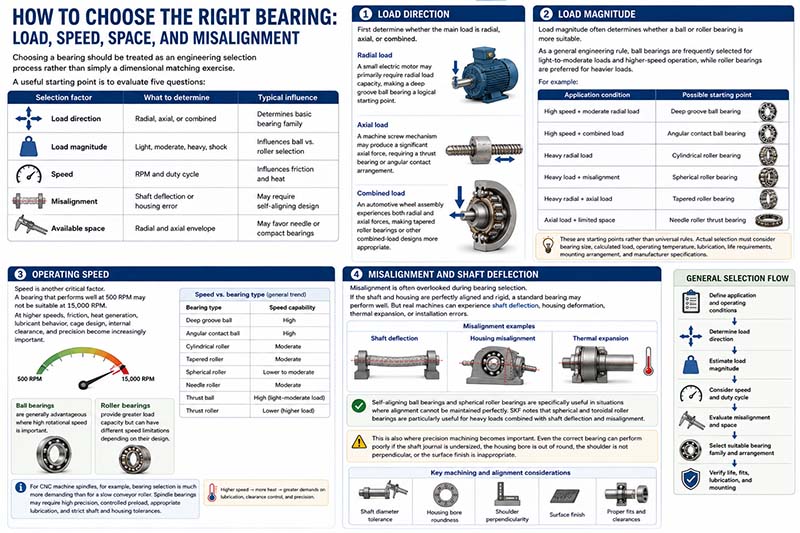
Choosing a bearing should be treated as an engineering selection process rather than simply a dimensional matching exercise.
A useful starting point is to evaluate five questions:
| Selection factor | What to determine | Typical influence |
|---|---|---|
| Load direction | Radial, axial, or combined | Determines basic bearing family |
| Load magnitude | Light, moderate, heavy, shock | Influences ball vs. roller selection |
| Speed | RPM and duty cycle | Influences friction and heat |
| Misalignment | Shaft deflection or housing error | May require self-aligning design |
| Available space | Radial and axial envelope | May favor needle or compact bearings |
Load Direction
First determine whether the main load is radial, axial, or combined.
A small electric motor may primarily require radial load capacity, making a deep groove ball bearing a logical starting point.
A machine screw mechanism may produce a significant axial force, requiring a thrust bearing or angular contact arrangement.
An automotive wheel assembly experiences both radial and axial forces, making tapered roller bearings or other combined-load designs more appropriate.
Load Magnitude
Load magnitude often determines whether a ball or roller bearing is more suitable.
As a general engineering rule, ball bearings are frequently selected for light-to-moderate loads and higher-speed operation, while roller bearings are preferred for heavier loads.
For example:
| Application condition | Possible starting point |
|---|---|
| High speed + moderate radial load | Deep groove ball bearing |
| High speed + combined load | Angular contact ball bearing |
| Heavy radial load | Cylindrical roller bearing |
| Heavy load + misalignment | Spherical roller bearing |
| Heavy radial + axial load | Tapered roller bearing |
| Axial load + limited space | Needle roller thrust bearing |
These are starting points rather than universal rules. Actual selection must consider bearing size, calculated load, operating temperature, lubrication, life requirements, mounting arrangement, and manufacturer specifications.
Operating Speed
Speed is another critical factor.
A bearing that performs well at 500 RPM may not be suitable at 15,000 RPM. At higher speeds, friction, heat generation, lubricant behavior, cage design, internal clearance, and precision become increasingly important.
Ball bearings are generally advantageous where high rotational speed is important. Roller bearings provide greater load capacity but can have different speed limitations depending on their design. NSK similarly classifies balls as generally favorable for higher-speed operation and rollers as favorable for higher load capacity.
For CNC machine spindles, for example, bearing selection is much more demanding than for a slow conveyor roller. Spindle bearings may require high precision, controlled preload, appropriate lubrication, and strict shaft and housing tolerances.
Misalignment and Shaft Deflection
Misalignment is often overlooked during bearing selection.
If the shaft and housing are perfectly aligned and rigid, a standard bearing may perform well. But real machines can experience shaft deflection, housing deformation, thermal expansion, or installation errors.
Self-aligning ball bearings and spherical roller bearings are specifically useful in situations where alignment cannot be maintained perfectly. SKF notes that spherical and toroidal roller bearings are particularly useful for heavy loads combined with shaft deflection and misalignment.
This is also where precision machining becomes important. Even the correct bearing can perform poorly if the shaft journal is undersized, the housing bore is out of round, the shoulder is not perpendicular, or the surface finish is inappropriate.
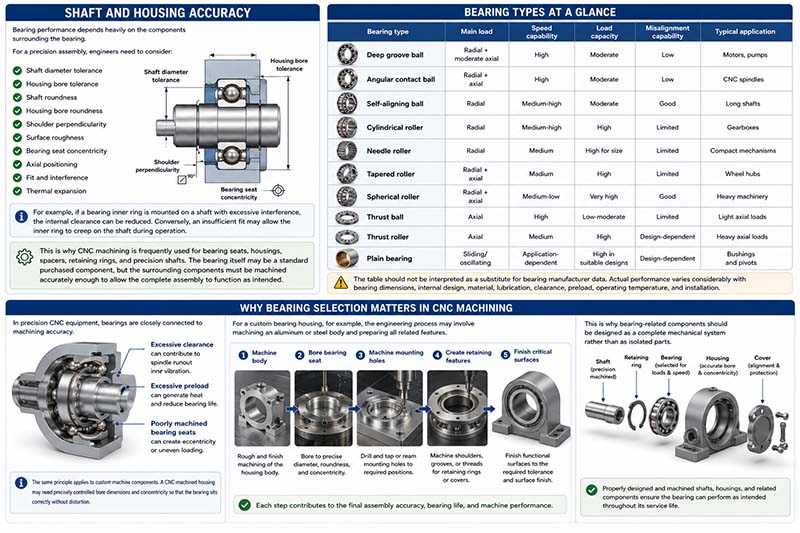
Shaft and Housing Accuracy
Bearing performance depends heavily on the components surrounding the bearing.
For a precision assembly, engineers need to consider:
- Shaft diameter tolerance
- Housing bore tolerance
- Shaft roundness
- Housing bore roundness
- Shoulder perpendicularity
- Surface roughness
- Bearing seat concentricity
- Axial positioning
- Fit and interference
- Thermal expansion
For example, if a bearing inner ring is mounted on a shaft with excessive interference, the internal clearance can be reduced. Conversely, an insufficient fit may allow the inner ring to creep on the shaft during operation.
This is why CNC machining is frequently used for bearing seats, housings, spacers, retaining rings, and precision shafts. The bearing itself may be a standard purchased component, but the surrounding components must be machined accurately enough to allow the complete assembly to function as intended.
Bearing Types at a Glance
The easiest way to understand different kinds of bearings is to compare their primary mechanical strengths.
| Bearing type | Main load | Speed capability | Load capacity | Misalignment capability | Typical application |
|---|---|---|---|---|---|
| Deep groove ball | Radial + moderate axial | High | Moderate | Low | Motors, pumps |
| Angular contact ball | Radial + axial | High | Moderate | Low | CNC spindles |
| Self-aligning ball | Radial | Medium-high | Moderate | Good | Long shafts |
| Cylindrical roller | Radial | Medium-high | High | Limited | Gearboxes |
| Needle roller | Radial | Medium | High for size | Limited | Compact mechanisms |
| Tapered roller | Radial + axial | Medium | High | Limited | Wheel hubs |
| Spherical roller | Radial + axial | Medium-low | Very high | Good | Heavy machinery |
| Thrust ball | Axial | High | Low-moderate | Limited | Light axial loads |
| Thrust roller | Axial | Medium | High | Design-dependent | Heavy axial loads |
| Plain bearing | Sliding/oscillating | Application-dependent | High in suitable designs | Design-dependent | Bushings and pivots |
The table should not be interpreted as a substitute for bearing manufacturer data. Actual performance varies considerably with bearing dimensions, internal design, material, lubrication, clearance, preload, operating temperature, and installation.
Why Bearing Selection Matters in CNC Machining
In precision CNC equipment, bearings are closely connected to machining accuracy.
A spindle bearing with excessive clearance can contribute to spindle runout and vibration. Excessive preload can generate heat and reduce bearing life. Poorly machined bearing seats can create eccentricity or uneven loading.
The same principle applies to custom machine components. A CNC-machined housing may need precisely controlled bore dimensions and concentricity so that the bearing sits correctly without distortion.
For a custom bearing housing, for example, the engineering process may involve machining an aluminum or steel body, boring the bearing seat, machining mounting holes, creating retaining features, and finishing critical surfaces according to the bearing manufacturer’s requirements.
This is why bearing-related components should be designed as a complete mechanical system rather than as isolated parts.
Final Thoughts
There is no single “best” bearing for every machine. Deep groove ball bearings are excellent general-purpose solutions for many high-speed applications, angular contact bearings are valuable when precision and combined loading are important, cylindrical and spherical roller bearings excel under heavy radial loads, tapered roller bearings are well suited to combined radial and axial forces, and thrust bearings are designed specifically for axial loading.
The correct choice depends on the actual operating conditions: load direction, load magnitude, speed, available space, misalignment, lubrication, temperature, required service life, and dimensional accuracy.
For companies developing custom machinery, replacement components, automation equipment, CNC machines, robotics, or industrial assemblies, the bearing itself is only one part of the system. The shaft, housing, spacer, retaining components, mounting surfaces, and tolerances must all work together.
If you need precision-machined bearing housings, shafts, spacers, retaining components, or other custom mechanical parts, Xavier can provide CNC machining support for prototypes and production components. By combining appropriate material selection, CNC milling and turning, precision boring, dimensional inspection, and suitable surface finishing, Xavier helps ensure that the machined components surrounding your bearings meet the requirements of the final assembly.
We are an integrated CNC machining manufacturer specializing in CNC anodizing surface finishing, CNC electroless nickel surface finishing, and CNC electrogalvanizing surface finishing. Our core business focuses on CNC machining services, CNC contract manufacturing, and the production of various custom metal parts.
We are an CNC anodizing surface finishing manufacturer offering CNC electroless nickel surface finishing services in volume, and you can contact us for CNC electrogalvanizing surface finishing pricing. Feel free to contact us for your custom CNC machining requirements.
Some of the images and text in this article are collected and compiled from the internet. If there is anything inappropriate, please contact us for processing.