
10 Key Topics Covered
- Ferrous vs. Non-Ferrous Metals: Definitions and Fundamental Differences
- Common Types of Ferrous Metals and Their Industrial Applications
- Common Types of Non-Ferrous Metals and Their Industrial Applications
- Strength, Hardness, Density, and Weight Comparison
- Corrosion Resistance and Rust Formation
- Magnetic Properties, Electrical Conductivity, and Thermal Conductivity
- CNC Machining Characteristics and Manufacturing Challenges
- Material Selection for Aerospace, Automotive, Robotics, Medical, and Industrial Parts
- Material Costs, Machining Costs, and Surface Finishing
- How to Choose the Right Metal for Custom CNC Machined Parts
Ferrous vs. Non-Ferrous Metals: 10 Key Differences, Properties, Examples, and CNC Machining Applications
Choosing the right metal is one of the most important decisions in manufacturing. Whether you are producing automotive components, aerospace brackets, industrial equipment, or precision CNC machined parts, the material directly affects strength, weight, corrosion resistance, machining performance, and production costs.
Two major categories of metals used in manufacturing are ferrous and non-ferrous metals. Although both are widely used in industrial applications, they have different chemical compositions and physical properties that influence their performance.
Ferrous metals are primarily iron-based materials, including carbon steel, alloy steel, stainless steel, and cast iron. Non-ferrous metals are metals in which iron is not the principal element, such as aluminum, copper, brass, bronze, and titanium.
Understanding the differences between ferrous and non-ferrous metals helps engineers and purchasing professionals select suitable materials for specific applications while controlling manufacturing costs.
1. Ferrous vs. Non-Ferrous Metals: Definitions and Fundamental Differences
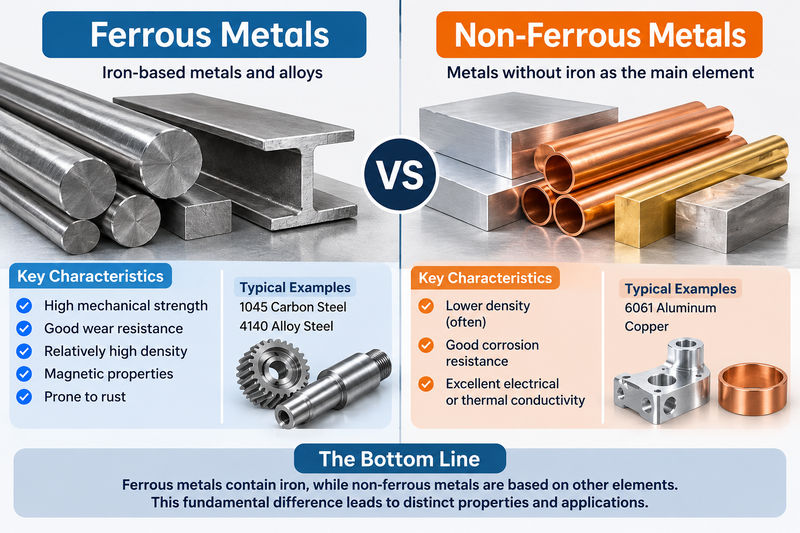
The primary difference between ferrous and non-ferrous metals is their chemical composition. Ferrous metals contain iron as their main constituent, while non-ferrous metals are based on other metallic elements.
This distinction influences their mechanical properties, corrosion behavior, magnetic characteristics, and manufacturing applications.
What Are Ferrous Metals?
Ferrous metals are iron-based metals and alloys. Carbon is commonly added to iron to produce steel, while other alloying elements, including chromium, nickel, molybdenum, and manganese, are introduced to improve specific properties.
Common characteristics include:
- High mechanical strength and structural stiffness.
- Good wear resistance in many grades.
- Relatively high density.
- Magnetic properties in many material grades.
- Susceptibility to rust in unprotected carbon and alloy steels.
For example, 1045 carbon steel is commonly used for shafts and mechanical components because of its strength and machinability. Alloy steels such as 4140 offer improved strength and hardenability for demanding applications.
What Are Non-Ferrous Metals?
Non-ferrous metals are metals and alloys that do not use iron as their principal base element.
Common examples include aluminum, copper, brass, bronze, titanium, magnesium, and nickel-based alloys.
Their characteristics vary considerably, but many offer advantages such as lower density, good corrosion resistance, and excellent electrical or thermal conductivity.
For example, 6061 aluminum is widely used for lightweight CNC machined components, while copper is preferred for electrical and thermal applications.
2. Common Types of Ferrous Metals and Their Industrial Applications
Ferrous metals are essential in manufacturing because they provide a wide range of mechanical properties, from general-purpose structural strength to high hardness and wear resistance.
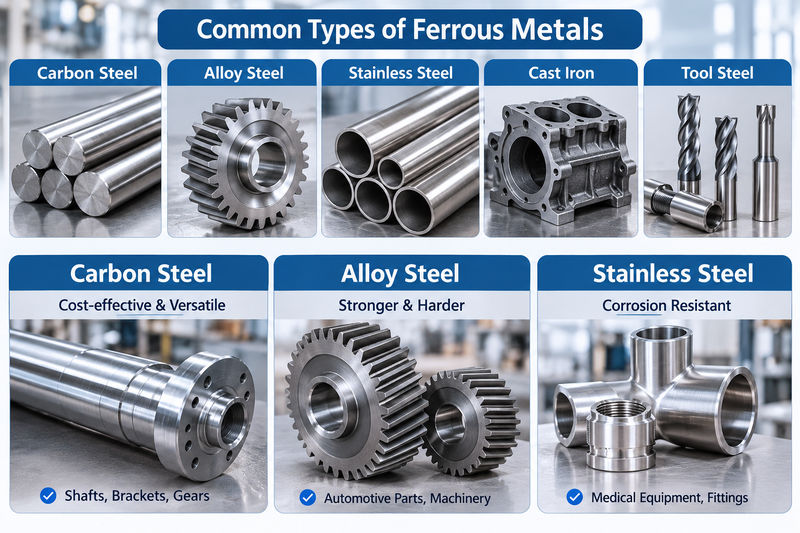
| Ferrous Metal | Main Characteristics | Typical Applications |
|---|---|---|
| Carbon Steel | Strength, affordability, machinability | Shafts, brackets, gears |
| Alloy Steel | Improved strength and hardenability | Automotive parts, machinery |
| Stainless Steel | Corrosion resistance and durability | Medical equipment, fittings |
| Cast Iron | Vibration damping and castability | Machine bases, housings |
| Tool Steel | High hardness and wear resistance | Dies, molds, cutting tools |
Carbon Steel
Carbon steel contains iron and carbon, with its properties strongly influenced by carbon content and heat treatment.
Low-carbon steel, such as 1018, is relatively easy to machine, weld, and form. Medium-carbon steel, such as 1045, offers greater strength and hardness, making it suitable for shafts, pins, and mechanical transmission components.
For CNC machining, carbon steel provides a practical balance between material cost, mechanical performance, and cutting efficiency.
Alloy Steel and Stainless Steel
Alloy steels contain additional elements such as chromium, nickel, and molybdenum to improve strength, toughness, and hardenability.
For example, 4140 alloy steel is frequently used for high-load shafts, gears, and industrial machine components.
Stainless steel is also ferrous because iron remains its principal element. Its chromium content, generally at least 10.5% by mass, helps form a protective passive surface layer.
Grades such as 304 and 316 are widely used in chemical equipment, marine components, food-processing machinery, and medical devices.
3. Common Types of Non-Ferrous Metals and Their Industrial Applications
Non-ferrous metals are important when lightweight construction, electrical conductivity, corrosion resistance, or specialized mechanical performance is required.
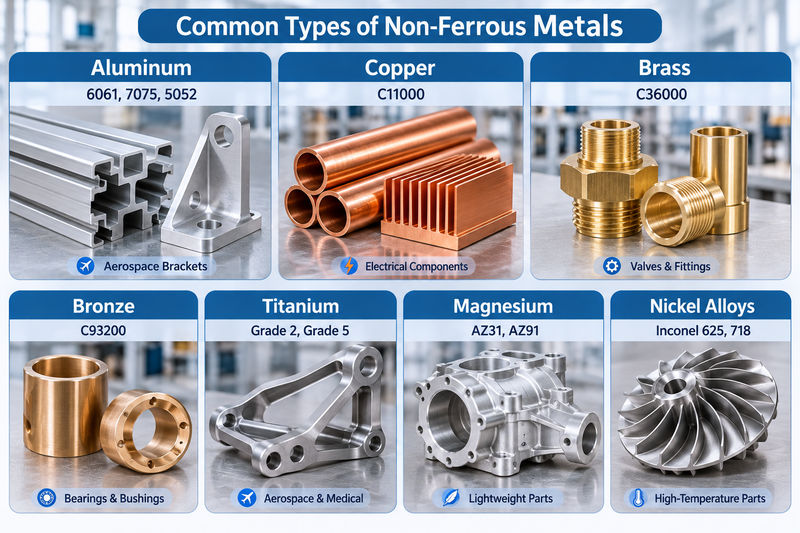
| Non-Ferrous Metal | Typical Grades or Types | Common Applications |
|---|---|---|
| Aluminum | 6061, 7075, 5052 | Aerospace brackets, housings |
| Copper | C11000 | Electrical connectors, heat exchangers |
| Brass | C36000 | Valves, fittings, precision components |
| Bronze | C93200 | Bearings, bushings, wear components |
| Titanium | Grade 2, Grade 5 | Aerospace, medical implants |
| Magnesium | AZ31, AZ91 | Lightweight structural components |
| Nickel Alloys | Inconel 625, 718 | High-temperature components |
Aluminum
Aluminum is one of the most popular non-ferrous metals for CNC machining. With a typical density of approximately 2.70 g/cm³, it weighs about one-third as much as steel.
6061 aluminum offers good machinability, corrosion resistance, and mechanical strength, making it suitable for brackets, enclosures, fixtures, and industrial components.
7075 aluminum provides higher strength and is frequently selected for aerospace and high-performance mechanical parts.
Copper, Brass, and Bronze
Copper is valued for its excellent electrical and thermal conductivity. It is commonly used in electrical contacts, heat sinks, and cooling components.
Brass combines copper and zinc, offering good machinability and corrosion resistance. C36000 brass, for example, is particularly suitable for turned precision components.
Bronze alloys provide useful wear resistance and bearing properties, making them suitable for bushings, bearings, and marine hardware.
Titanium and Nickel Alloys
Titanium offers an excellent strength-to-weight ratio and outstanding corrosion resistance. Grade 5 titanium (Ti-6Al-4V) is widely used in aerospace structures and demanding medical applications.
Nickel-based alloys such as Inconel 718 maintain mechanical strength at elevated temperatures, making them suitable for turbine components and other high-temperature applications.
4. Strength, Hardness, Density, and Weight Comparison
Mechanical properties are among the most important considerations when comparing ferrous and non-ferrous metals.
However, it is incorrect to assume that all ferrous metals are stronger than non-ferrous metals. High-strength titanium alloys and precipitation-hardened aluminum alloys can outperform many ordinary steels in specific strength-to-weight comparisons.
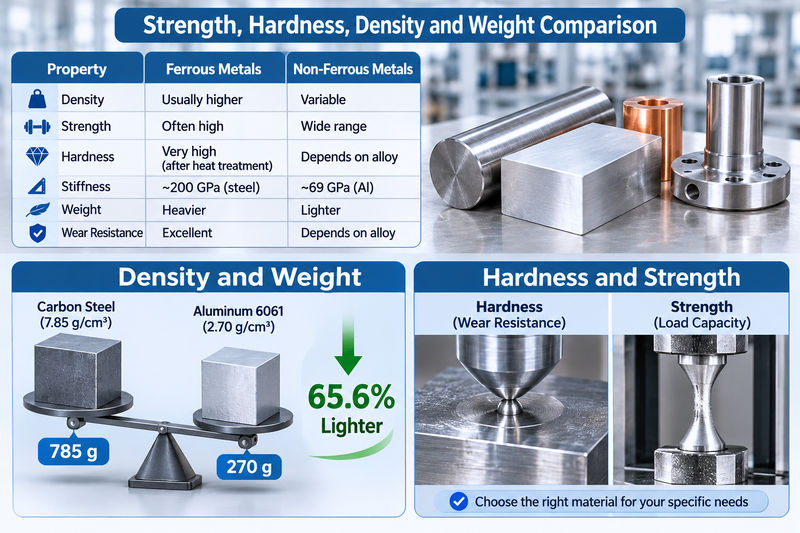
| Property | Ferrous Metals | Non-Ferrous Metals |
|---|---|---|
| Density | Usually higher for steel and iron | Highly variable |
| Strength | Often high | Ranges from low to extremely high |
| Hardness | Can be very high after heat treatment | Depends on alloy and temper |
| Stiffness | Steel typically around 200 GPa | Aluminum typically around 69 GPa |
| Weight | Generally heavier for comparable steel parts | Aluminum and magnesium are lighter |
| Wear Resistance | Excellent in many hardened grades | Depends on alloy and surface treatment |
Density and Weight
Density directly influences the weight of a finished component.
Typical density values include:
- Carbon steel: approximately 7.85 g/cm³.
- Stainless steel 304: approximately 8.0 g/cm³.
- Aluminum 6061: approximately 2.70 g/cm³.
- Titanium Grade 5: approximately 4.43 g/cm³.
- Copper: approximately 8.96 g/cm³.
Consider two components with identical dimensions and volumes of 100 cm³.
A carbon steel component would weigh approximately 785 g, while an aluminum 6061 component would weigh approximately 270 g.
This represents a weight reduction of approximately 65.6%.
For aerospace and automotive applications, reducing component weight can improve fuel efficiency, payload capacity, and overall system performance.
Hardness and Strength
Hardness measures resistance to localized indentation and wear, while tensile strength measures the maximum tensile stress a material can withstand.
These properties are not interchangeable. A hardened steel shaft may offer excellent wear resistance, while a properly heat-treated aluminum alloy may provide an attractive combination of strength and low weight. Ferrous vs Non-Ferrous Metals
Material selection should therefore consider the actual load, impact conditions, operating temperature, and required service life.
5. Corrosion Resistance and Rust Formation
Corrosion resistance is another major difference between ferrous and non-ferrous metals.
Ferrous metals containing ordinary carbon steel or alloy steel can react with oxygen and moisture, producing iron oxide, commonly known as rust.
However, stainless steel behaves differently because chromium forms a protective passive layer that slows further corrosion.
Non-ferrous metals generally do not develop iron-based red rust, but this does not mean they are completely corrosion-proof.
| Material | Corrosion Behavior | Recommended Protection |
|---|---|---|
| Carbon Steel | Prone to rust | Painting, plating, black oxide |
| Alloy Steel | Depends on alloy composition | Coating or protective treatment |
| Stainless Steel 304 | Good general corrosion resistance | Passivation when appropriate |
| Aluminum 6061 | Natural oxide protection | Anodizing |
| Copper | Develops protective or decorative patina | Polishing or protective coating |
| Brass | Generally good corrosion resistance | Passivation or suitable coating |
Corrosion in Different Environments
For outdoor equipment exposed to rain and humidity, untreated carbon steel may deteriorate quickly without suitable protection.
Marine applications require additional attention because chloride exposure can cause pitting and crevice corrosion in certain stainless steel grades.
Aluminum naturally develops a thin oxide film that protects its surface. Anodizing can further improve surface durability and provide additional finishing options.
For CNC machined components, the correct finishing process should be selected according to the operating environment, dimensional requirements, and expected service life.
6. Magnetic Properties, Electrical Conductivity, and Thermal Conductivity
Magnetism and conductivity are important when designing electrical equipment, sensors, motors, and precision mechanical assemblies.
Magnetic Properties
Many ferrous metals are magnetic, especially carbon steel, ferritic stainless steel, and martensitic stainless steel.
However, austenitic stainless steel, such as annealed 304 and 316, is generally weakly magnetic or non-magnetic. Cold working can increase its magnetic response.
Most common aluminum, copper, and brass alloys are non-magnetic. Nickel and cobalt are important exceptions among non-ferrous metals.
Therefore, a magnet test alone cannot reliably identify every metal or determine whether a material meets a non-magnetic requirement.
Electrical and Thermal Conductivity
Copper and aluminum are particularly useful in applications requiring efficient electrical or thermal transfer.
Approximate conductivity values at room temperature are shown below.
| Material | Electrical Conductivity (MS/m) | Thermal Conductivity (W/m·K) |
|---|---|---|
| Copper | 58–59 | 390–400 |
| Aluminum 6061 | 25–26 | 167 |
| Carbon Steel | 6–8 | 45–60 |
| Stainless Steel 304 | 1.3–1.5 | 16 |
These values are approximate and depend on alloy composition, temperature, and material condition.
Copper is suitable for electrical terminals and heat exchangers, while aluminum is widely used in lightweight heat sinks and electronic housings.
7. CNC Machining Characteristics and Manufacturing Challenges
The difference between ferrous and non-ferrous metals becomes especially important during CNC milling, turning, drilling, and boring.
Different materials require different cutting speeds, feed rates, tooling geometries, and cooling strategies.
| Material | CNC Machining Characteristics | Main Challenges |
|---|---|---|
| 6061 Aluminum | Excellent machinability | Burr formation, thin-wall deformation |
| 7075 Aluminum | Good machinability | Distortion and residual stress |
| 304 Stainless Steel | Moderate to difficult | Work hardening and heat generation |
| 4140 Steel | Good with suitable tooling | Tool wear and heat treatment |
| Brass C36000 | Excellent machinability | Burr and chip control |
| Titanium Grade 5 | Difficult | Heat concentration and tool wear |
| Inconel 718 | Very difficult | High cutting forces and rapid tool wear |
CNC Machining Ferrous Metals
Carbon steel and many alloy steels can be machined efficiently using carbide cutting tools.
However, harder steel grades and heat-treated components require careful control of cutting parameters.
Stainless steel presents additional challenges because it can work-harden during cutting. If the cutting tool rubs against the surface instead of maintaining a proper chip load, localized hardening can increase tool wear and machining difficulty.
For precision stainless steel components, stable workholding, sharp tooling, proper coolant delivery, and consistent chip removal are essential.
CNC Machining Non-Ferrous Metals
Aluminum and brass generally offer excellent machinability.
Aluminum can be machined at relatively high cutting speeds, allowing manufacturers to produce complex geometries with efficient cycle times.
However, thin-walled aluminum components may deform under excessive clamping pressure or cutting forces. Tool selection and machining sequences should minimize these risks.
Titanium and nickel alloys are more demanding. Their low thermal conductivity can concentrate heat around the cutting edge, requiring rigid setups, appropriate carbide tools, controlled cutting parameters, and effective cooling.
8. Material Selection for Aerospace, Automotive, Robotics, Medical, and Industrial Parts
Choosing between ferrous and non-ferrous metals depends on the component’s operating environment and engineering requirements.
| Industry | Recommended Materials | Typical CNC Components |
|---|---|---|
| Aerospace | 7075 Aluminum, Titanium Grade 5, 4140 Steel | Brackets, housings, structural fittings |
| Automotive | 1045 Steel, 4140 Steel, 6061 Aluminum | Shafts, gears, mounting brackets |
| Robotics | 6061 Aluminum, 7075 Aluminum, Stainless Steel | Robot arms, joints, precision fixtures |
| Medical | 316L Stainless Steel, Titanium Grade 5 | Instrument components, medical fixtures |
| Marine | 316 Stainless Steel, Bronze, Aluminum | Fittings, shafts, connectors |
| Industrial Machinery | Carbon Steel, Alloy Steel, Cast Iron | Machine bases, gears, housings |
Practical Material Selection Examples
Example 1: Aerospace mounting bracket
An aerospace mounting bracket may require high strength, low weight, and good dimensional stability. Aluminum 7075-T6 can be a suitable option when its strength, corrosion protection, and operating conditions meet the design requirements.
Example 2: Industrial transmission shaft
A transmission shaft subjected to repeated mechanical loads may benefit from 4140 alloy steel. Heat treatment can improve its strength and wear performance, depending on the design.
Example 3: Medical equipment component
For equipment requiring corrosion resistance and repeated cleaning, 316L stainless steel may be appropriate. Surface finish, cleanliness, and material certification should also be considered.
The best material is not necessarily the strongest or most expensive one. It is the material that satisfies the component’s functional requirements at an acceptable total manufacturing cost.
9. Material Costs, Machining Costs, and Surface Finishing
Material price is only one part of CNC manufacturing cost. Machining time, tool consumption, finishing operations, inspection, and material waste can significantly affect the final quotation.
Ferrous metals such as ordinary carbon steel often have competitive raw-material prices. However, difficult machining conditions, heat treatment, and protective coatings can increase production costs.
Non-ferrous metals such as aluminum may have higher raw-material prices than common steel grades, but their excellent machinability can reduce machining time.
Titanium and Inconel typically involve higher material and processing costs because of their demanding machining requirements.
Surface Finishing Options
| Material | Common Surface Finishing |
|---|---|
| Carbon Steel | Black oxide, zinc plating, electroless nickel |
| Stainless Steel | Passivation, electropolishing |
| Aluminum | Anodizing, hard anodizing, polishing |
| Brass | Polishing, electroplating |
| Copper | Polishing, protective coating |
| Titanium | Anodizing, polishing |
For example, an aluminum 6061 component may undergo CNC milling followed by anodizing to improve surface protection and appearance.
A precision steel shaft may require grinding after heat treatment to achieve its final dimensional tolerances and surface finish.
Engineers should specify finishing requirements early because coating thickness, heat treatment, and post-processing can influence final dimensions.
10. How to Choose the Right Metal for Custom CNC Machined Parts
Selecting the right material requires more than comparing two metal categories. Engineers should evaluate the complete component requirements before finalizing a material specification.
Consider the following factors:
1. Mechanical loading: Determine whether the component experiences tension, compression, bending, impact, or repeated fatigue loading.
2. Weight limitations: Consider aluminum or titanium when weight reduction is important, but evaluate stiffness and structural deflection as well.
3. Operating environment: Evaluate humidity, saltwater, chemicals, temperature, and exposure to abrasive materials.
4. Machining complexity: Deep holes, thin walls, complex cavities, and tight tolerances can influence material selection and manufacturing costs.
5. Surface finishing: Confirm whether the component needs anodizing, passivation, plating, polishing, or another protective treatment.
6. Budget and production volume: Compare material availability, machining cycle time, tooling requirements, and finishing costs rather than focusing only on raw-material prices.
Before placing a CNC machining order, provide the manufacturer with the material grade, heat treatment condition, component drawings, dimensional tolerances, surface finish requirements, and expected production quantity.
This information allows the manufacturer to recommend an appropriate machining strategy and provide a more accurate quotation.
Choose Xavier for Precision CNC Machined Ferrous and Non-Ferrous Metal Parts
Selecting the right metal is only the first step toward producing reliable precision components. The manufacturing process, machining equipment, cutting strategy, dimensional inspection, and surface finishing all contribute to final product quality.
Xavier is a China-based CNC machining manufacturer providing custom CNC machining and metal parts manufacturing services for international B2B customers.
Our manufacturing capabilities cover a wide range of ferrous and non-ferrous materials, including carbon steel, alloy steel, stainless steel, aluminum, brass, bronze, copper, titanium, and other engineering alloys.
Whether you need precision aluminum brackets, stainless steel fittings, hardened steel shafts, brass connectors, or complex titanium components, Xavier can support your project from material selection and machining to finishing and quality inspection.
We focus on practical manufacturing solutions that balance dimensional accuracy, material performance, production efficiency, and cost.
Have a custom metal component to manufacture?
Send your 2D drawings or 3D CAD files to Xavier for a professional manufacturing assessment and quotation.
Visit https://www.xavier-parts.com/ to explore our CNC machining capabilities and discuss your next custom metal parts project.
Xavier is an integrated CNC machining manufacturer and trading company specializing in custom CNC machining, contract manufacturing, and the production of precision metal components. We also provide a range of professional surface finishing solutions, including CNC passivation surface finishing, CNC electropolishing surface finishing, and CNC chemical conversion coating surface finishing to enhance the performance and appearance of machined metal parts.
As a professional CNC passivation manufacturer, we offer bulk electropolishing services and competitive chemical conversion coating prices. Feel free to contact us to discuss your custom CNC machining and surface finishing requirements.
Some of the images and text in this article are collected and compiled from the internet. If there is anything inappropriate, please contact us for processing.