1. What Are the Different Types of Bearings?
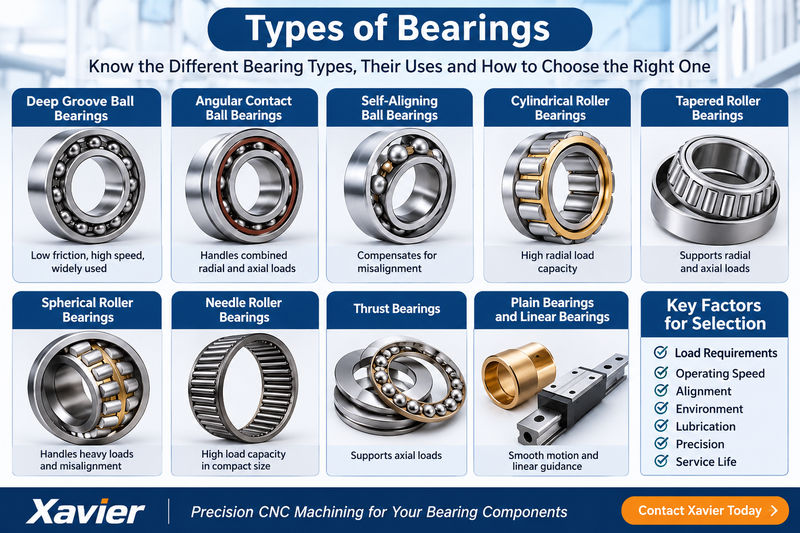
Bearings are essential mechanical components designed to support rotating or moving parts, reduce friction, maintain shaft positioning, and transfer loads between machine components. They are widely used in CNC machines, automotive systems, electric motors, industrial pumps, aerospace equipment, robotics, and heavy machinery.
Although bearings may look similar externally, their internal structures and operating characteristics can differ significantly. The main distinction is between rolling-element bearings, which use balls or rollers to minimize friction, and plain bearings, which support movement through sliding contact or a lubricating film.
Another important consideration is load direction. Radial loads act perpendicular to the shaft, while axial loads act parallel to the shaft. Some bearings can accommodate both simultaneously.
| Bearing Category | Main Structure | Primary Function |
|---|---|---|
| Ball bearings | Spherical rolling elements | High-speed, relatively low-friction operation |
| Roller bearings | Cylindrical or shaped rollers | High load-bearing capacity |
| Thrust bearings | Axial ball or roller arrangements | Support axial forces |
| Plain bearings | Sliding contact surfaces | Low-speed and oscillating movement |
| Linear bearings | Balls, rollers or sliding elements | Guide straight-line movement |
Understanding these differences is the first step toward choosing a bearing that meets the mechanical requirements of a particular application.
2. Deep Groove Ball Bearings
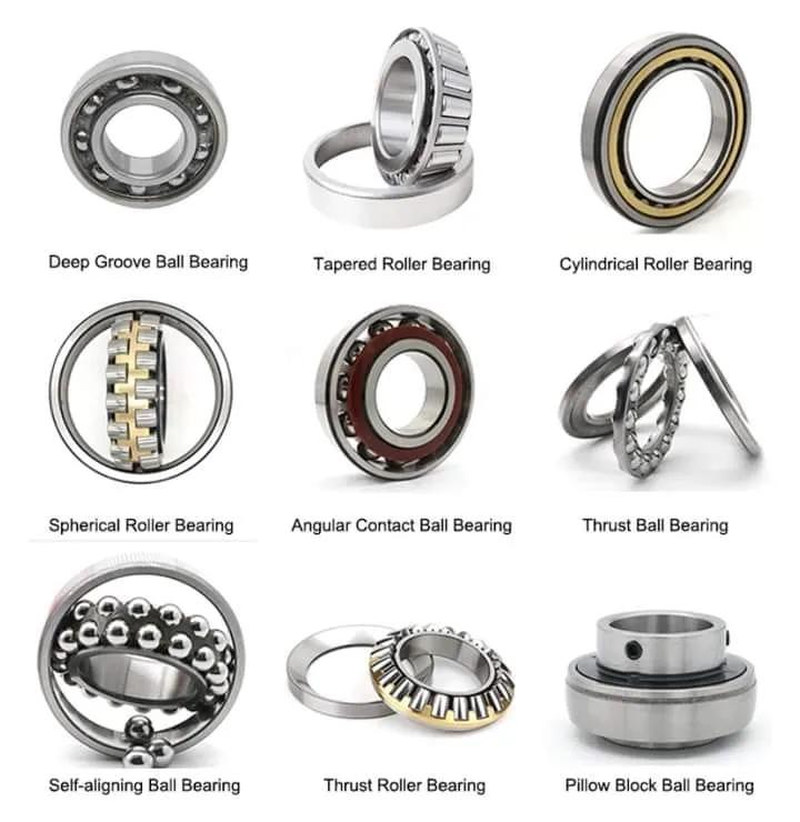
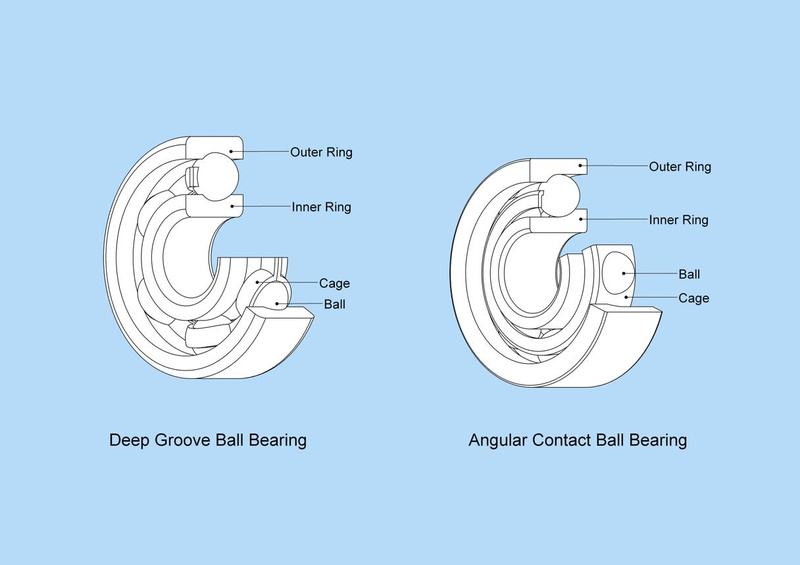
Deep groove ball bearings are among the most commonly used bearing types in industrial equipment. Their structure consists of an inner ring, an outer ring, a ball cage, and precision-ground steel balls running between two deep raceways.
The deep raceway geometry allows these bearings to support primarily radial loads while also accommodating moderate axial loads in both directions. Their relatively low friction makes them suitable for applications requiring continuous rotation and high operating speeds.
One major advantage is their simple construction. They are generally easy to install, widely available, and require relatively little maintenance when correctly lubricated and protected against contamination.
Typical applications include:
- Electric motors and generators.
- Industrial fans and ventilation systems.
- Water pumps and compressors.
- Small gearboxes and transmission assemblies.
- CNC machine auxiliary mechanisms.
Deep groove ball bearings are available in open, shielded, and sealed configurations. Open bearings are suitable for applications with external lubrication systems, while sealed versions help prevent dust, moisture, and debris from entering the rolling contact area.
From a manufacturing perspective, bearing seats must have accurate diameters, appropriate surface finishes, and controlled geometric tolerances. An improperly machined housing bore can cause uneven loading, vibration, and premature bearing failure.
3. Angular Contact Ball Bearings
Angular contact ball bearings are designed for applications where radial and axial forces act simultaneously. Unlike deep groove ball bearings, their raceway geometry creates a defined contact angle between the balls and raceways.
This angle determines how loads are distributed through the bearing. A larger contact angle generally increases axial load capacity but can influence rotational speed and friction characteristics.
Single-row angular contact bearings typically support axial loads in one direction. For applications requiring axial support in both directions, two bearings can be mounted together.
Common mounting configurations include:
| Arrangement | Characteristics | Typical Application |
|---|---|---|
| Back-to-back (DB) | High rigidity and moment resistance | CNC machine spindles |
| Face-to-face (DF) | Better tolerance of certain alignment variations | Pumps and precision assemblies |
| Tandem (DT) | Increased axial load capacity in one direction | High-load spindle systems |
Angular contact ball bearings are particularly important in CNC machine tool spindles. High-speed machining generates rotational forces, thermal expansion, and cutting loads that can affect spindle accuracy.
Preload is another important consideration. Applying the correct preload reduces internal clearance and improves stiffness. However, excessive preload increases friction and heat generation, potentially shortening bearing life.
4. Self-Aligning Ball Bearings
Self-aligning ball bearings are designed to accommodate angular misalignment between the shaft and housing. Their most distinctive feature is a spherical outer raceway that allows the inner ring and ball assembly to adjust its position slightly.
This design is particularly useful when shaft deflection, installation errors, or housing deformation cannot be completely eliminated.
Unlike standard deep groove ball bearings, self-aligning designs can compensate for a certain amount of angular misalignment without creating excessive edge loading.
Common applications include:
- Agricultural machinery.
- Textile manufacturing equipment.
- Conveyor systems.
- Long shaft assemblies.
- Industrial fans and blowers.
However, self-aligning ball bearings are not intended to replace every precision bearing arrangement. Their load capacity and rigidity may be lower than those of appropriately sized roller bearings.
When designing the supporting structure, engineers should pay attention to housing alignment, shaft stiffness, and bearing clearance. Even though the bearing can compensate for limited misalignment, excessive shaft bending can still cause vibration and uneven loading.
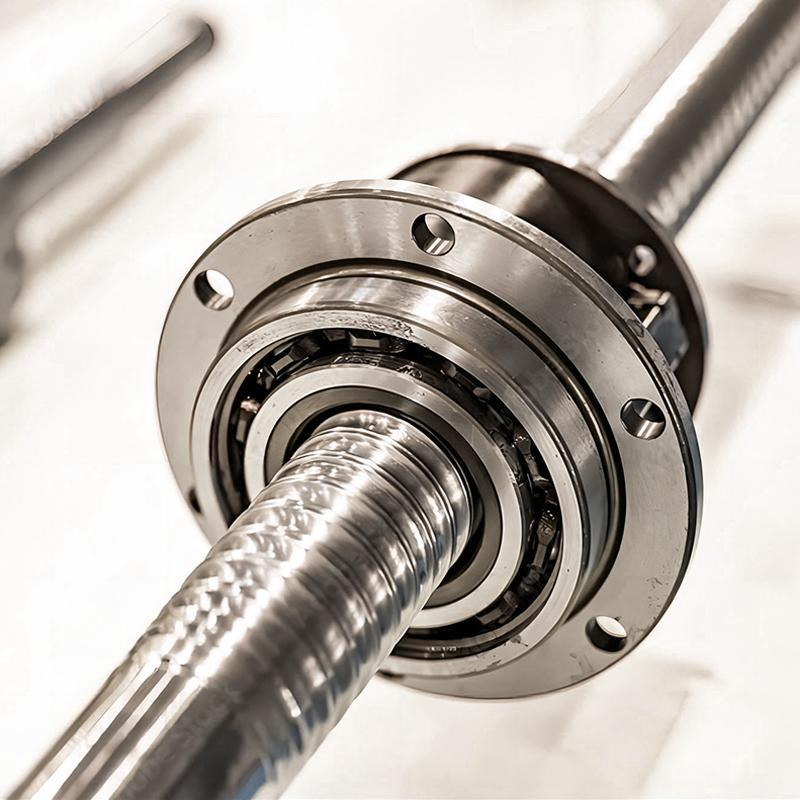
5. Cylindrical Roller Bearings
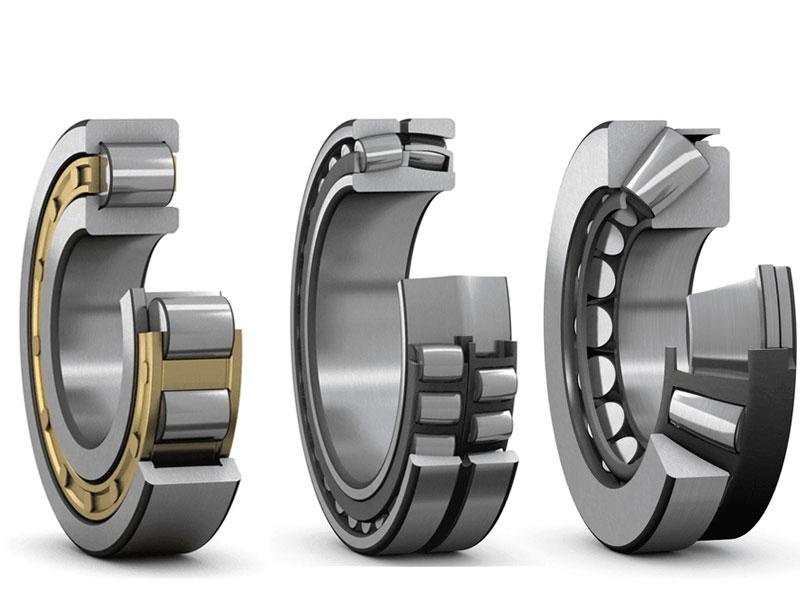
Cylindrical roller bearings use cylindrical rolling elements instead of spherical balls. Because the rollers have a larger contact area with the raceways, they can generally support higher radial loads than similarly sized ball bearings.
Their internal construction makes them suitable for heavy-duty applications where shaft stiffness and radial load capacity are important.
Depending on the design, cylindrical roller bearings may have different flange arrangements. NU and N configurations commonly allow axial displacement between the shaft and housing, making them useful as floating bearings. Other configurations, such as NJ and NUP, can provide varying degrees of axial positioning.
Typical applications include:
- Industrial gearboxes.
- Large electric motors.
- Rolling mills.
- Machine tool equipment.
- Heavy industrial transmission systems.
One important advantage is their ability to accommodate high radial forces without requiring an excessively large bearing diameter.
However, standard cylindrical roller bearings generally have limited axial load capacity. Engineers must therefore consider whether separate thrust support or another bearing arrangement is required.
The machining accuracy of bearing housings and shaft journals is especially important. Poor cylindricity, incorrect fits, or excessive surface roughness can affect load distribution and operating temperature.
6. Tapered Roller Bearings
Tapered roller bearings feature conical rollers positioned between inclined inner and outer raceways. Their contact geometry allows them to support combined radial and axial loads.
The load capacity depends on the roller dimensions, contact angle, internal geometry, and bearing arrangement.
A particularly important characteristic is that a single-row tapered roller bearing generally supports axial loads in one direction. Therefore, two bearings are frequently installed in opposing arrangements to accommodate axial forces in both directions.
Typical applications include:
- Automotive wheel hubs.
- Truck and trailer axles.
- Industrial gearboxes.
- Differential assemblies.
- Heavy-duty rotating shafts.
Tapered roller bearings require careful adjustment of internal clearance or preload. Too much clearance can reduce rigidity and create shaft movement, while excessive preload increases friction and operating temperature.
For example, an automotive wheel hub must withstand vehicle weight, cornering forces, braking forces, and vibration. A correctly adjusted tapered roller bearing arrangement helps maintain shaft positioning under these changing loads.
From a CNC machining perspective, the accuracy of tapered bearing seats, shoulder faces, and housing bores is critical. Incorrect geometry can prevent proper roller contact and cause localized stress concentrations.
7. Spherical Roller Bearings
Spherical roller bearings are designed for heavy radial loads, combined loading, and applications where shaft misalignment may occur.
They typically contain two rows of barrel-shaped rollers running on a common spherical outer raceway. This geometry allows the bearing to compensate for limited angular misalignment while maintaining load-carrying capability.
Compared with self-aligning ball bearings, spherical roller bearings are generally better suited to heavier industrial loads.
Common applications include:
- Mining and crushing machinery.
- Industrial conveyors.
- Paper manufacturing equipment.
- Vibrating screens.
- Large industrial fans.
- Wind turbine gearboxes.
Spherical roller bearings are particularly useful when operating conditions include shock loading, vibration, and shaft deflection.
However, their operating speed is generally lower than that of many ball bearing designs. Lubrication is also important because the large contact areas and heavy loads can generate substantial heat.
Engineers should consider bearing clearance, lubricant viscosity, operating temperature, and housing stiffness during selection. In demanding environments, contamination protection is equally important because abrasive particles can damage the raceways and rollers.
8. Needle Roller Bearings
Needle roller bearings use long, thin cylindrical rollers with a relatively small diameter. Their main advantage is high radial load capacity within a limited installation space.
Unlike conventional cylindrical roller bearings, needle roller bearings can provide substantial load capacity without requiring a large radial cross-section.
They are particularly suitable for compact mechanical assemblies where increasing the shaft or housing diameter would be impractical.
Typical applications include:
- Automotive transmissions.
- Planetary gear systems.
- Automotive rocker arms.
- Gear pumps.
- Universal joints.
- Compact industrial mechanisms.
Some needle roller bearings operate without an inner ring, allowing the shaft itself to function as the inner raceway. This can reduce overall assembly dimensions and component costs.
However, the shaft surface must then meet the required hardness, surface finish, and dimensional accuracy. A soft or poorly finished shaft can wear rapidly under repeated roller contact.
For CNC-machined components, controlling shaft diameter, roundness, concentricity, and surface roughness is essential. Heat treatment or surface hardening may also be necessary depending on the application and bearing design.
9. Thrust Bearings
Thrust bearings are specifically designed to support axial loads rather than primarily radial forces. They prevent unwanted movement along the shaft axis and help maintain the positioning of rotating components.
There are two major categories: thrust ball bearings and thrust roller bearings.
| Type | Rolling Element | Main Characteristics |
|---|---|---|
| Thrust ball bearing | Spherical balls | Suitable for relatively light to moderate axial loads |
| Cylindrical thrust roller bearing | Cylindrical rollers | High axial load capacity |
| Needle thrust bearing | Needle rollers | High axial capacity in compact spaces |
| Spherical thrust roller bearing | Spherical rollers | Heavy axial loads and limited misalignment compensation |
Thrust ball bearings are frequently used in turntables, vertical shafts, and light-duty positioning mechanisms. Roller thrust bearings are more appropriate for heavy industrial applications such as cranes, extruders, and large rotating equipment.
A critical point is that most thrust bearings are not designed to accommodate significant radial loads. If an application involves both radial and axial forces, an additional radial bearing or a suitable combined-load bearing arrangement may be necessary.
Machining accuracy is also important. The bearing support faces must be sufficiently flat and perpendicular to the shaft axis to avoid uneven axial loading.
10. Plain Bearings and Linear Bearings
Plain bearings and linear bearings serve different motion requirements from conventional rolling-element bearings.
Plain bearings, also called bushings or sleeve bearings, support moving shafts through sliding contact. Depending on the design, they may use hydrodynamic lubrication, boundary lubrication, or low-friction bearing materials.
Common materials include bronze, brass, stainless steel-backed composites, PTFE-based materials, and engineering plastics such as POM and nylon.
Their main advantages include simple construction, compact dimensions, good shock-load resistance, and suitability for oscillating or low-speed movement.
Linear bearings, on the other hand, are designed to guide components along a straight path rather than support continuous shaft rotation.
They are widely used in CNC machine axes, automation systems, industrial robots, and precision positioning equipment.
Important differences:
| Feature | Plain Bearing | Linear Bearing |
|---|---|---|
| Motion | Sliding or oscillating | Straight-line movement |
| Main function | Support moving shafts | Guide linear travel |
| Common materials | Bronze, PTFE, POM | Steel, stainless steel, polymer |
| Applications | Hinges, pivots, bushings | CNC slides, automation systems |
In CNC equipment, linear guideways must maintain accurate positioning while resisting cutting forces and vibration. Rail straightness, mounting surface flatness, and installation alignment directly influence machine accuracy.
How to Choose the Right Bearing for Your Application
Selecting a suitable bearing requires more than matching the inner diameter and outer diameter. Engineers should evaluate the complete operating environment and mechanical requirements.
The following factors are particularly important:
- Load requirements: Determine radial loads, axial loads, combined loads, and potential shock forces.
- Operating speed: Check the bearing’s allowable rotational speed under the actual lubrication and temperature conditions.
- Alignment: Consider shaft deflection, housing tolerances, and installation misalignment.
- Operating environment: Evaluate dust, moisture, chemicals, vibration, and temperature.
- Lubrication: Select suitable grease or oil based on speed, load, and operating conditions.
- Precision requirements: Consider bearing accuracy classes, shaft tolerances, housing fits, and rotational runout.
- Service life: Evaluate fatigue life, maintenance intervals, and replacement costs.
For example, a high-speed CNC spindle may require precision angular contact ball bearings with controlled preload, whereas a heavy conveyor gearbox may benefit from spherical or cylindrical roller bearings.
There is no universally best bearing. The correct solution depends on the relationship between load, speed, stiffness, precision, and operating conditions.
Why Precision CNC Machining Matters in Bearing Assemblies
Bearing performance depends not only on the bearing itself but also on the accuracy of the surrounding mechanical components.
Shaft journals, bearing housings, mounting shoulders, spacers, and retaining components must be manufactured to meet the specified dimensional and geometric requirements.
Common machining considerations include:
- Dimensional tolerances: Accurate shaft and housing dimensions ensure the intended interference or clearance fit.
- Concentricity and runout: Proper alignment reduces vibration and uneven loading.
- Surface roughness: Correct surface finish supports stable contact and reliable assembly.
- Flatness and perpendicularity: Accurate shoulder and mounting faces help maintain proper bearing positioning.
- Material selection: Aluminum alloys, alloy steels, stainless steels, and other engineering materials may be selected according to strength, weight, corrosion resistance, and operating conditions.
For example, an aluminum bearing housing may offer weight savings, but the designer must consider thermal expansion and the difference in stiffness compared with steel. A hardened alloy steel shaft may be more suitable where the shaft directly serves as a needle bearing raceway.
Precision CNC turning, milling, boring, and grinding can help achieve the required geometry and surface quality for these components.
Conclusion: Precision CNC Machining Solutions from Xavier
Choosing the right bearing type is essential for improving equipment reliability, reducing friction, maintaining mechanical accuracy, and extending service life. From deep groove ball bearings and angular contact bearings to cylindrical, tapered, spherical, and needle roller designs, each type serves a different combination of load and operating requirements.
However, bearing performance also depends heavily on the precision of the shafts, housings, mounting components, and related mechanical parts.
Xavier provides professional CNC machining services for custom metal components, supporting international manufacturers and engineering teams with precision CNC turning, CNC milling, drilling, boring, and other machining solutions.
Whether you need custom bearing housings, precision shafts, mechanical support components, or complex machined metal parts, Xavier can help turn your engineering drawings into manufactured components.
Contact Xavier today and send us your 2D drawings or 3D CAD files to discuss your material requirements, machining tolerances, production quantities, and custom CNC machining project.
As an integrated CNC machining manufacturer and trading company, Xavier specializes in custom CNC machining services and the precision manufacturing of various metal components. We also provide professional CNC anodizing surface finishing, CNC electrogalvanizing surface finishing, and CNC chemical conversion coating surface finishing to meet different product requirements.
As a reliable CNC anodizing surface finishing manufacturer, we offer bulk CNC electrogalvanizing surface finishing services at competitive prices. Contact us today to inquire about CNC chemical conversion coating surface finishing prices and discuss your project requirements.
Some of the images and text in this article are collected and compiled from the internet. If there is anything inappropriate, please contact us for processing.