Heat Deflection Temperature (HDT): The Complete Guide for Plastic Material Selection in CNC Machining
Heat Deflection Temperature (HDT), also known as Heat Distortion Temperature, is one of the most important thermal properties engineers consider when selecting plastic materials for CNC machining, injection molding, aerospace components, automotive parts, and industrial equipment.
A plastic part may have excellent strength and dimensional accuracy at room temperature, but if it deforms under heat during operation, the entire product can fail. HDT helps engineers understand how a material behaves when both temperature and mechanical load are present. ASTM D648 and ISO 75 are the most widely used standards for measuring HDT worldwide.
What Is Heat Deflection Temperature (HDT)?
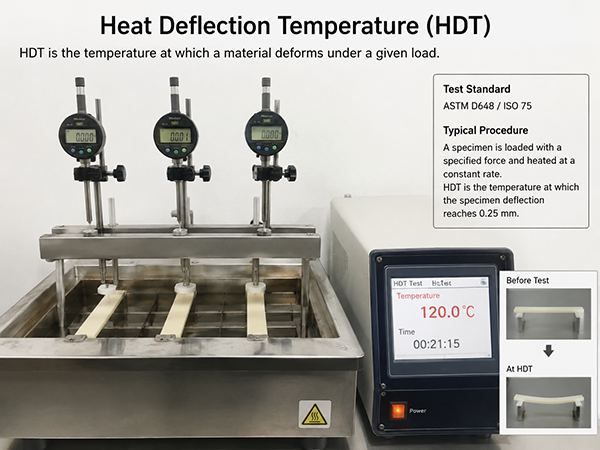
Heat Deflection Temperature is the temperature at which a plastic specimen deforms by a specified amount while subjected to a constant load and a controlled increase in temperature.
Unlike melting temperature, HDT measures a material’s ability to maintain stiffness under load at elevated temperatures. It provides a practical indication of thermal performance in real-world applications.
Example
Consider two CNC-machined plastic brackets:
| Material | Melting Point | HDT |
|---|---|---|
| ABS | ~220°C | ~95°C |
| PEEK | ~343°C | ~160-315°C |
Although ABS does not melt until around 220°C, it may begin deforming near 95°C under load, making it unsuitable for high-temperature structural applications.
Why HDT Matters in Engineering Design
Many engineers mistakenly focus only on tensile strength or melting temperature.
However, components often fail because they lose rigidity before reaching their melting point.
HDT helps determine whether a material can:
- Maintain dimensional stability
- Resist thermal deformation
- Support mechanical loads
- Operate safely near heat sources
- Meet long-term reliability requirements
Industries relying heavily on HDT include:
- Aerospace
- Automotive
- Medical devices
- Electronics
- Robotics
- Industrial machinery
Research and testing organizations emphasize that HDT is especially useful for evaluating load-bearing plastic parts exposed to elevated temperatures.
Understanding the ASTM D648 Test Method
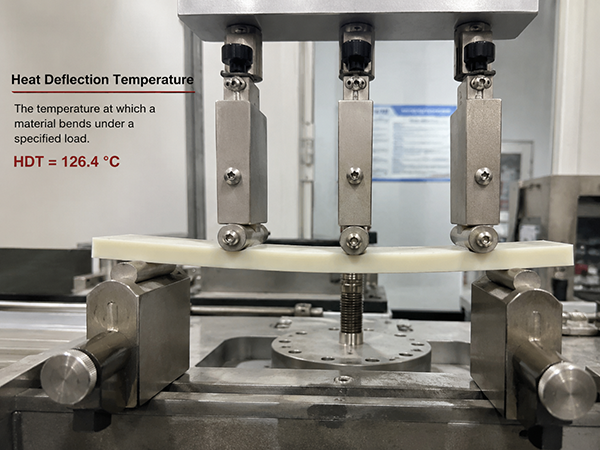
ASTM D648 is the most commonly referenced HDT testing standard.
Test Procedure
A plastic specimen is:
- Loaded under a specified bending stress
- Immersed in a heated oil bath
- Heated at approximately 2°C per minute
- Measured until a deflection of 0.25 mm occurs
The temperature at that point is recorded as the HDT.
Typical Test Conditions
| Parameter | Value |
|---|---|
| Heating Rate | 2°C/min |
| Deflection Target | 0.25 mm |
| Load A | 1.8 MPa |
| Load B | 0.45 MPa |
The result is highly repeatable and useful for comparing materials.
ISO 75 vs ASTM D648
Most plastic suppliers publish HDT data according to either ISO 75 or ASTM D648.
Key Differences
| Feature | ASTM D648 | ISO 75 |
|---|---|---|
| Standard Region | North America | International |
| Deflection Criteria | 0.25 mm | 0.25-0.34 mm |
| Common Loads | 0.45 MPa, 1.8 MPa | Method A & B |
| Application | Material Comparison | Global Specifications |
Both methods are widely accepted and produce similar comparative data.
HDT vs Glass Transition Temperature (Tg)
One of the most common engineering mistakes is confusing HDT with Tg.
Glass Transition Temperature (Tg)
Tg represents the temperature where an amorphous polymer begins transitioning from a rigid state to a softer state.
HDT
HDT represents actual deformation under load.
| Property | Tg | HDT |
|---|---|---|
| Measures | Molecular Transition | Structural Deformation |
| Load Applied | No | Yes |
| Design Relevance | Moderate | High |
| Real-world Performance | Limited | Strong |
For engineering plastics, HDT often provides more practical information than Tg when evaluating service temperatures.
Factors That Affect Heat Deflection Temperature
Several variables influence HDT values.
Material Structure
Semi-crystalline polymers generally have higher HDT than amorphous polymers.
Examples:
| Polymer Type | Structure |
|---|---|
| ABS | Amorphous |
| PC | Amorphous |
| Nylon | Semi-crystalline |
| PEEK | Semi-crystalline |
Semi-crystalline materials retain stiffness better at elevated temperatures.
Fiber Reinforcement
Glass fiber and carbon fiber significantly increase HDT.
Example:
| Material | Typical HDT |
|---|---|
| PA6 | 70-90°C |
| PA6 GF30 | 180-220°C |
| PEEK | 160°C+ |
| Carbon Fiber PEEK | 300°C+ |
Fiber reinforcement restricts polymer chain movement and increases thermal rigidity.
Typical HDT Values of Common CNC Machining Plastics
The following table provides approximate HDT ranges commonly used in CNC machining.
| Material | Typical HDT |
|---|---|
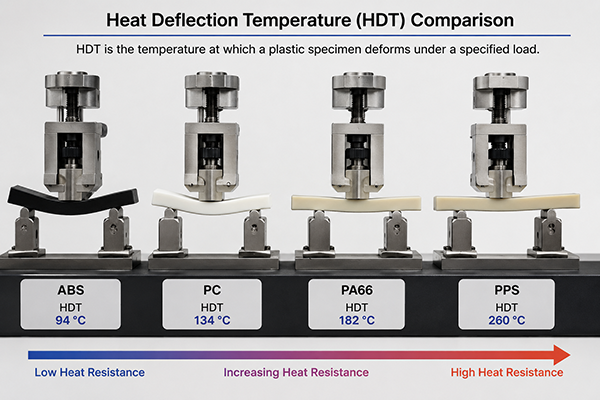
| ABS | 85-100°C |
| Acrylic (PMMA) | 85-105°C |
| Polycarbonate | 120-140°C |
| Acetal (POM) | 110-130°C |
| Nylon 6 | 70-120°C |
| Nylon GF30 | 180-220°C |
| PPS | 220-260°C |
| PEI (Ultem) | 200-215°C |
| PEEK | 160-315°C |
These values vary depending on grade and reinforcement.
HDT in Automotive Applications
Automotive components experience continuous heat exposure.
Examples include:
- Engine covers
- Sensor housings
- Connectors
- Under-hood brackets
- Air intake systems
Typical Requirements
| Component Location | Required HDT |
|---|---|
| Cabin Interior | 80°C+ |
| Engine Bay | 120°C+ |
| Turbo Area | 180°C+ |
For these applications, reinforced nylon, PPS, and PEEK are commonly selected.
HDT in Aerospace Components
Aerospace engineers often prioritize thermal stability as much as mechanical strength.
Typical aerospace applications:
- Avionics housings
- Sensor brackets
- Aircraft interior components
- UAV structural parts
- Satellite mechanisms
Materials frequently used include:
- PEEK
- PEKK
- PEI
- Carbon Fiber Reinforced PEEK
These materials maintain stiffness while reducing overall system weight.
HDT in Electronics and Electrical Equipment
Modern electronics generate substantial heat.
Applications include:
- Circuit board supports
- Electrical connectors
- Battery enclosures
- EV charging systems
- Semiconductor fixtures
A low-HDT plastic may warp, causing alignment issues or electrical failures.
For electrical environments, engineers often select:
- PPS
- PEEK
- PEI
- Glass-filled Nylon
These materials provide both thermal resistance and dimensional stability.
How CNC Machining Influences Thermal Performance
Material selection is only part of the equation.
CNC machining practices can influence performance through:
Residual Stress
Improper machining parameters can create internal stresses that become visible when parts are exposed to heat.
Thin Wall Design
Thin sections deform faster under thermal loads.
Sharp Corners
Stress concentration points increase deformation risk.
Best practices include:
- Uniform wall thickness
- Proper tool selection
- Stress-relief annealing when necessary
- Conservative machining parameters
Common Misconceptions About HDT
Myth 1: HDT Equals Maximum Service Temperature
False.
ASTM itself notes HDT should not be used alone to predict long-term service temperature. Actual performance depends on exposure duration, geometry, and loading conditions.
Myth 2: High Melting Point Means High HDT
False.
Many plastics soften under load long before melting.
Myth 3: HDT Is Only Important for High-Temperature Industries
False.
Even sunlight exposure can elevate component temperatures above 70°C.
Outdoor products, automotive interiors, and industrial enclosures frequently experience HDT-related failures.
How to Select a Material Based on HDT
A practical engineering guideline is:
| Operating Temperature | Recommended HDT |
|---|---|
| 50°C | 80°C+ |
| 80°C | 110°C+ |
| 120°C | 150°C+ |
| 180°C | 220°C+ |
Maintaining a safety margin of 20-40°C above expected operating temperature is generally recommended.
Engineers should also evaluate:
- Creep resistance
- Moisture absorption
- Chemical resistance
- Mechanical strength
- Manufacturing cost
HDT should never be the sole material-selection criterion.
Why HDT Is Critical for CNC Plastic Parts
When designing precision CNC-machined plastic components, dimensional stability often determines product success.
A material with insufficient HDT can cause:
- Misalignment
- Bearing failure
- Seal leakage
- Reduced service life
- Warranty claims
Understanding HDT allows engineers to make informed material choices before production begins, reducing costly redesigns and field failures.
Xavier Precision CNC Machining Recommendation
At Xavier, we help customers select the right engineering plastics based on real-world operating conditions—not just datasheet numbers.
Whether your project requires:
- High-temperature PEEK components
- Glass-filled Nylon structural parts
- Precision PPS electrical components
- PEI aerospace-grade machined parts
our engineering team evaluates HDT, mechanical properties, dimensional tolerances, and end-use requirements to ensure optimal performance.
By combining advanced CNC machining capabilities with deep material expertise, Xavier delivers precision plastic components that maintain stability even in demanding thermal environments.
We are an integrated manufacturer specializing in CNC machining services, focusing on custom CNC machining and the production of various metal components. We also provide
CNC electroless nickel plating surface finishing,
CNC zinc plating surface finishing, and
CNC chemical conversion coating surface finishing.
We are a professional CNC electroless nickel plating surface finishing manufacturer, providing high-volume
CNC zinc plating surface finishing services. Contact us today to inquire about
CNC chemical conversion coating surface finishing pricing.
Some of the images and text in this article are collected and compiled from the internet. If there is anything inappropriate, please contact us for processing.