
Screw Machining Services: Precision Manufacturing for High-Volume Custom Components
Screw machining services are a specialized manufacturing process used to produce high-precision cylindrical components at high production volumes. Modern screw machining—particularly CNC Swiss screw machining—combines turning, drilling, milling, and threading in a single automated process to manufacture complex parts with tight tolerances and excellent surface finish.
The process is widely used in industries such as medical devices, automotive systems, aerospace hardware, and electronics because it allows manufacturers to produce thousands or even millions of identical components with extremely consistent quality.
Below are the 10 most important technical topics related to screw machining services, based on commonly discussed themes found in high-ranking manufacturing resources.
Key Knowledge Topics Related to Screw Machining Services
- What Screw Machining Is and How It Works
- Swiss Screw Machines vs Traditional CNC Lathes
- Typical Tolerances Achievable in Screw Machining
- Materials Commonly Used in Screw Machined Parts
- Production Volume and Cost Efficiency
- Guide Bushing Technology and Its Role in Precision
- Surface Finish and Quality Control
- Industries That Rely on Screw Machined Components
- Design Considerations for Screw Machined Parts
- Screw Machining vs Other Manufacturing Methods
What Screw Machining Is and How It Works
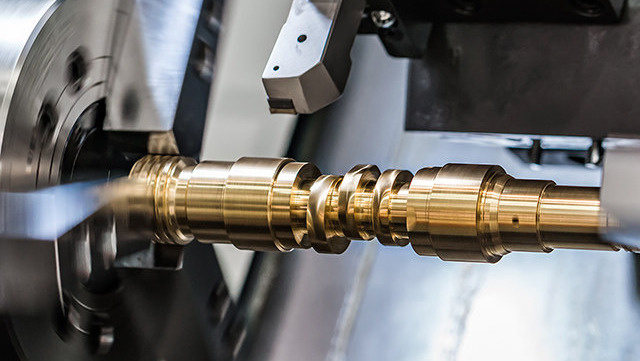
Screw machining is a machining method used primarily to manufacture small, cylindrical, threaded, or precision turned components using automated lathes. In modern manufacturing environments, most screw machining is performed using CNC Swiss-type machines.
The process works by feeding a bar stock of material through a guide bushing, where cutting tools perform multiple machining operations as the bar rotates. This configuration stabilizes the workpiece and reduces deflection during machining.
Typical operations performed in screw machining include:
| Operation | Description |
|---|---|
| Turning | Reducing outer diameter |
| Threading | Creating screw threads |
| Drilling | Producing internal holes |
| Milling | Machining flats or slots |
| Parting | Cutting finished parts from bar stock |
One of the biggest advantages is multi-tool simultaneous machining, where several cutting tools operate on different parts of the workpiece at the same time. This significantly reduces cycle time.
Example:
A sensor connector pin used in automotive electronics may require turning, threading, cross drilling, and chamfering. A Swiss screw machine can complete all these operations in one setup.
Swiss Screw Machines vs Traditional CNC Lathes
Swiss screw machines differ significantly from standard CNC lathes.
The main difference lies in workpiece support and tool positioning.
| Feature | Swiss Screw Machine | Conventional CNC Lathe |
|---|---|---|
| Workpiece support | Guide bushing near cutting tool | Chuck only |
| Part size | Small diameter, long parts | Medium to large parts |
| Precision | Extremely high | High |
| Productivity | High-volume production | Flexible batch production |
| Tooling | Multiple tools simultaneously | Usually sequential operations |
The guide bushing system keeps the cutting point extremely close to the support point, reducing vibration and deflection when machining long slender parts.
Because of this design, Swiss machines are ideal for manufacturing:
- Connector pins
- Precision fasteners
- Medical screws
- Hydraulic valve components
Typical Tolerances Achievable in Screw Machining
Precision is one of the biggest reasons manufacturers choose screw machining services.
Typical tolerances achievable include:
| Feature Type | Typical Tolerance |
|---|---|
| General screw machined parts | ±0.01 mm |
| Precision turned features | ±0.005 mm |
| Critical micro components | ±0.0025 mm |
Swiss screw machining can maintain tolerances as tight as ±0.0001 inches (±0.0025 mm) on critical dimensions.
Some high-end medical or aerospace parts may even reach tolerances around ±0.0002 inches (≈0.005 mm) across production runs.
Example:
A dental implant screw may require thread pitch accuracy within 0.0002 inches to ensure correct fit with the implant fixture.
Materials Commonly Used in Screw Machined Parts
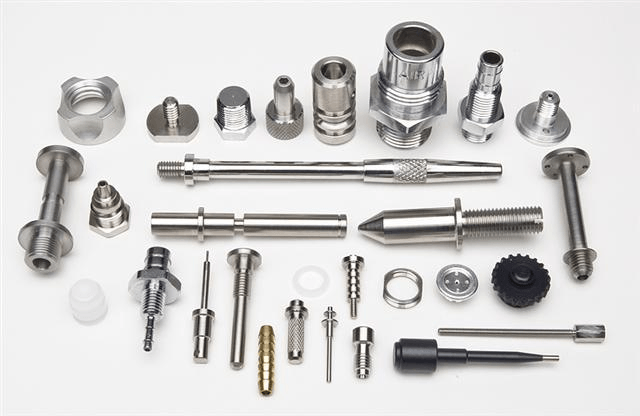
Screw machining supports a wide range of metals and engineering plastics.
Typical materials include:
| Material | Typical Applications |
|---|---|
| Brass | Electrical connectors |
| Stainless steel | Medical instruments |
| Aluminum | Lightweight mechanical parts |
| Titanium | Aerospace fasteners |
| Copper alloys | Electrical terminals |
| Engineering plastics (PEEK, Delrin) | Medical and electronic components |
Swiss screw machining can process more than 60 different materials, including high-temperature alloys and advanced polymers.
Material selection usually depends on:
- mechanical strength requirements
- corrosion resistance
- electrical conductivity
- thermal properties
Production Volume and Cost Efficiency
Screw machining is especially effective for high-volume manufacturing.
Typical production ranges:
| Production Type | Quantity |
|---|---|
| Prototype | 50–500 parts |
| Medium batch | 1,000–20,000 parts |
| High-volume production | 100,000+ parts |
Once the machine is programmed and set up, screw machines can run continuously with minimal operator intervention, significantly lowering labor costs.
In many factories, bar feeders and robotic unloading systems allow machines to run 24/7, which dramatically improves productivity.
Guide Bushing Technology and Its Role in Precision
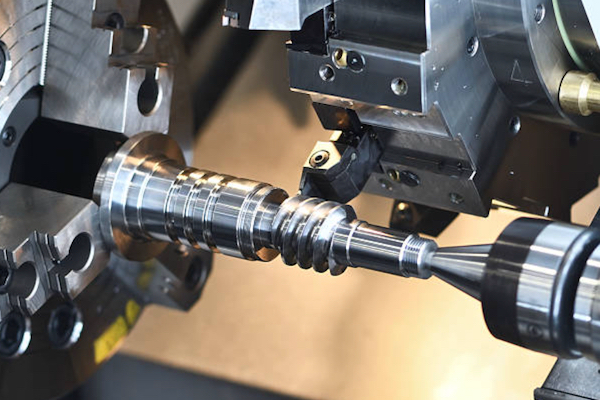
The guide bushing is the defining feature of Swiss screw machining.
It supports the bar stock extremely close to the cutting tool, which:
- reduces vibration
- minimizes tool deflection
- improves dimensional accuracy
Because of this design, Swiss machines are particularly effective for parts with a high length-to-diameter ratio, such as long thin shafts or pins.
Typical dimensional capability:
| Parameter | Range |
|---|---|
| Diameter | 0.5 mm – 32 mm |
| Length | up to 300 mm |
| Optimal ratio | L/D up to 20:1 |
Without guide bushing support, these parts would bend or vibrate during machining.
Surface Finish and Quality Control
Surface finish is another key advantage of screw machining.
Typical achievable surface roughness:
| Finish Type | Roughness |
|---|---|
| Standard screw machining | Ra 1.6 μm |
| Precision finishing | Ra 0.8 μm |
| Micro precision machining | Ra 0.2 μm |
Swiss machines often produce smooth surfaces without secondary finishing operations, which reduces production cost.
Quality control processes usually include:
- coordinate measuring machines (CMM)
- optical inspection
- thread gauges
- statistical process control (SPC)
Industries That Rely on Screw Machined Components
Screw machining services are critical in industries that require high precision and high production volumes.
Medical Industry
Applications include:
- surgical screws
- dental implants
- orthopedic fixation devices
Medical components often require extreme accuracy and biocompatible materials.
Automotive Industry
Typical parts include:
- sensor housings
- fuel injector components
- electrical connectors
High-volume automotive production benefits greatly from automated screw machining.
Electronics Industry
Examples include:
- RF connectors
- fiber optic alignment pins
- precision terminals
These parts are typically small and require tight tolerances.
Design Considerations for Screw Machined Parts
Good part design improves manufacturability and reduces cost.
Recommended design guidelines:
| Feature | Recommendation |
|---|---|
| Minimum diameter | ≥ 0.5 mm |
| Minimum wall thickness | ≥ 0.3 mm |
| Thread length | ≤ 3× diameter |
| Deep hole ratio | ≤ 10× diameter |
Design engineers should also minimize unnecessary tight tolerances.
Example:
Specifying ±0.002 mm tolerance on a non-functional surface significantly increases machining time without improving product performance.
Screw Machining vs Other Manufacturing Methods
Different processes are suitable for different part geometries.
| Process | Best For |
|---|---|
| Screw machining | Small cylindrical precision parts |
| CNC milling | Complex prismatic parts |
| CNC turning | Medium-volume round components |
| Die casting | Large quantities of aluminum parts |
| Metal injection molding | Very small complex parts |
Screw machining is usually the most economical solution for high-volume small precision components.
Why Choose Xavier for Screw Machining Services
When sourcing reliable screw machining services, the most important factors include machining accuracy, production capacity, and quality control systems.
Xavier provides professional screw machining services for global customers requiring precision turned parts.
Xavier’s capabilities include:
- CNC Swiss screw machining
- Multi-axis turning centers
- Precision tolerances down to micron level
- Materials including stainless steel, brass, aluminum, and titanium
- Rapid prototyping and large-scale production
Whether you require custom threaded fasteners, connector pins, precision shafts, or miniature medical components, Xavier can deliver consistent quality and cost-effective manufacturing solutions.
For companies looking for dependable high-precision screw machining services, Xavier is a trusted manufacturing partner capable of turning complex designs into high-quality precision components.
Some of the images and text in this article are collected and compiled from the internet. If there is anything inappropriate, please contact us for processing.