Electroplating and Electroless Plating Selection Guide
Electroless plating and electroplating are two common metal surface treatment methods, playing a key role in improving metal performance and appearance. However, there are many differences between them, and each has its own unique advantages and disadvantages. Understanding these differences and characteristics is crucial to choosing the right surface treatment process. This article will explore the differences between electroplating and electroless plating, their respective advantages and disadvantages, to help you better understand these two technologies.
In modern manufacturing and surface engineering, metal surface treatment technologies are crucial for improving product performance and appearance. Electroplating and electroless plating are the two most commonly used processes. The former relies on an applied electric current to drive the deposition of metal ions, while the latter uses a chemical reduction reaction to form the coating.
Each method has its own advantages and limitations. Choosing the appropriate process for different materials and applications is a common concern for engineers and manufacturers.
Table of Contents
1.What is Electroplating?
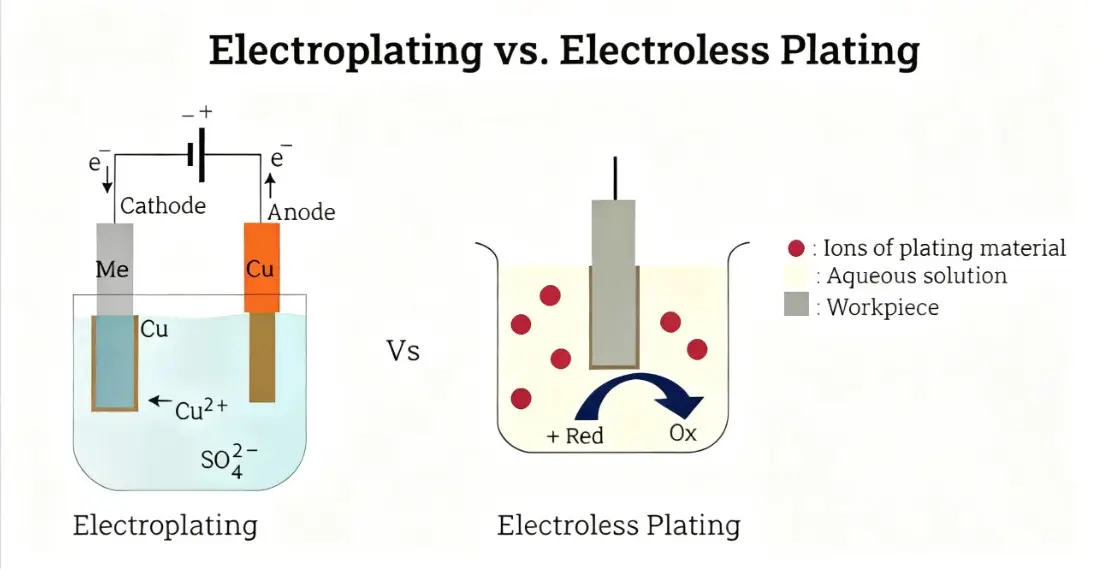
Electroplating is a surface treatment process that uses electrochemical principles to deposit a thin metal film on a workpiece. An applied electric current reduces the metal ions in the electrolyte and deposits them evenly on the workpiece, giving it new properties and appearance.
During the electroplating process, the workpiece to be plated typically serves as the cathode, placed in an electrolyte containing a specific metal salt. The corresponding metal material acts as the anode, dissolving and continuously replenishing the metal ions in the solution. As the current continues, the metal ions are attracted to the workpiece surface, forming a dense, uniform metal coating.
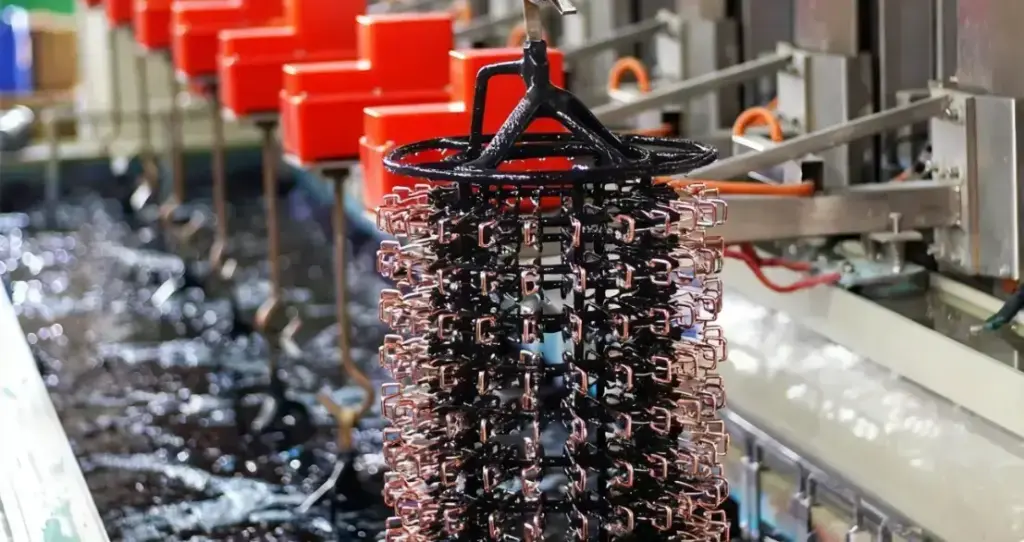
Electroplating not only improves the corrosion resistance, wear resistance, and conductivity of the base metal, but also enhances its decorative properties and gloss. Depending on the application and type of coating, common electroplating processes include nickel, copper, zinc, chromium, and precious metal plating such as gold and silver.
2.What is electroless plating?
Electroless plating is a surface treatment process that deposits a metal layer on a workpiece through a chemical reaction without applying an external current. The basic principle is that a reducing agent in a solution directly reduces metal ions to metal atoms, which are then uniformly deposited on the activated substrate surface, forming a dense and strongly bonded coating.
During the electroless plating process, the workpiece is thoroughly cleaned and pretreated before being immersed in a specially formulated electroless plating solution. The plating solution typically contains a metal salt (to provide the metal ions), a reducing agent, a chelating agent, a stabilizer, and additives to adjust the pH and improve coating properties. The entire reaction proceeds continuously through an autocatalytic mechanism, forming a uniform metal deposit without the need for electrical current.
Compared to traditional electroplating, chemical plating can deposit coatings on both conductive (metal) and non-conductive (such as plastics and ceramics) surfaces with more uniform thickness, making it particularly suitable for parts with complex shapes or requiring high precision.
3.Advantages and Disadvantages of Electroplating
1)Advantages
Enhanced durability: Electroplating can improve the durability and wear resistance of metal surfaces by providing a protective layer of another metal.
Improved corrosion resistance: The resulting coating provides better corrosion protection and extends the service life of metal parts.
Decorative options: Can be used to create decorative finishes on metal parts, such as chrome or gold plating.
Precise control: The thickness and uniformity of the coating can be precisely controlled, allowing for more precise customization.
2)Disadvantages
Higher cost: The electroplating process requires specialized equipment and skilled operators, which is costly.
Environmental issues: Toxic waste is generated and needs to be handled carefully to avoid damage to the environment.
High surface preparation requirements: A clean and conductive surface is required for the metal coating to adhere properly, and additional surface preparation steps may be required.
4.Advantages and Disadvantages of Electroless Plating
1)Advantages
Uniform coating thickness: It can produce more uniform and consistent coating thickness than electroplating, improving coating quality and consistency.
Good adhesion: It has better adhesion than electroplating, especially on non-conductive surfaces, and has a wider range of applications.
Strong corrosion resistance: Because the process can produce a dense and uniform coating, it is more corrosion-resistant than electroplating.
Reduced environmental impact: It produces less toxic waste and is a more environmentally friendly choice.
Economical and efficient: Compared with electroplating, it has lower energy consumption and simpler processes, making it an economical and efficient choice for metal surface coating.
2)Disadvantages
Less precise control: It is more difficult to control than electroplating, resulting in less precise coating thickness and quality.
Long process time: It usually takes longer than electroplating, increasing production time and cost.
Limited metal range: It is usually limited to plating certain metals, such as nickel, gold and copper.
5.Differences between Electroplating and Chemical Plating
Different Principles
Electroplating relies on an applied current to reduce metal ions to form a metal layer on the workpiece surface. It is an electrochemical process. Chemical plating, on the other hand, does not require current. Instead, a redox reaction between a chemical reducing agent and metal ions spontaneously deposits a metal layer on the activated surface.
Different Process Characteristics
Electroplating has a fast deposition rate and is easy to control thickness. However, due to the influence of the electric field distribution, workpieces with complex structures are prone to uneven coatings. Chemical plating has a relatively slow deposition rate, but it can form uniform and dense coatings on various surfaces and is particularly suitable for parts with complex shapes or internal holes.
Different Applicable Substrates
Electroplating is generally used for conductive metal materials. After an activation treatment, chemical plating can be used to deposit coatings on non-conductive surfaces such as plastics, ceramics, and composite materials, extending its application range.
Equipment and Operation Differences
Electroplating requires a power source, an anode, and an electrolytic device, and process control is primarily based on electrical parameters. Chemical plating does not rely on a power source and primarily maintains reaction stability by controlling the chemical solution’s composition, temperature, and pH.
Cost and Environmental Differences
Electroplating is a mature process with high production efficiency, but it consumes a lot of energy and generates wastewater and liquid waste. Chemical plating does not require electricity, but it has higher reagent costs and solution maintenance costs, and is more environmentally friendly under certain conditions.
Advantages and Disadvantages and Applications
Electroplating offers advantages such as high speed, strong decorative properties, and suitability for mass production, but its coating distribution is limited. Chemical plating, on the other hand, is known for its uniform coating, strong adhesion, and excellent corrosion resistance, but its process control is more complex.
Generally speaking, electroplating is mostly used for decorative coatings and high-efficiency production scenarios, while chemical plating is more suitable for parts with high requirements, corrosion protection, or complex shapes.
The table below clearly illustrates the differences between electroplating and chemical plating:
| Feature | Electroplating | Electroless Plating |
| Principle | Metal ions deposit with applied external current | Metal deposits spontaneously by reducing agent without current |
| Power Requirement | Requires power supply, anode and cathode | No power supply required, only relies on chemical reaction |
| Deposition Rate | Relatively fast, thickness can be controlled | Relatively slow, thickness increases uniformly |
| Thickness Control | Easy to control | Relatively difficult to control |
| Coverage Uniformity | May be uneven on complex structures | Uniform, suitable for complex geometries and internal holes |
| Substrate Adaptability | Mainly conductive metals | Conductive metals as well as non-conductive plastics, ceramics, etc. |
| Equipment and Operation | Power supply, anode, electrolytic cell, etc., require electrical control | Simple equipment, control solution composition, temperature, pH |
| Cost | High equipment and electricity costs | High reagent and maintenance costs, no electricity consumption |
| Environmental Friendliness | Generates electrolytic waste liquid, requiring strict treatment | Chemical waste liquid is easier to manage, but still needs standardization |
| Advantages | Fast deposition, controllable thickness, good decorativeness, suitable for mass production | Uniform coverage, strong adhesion, corrosion resistance, suitable for complex shapes |
| Disadvantages | Unevenness easily occurs on complex structures; non-conductors need treatment; high power consumption | Slow speed, slow thickness growth; high requirement for formula control; high cost |
| Typical Applications | Decorative parts, mechanical parts, electronic casings, automotive components | Precision parts, complex structural parts, plastic metallization, corrosion-resistant parts |
6.How to choose the right electroplating method for your project?
Corrosion and Wear Resistance
Electroless plating forms a uniform, dense coating with improved corrosion and wear resistance, making it suitable for industrial parts or precision machinery.
Decorative Effects
Electroplating can achieve a variety of colors and glosses, making it suitable for decorative products such as jewelry and lighting accessories; electroless plating produces a single color.
Cost
Electroplating equipment is mature and low-cost, making it suitable for large-scale production; however, electroless plating chemicals and maintenance costs are relatively high.
Output and Speed
Electroplating offers rapid deposition and easy-to-control thickness; electroless plating is slower and requires strict control of solution conditions.
Environmental Protection and Safety
Electroplating may generate hazardous waste and cyanide risks; wastewater treatment by electroless plating is relatively controllable and more environmentally friendly.
Workpiece Material
Conductive metals can be plated either electroplated or electroless; however, non-conductive materials (plastics, ceramics, and composites) can only be plated by electroless plating.
Part Structure
Simple shapes are suitable for electroplating; parts with complex geometries or numerous internal pores are more uniformly plated by electroless plating.
Conclusion:
Different projects have different requirements. There’s no “better” coating, only the most suitable option. Understanding the characteristics and application scopes of electroplating and electroless plating can help you find the optimal balance between cost, performance, and aesthetics, ultimately achieving the desired product result.
Providing Professional Electroplating and Electroless Plating Services
Xavier, as an ISO9001 and AS9100 certified parts processing company, is committed to providing customers with one-stop solutions for parts processing—from prototyping, precision machining, to surface treatment, with full process control and traceability.
For surface treatment, we possess mature electroplating zinc and electroless nickel plating technologies, customizing the optimal process for different materials and application scenarios, ensuring parts possess excellent corrosion protection and surface finish.
From small-batch trial runs to large-scale production, we provide efficient and stable processing support.

FAQ:
What is the fundamental difference between electroplating and electroless plating?
Electroplating relies on an applied current to reduce metal ions in an electrolyte and deposit them onto a conductive workpiece. Electroless plating, however, relies on a chemical reaction of a reducing agent in the solution to autocatalytically deposit a metal layer on an activated surface.
Which process is more corrosion-resistant or wear-resistant?
Generally speaking, phosphorus-containing electroless nickel plating provides a very uniform, dense coating with excellent corrosion resistance; electroplating (such as chromium plating) offers higher surface hardness and wear resistance. The choice depends on the specific plating type and application conditions.
Which process is more suitable for parts with complex geometries or internal holes?
Because electroless plating is not affected by the electric field distribution, the coating thickness is more uniform and is generally more suitable for parts with complex shapes, deep holes, and internal cavities. Electroless plating deposits thicker layers on convex surfaces and thinner layers on concave surfaces.
Can non-conductors (plastics) be plated directly?
Plastics must first be activated before plating; the electroless plating route (activation followed by electroless plating) is more commonly used and reliable in industry.
Which process offers advantages in terms of cost, output, and delivery time?
Electroplating equipment is mature, boasts fast deposition rates, and is typically low per-part cost, making it suitable for mass production. Chemical plating, on the other hand, has high maintenance costs for chemicals and solutions, and slower deposition rates, but can reduce rework for complex parts. Overall, comparisons should be made based on part type and production volume.