
1. Ten Key Topics to Cover
- Cast Iron vs Aluminum: Basic Material Composition and Types – Material structure, classifications, and common grades.
- Density and Weight Comparison – How material density affects component weight and equipment design.
- Strength, Hardness, and Mechanical Properties – Tensile strength, compressive strength, stiffness, and impact resistance.
- Corrosion Resistance and Environmental Durability – Oxidation, rust prevention, and operating environments.
- Thermal Conductivity and Heat Resistance – Heat dissipation, thermal expansion, and high-temperature applications.
- Wear Resistance and Vibration Damping – Friction, abrasion, vibration absorption, and structural stability.
- CNC Machinability and Manufacturing Performance – Cutting speeds, tooling, chip formation, and machining challenges.
- Surface Finishing and Post-Processing – Anodizing, painting, coating, grinding, and other finishing methods.
- Cost Comparison and Manufacturing Economics – Raw material prices, machining expenses, production volume, and lifecycle costs.
- Applications and How to Choose the Right Material – Automotive, machinery, aerospace, robotics, and industrial components.
Cast Iron vs Aluminum: 10 Key Differences in Strength, Weight, Cost, and CNC Machining
Choosing between cast iron and aluminum is an important decision in mechanical engineering, automotive manufacturing, industrial equipment production, and CNC machining. Although both materials are widely used to manufacture precision components, they offer very different mechanical properties, weights, thermal characteristics, and manufacturing advantages.
Cast iron is known for its excellent vibration damping, compressive strength, wear resistance, and structural stability. Aluminum, in contrast, is valued for its lightweight properties, corrosion resistance, thermal conductivity, and relatively easy machinability.
However, choosing the right material involves more than comparing their basic specifications. Engineers must also consider component geometry, operating loads, working temperatures, machining requirements, surface treatments, and total manufacturing costs.
In this guide, we will examine 10 important differences between cast iron and aluminum to help manufacturers, engineers, and purchasing professionals select the most suitable material for their CNC machined parts.
2. Cast Iron vs Aluminum: Basic Material Composition and Types
Cast iron and aluminum belong to two different metal families, and their chemical compositions directly influence their mechanical and manufacturing properties.
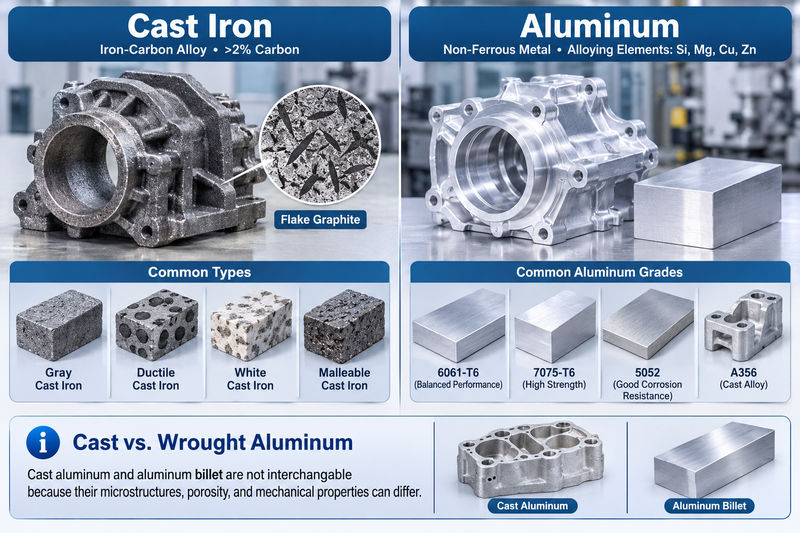
Cast iron is an iron-carbon alloy generally containing more than 2% carbon, along with silicon and other alloying elements. Its microstructure may contain graphite or iron carbides, depending on the casting process and chemical composition.
Common types include:
- Gray Cast Iron: Contains flake graphite and provides excellent vibration damping and machinability.
- Ductile Cast Iron: Contains spheroidal graphite, offering better tensile strength and toughness.
- White Cast Iron: Contains hard iron carbides and provides excellent abrasion resistance.
- Malleable Cast Iron: Offers improved ductility and impact resistance compared with conventional gray iron.
Aluminum is a non-ferrous metal. Commercial aluminum alloys contain different alloying elements, including silicon, magnesium, copper, and zinc, to improve their mechanical properties.
Common aluminum grades include:
- 6061-T6: A versatile alloy with balanced strength, machinability, and corrosion resistance.
- 7075-T6: A high-strength aluminum alloy commonly used in aerospace and demanding structural applications.
- 5052: Offers good corrosion resistance and formability.
- A356: A common cast aluminum alloy used for automotive and industrial components.
One important distinction is that aluminum can be supplied as wrought or cast material. Cast aluminum and aluminum billet are not interchangeable specifications because their microstructures, porosity, and mechanical properties can differ.
3. Density and Weight Comparison
Weight is one of the most significant differences between cast iron and aluminum.
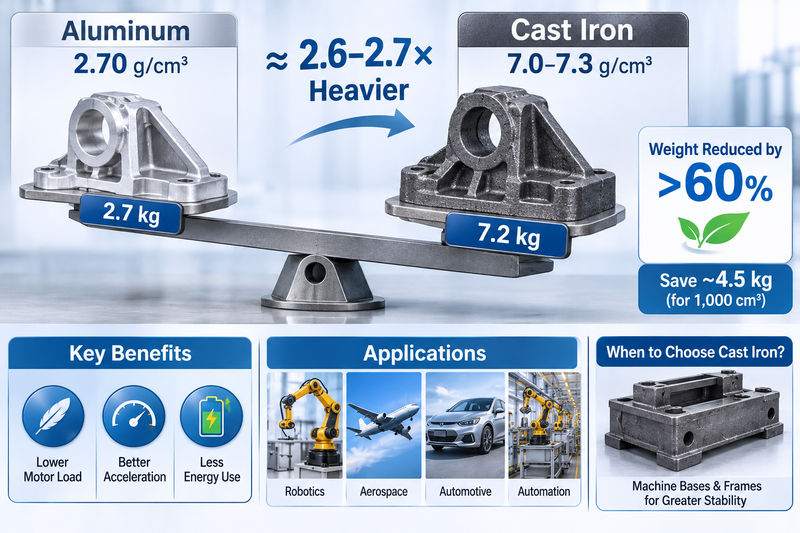
Aluminum has a typical density of approximately 2.70 g/cm³, while gray cast iron generally has a density of approximately 7.0–7.3 g/cm³. Therefore, cast iron is roughly 2.6–2.7 times heavier than aluminum for the same volume.
| Property | Aluminum | Cast Iron |
|---|---|---|
| Typical density | 2.70 g/cm³ | 7.0–7.3 g/cm³ |
| Relative weight | 1.0 | 2.6–2.7 |
| Weight advantage | Excellent | Limited |
| Typical advantage | Lightweight structures | Heavy-duty equipment |
Consider an industrial mounting bracket with a volume of 1,000 cm³.
- Aluminum bracket: approximately 2.7 kg.
- Cast iron bracket: approximately 7.2 kg.
The aluminum version would save approximately 4.5 kg, representing a weight reduction of more than 60%.
This difference becomes particularly important in robotics, aerospace equipment, automotive components, and automated production systems. Reducing moving-part weight can lower motor loads, improve acceleration, and reduce energy consumption.
However, heavier components are not always a disadvantage. Cast iron is often preferred for machine bases and equipment frames because its mass helps reduce unwanted movement and improves operational stability.
4. Strength, Hardness, and Mechanical Properties
Strength is another major consideration when comparing cast iron and aluminum. However, it is important to distinguish tensile strength, compressive strength, hardness, and impact resistance rather than treating strength as a single property.
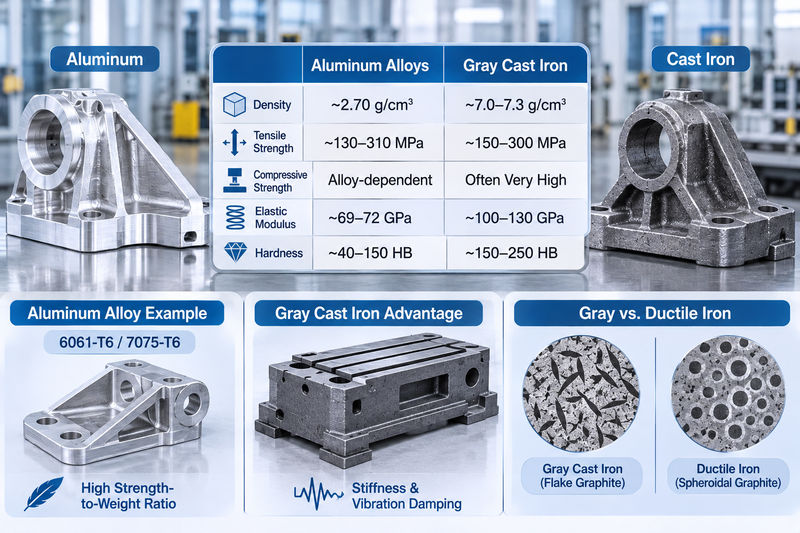
Typical mechanical property ranges are shown below. Actual values depend on the specific alloy, casting method, heat treatment, and material condition.
| Mechanical Property | Aluminum Alloys | Gray Cast Iron |
|---|---|---|
| Density | ~2.70 g/cm³ | ~7.0–7.3 g/cm³ |
| Tensile strength | ~130–310 MPa | ~150–300 MPa |
| Compressive strength | Alloy-dependent | Often very high |
| Elastic modulus | ~69–72 GPa | ~100–130 GPa |
| Hardness | ~40–150 HB | ~150–250 HB |
Aluminum alloys such as 6061-T6 provide a useful combination of strength and low weight. Higher-strength grades such as 7075-T6 can achieve tensile strengths around 500–570 MPa, depending on product form and temper.
Gray cast iron behaves differently. Its graphite flakes interrupt the metal matrix, which contributes to excellent vibration damping but also makes it relatively brittle under tensile and impact loading.
For example, an aluminum mounting bracket used in a robotic arm may benefit from its high strength-to-weight ratio. A cast iron machine base, however, may be a better choice because it needs stiffness, mass, and resistance to operational vibration.
Important: Gray cast iron should not be confused with ductile iron. Ductile iron generally provides significantly better tensile strength and impact resistance.
5. Corrosion Resistance and Environmental Durability
Corrosion resistance is an important factor when components operate outdoors, in humid environments, or around chemicals and moisture.
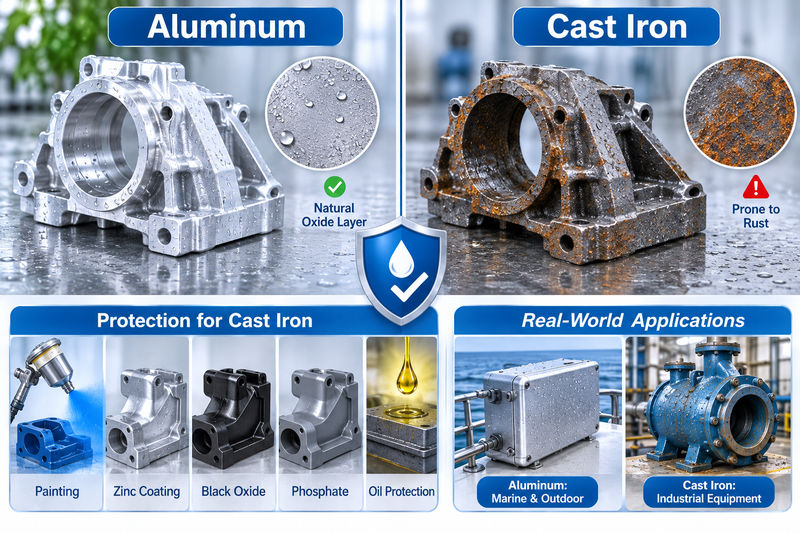
Aluminum naturally forms a thin aluminum oxide layer when exposed to air. This protective film helps prevent further oxidation and gives aluminum alloys good corrosion resistance in many environments.
For example, 5052 and 6061 aluminum are commonly considered for marine equipment housings, outdoor enclosures, and industrial brackets. Anodizing can further improve surface protection and wear performance.
Cast iron behaves differently. Because it contains a large proportion of iron, it can oxidize when exposed to moisture and oxygen. Without suitable protection, rust can gradually damage its surface and affect dimensional accuracy.
Common protective treatments for cast iron include:
- Painting and powder coating.
- Zinc-based protective coatings where suitable.
- Black oxide treatments.
- Phosphate coatings.
- Oil-based rust prevention.
For CNC machined components, special attention should be given to exposed surfaces, threaded holes, precision bores, and mating interfaces. cast iron vs aluminum
For example, a cast iron pump housing operating in a humid factory may require protective coating and regular maintenance. An aluminum housing may offer better natural corrosion resistance, although galvanic corrosion can occur when aluminum contacts dissimilar metals in the presence of an electrolyte.
Therefore, aluminum is generally preferable for lightweight components exposed to moisture, while cast iron remains suitable for protected industrial environments where structural stability and wear resistance are more important.
6. Thermal Conductivity and Heat Resistance
Thermal performance is another important difference between cast iron and aluminum.
Aluminum has significantly higher thermal conductivity than gray cast iron. Depending on the alloy, aluminum thermal conductivity commonly ranges from approximately 120 to 200 W/m·K, while gray cast iron is generally around 35–55 W/m·K.
| Thermal Property | Aluminum | Gray Cast Iron |
|---|---|---|
| Thermal conductivity | ~120–200 W/m·K | ~35–55 W/m·K |
| Specific heat capacity | ~900 J/kg·K | ~450–550 J/kg·K |
| Melting temperature | ~477–660°C, alloy-dependent | Approximately 1,150–1,250°C |
| Heat dissipation | Excellent | Moderate |
Aluminum’s high thermal conductivity makes it particularly useful for heat sinks, electronic equipment housings, motor enclosures, and cooling components.
For instance, an aluminum heat sink can transfer heat away from electronic components efficiently, helping maintain stable operating temperatures.
Cast iron has lower thermal conductivity but offers advantages in thermal mass and dimensional stability in many machinery applications. It is frequently used for engine blocks, machine bases, and industrial equipment structures.
Another important consideration is thermal expansion. Aluminum generally has a coefficient of thermal expansion around 23–24 µm/m·°C, while gray cast iron is approximately 10–12 µm/m·°C.
This means aluminum components may experience greater dimensional changes as operating temperatures fluctuate.
For precision CNC parts, this difference matters when designing bearing seats, precision bores, and components requiring tight assembly tolerances. cast iron vs aluminum
7. Wear Resistance and Vibration Damping
Cast iron has an important advantage in applications involving continuous vibration, friction, and mechanical wear.
Gray cast iron contains graphite flakes distributed throughout its metal matrix. These graphite structures help absorb vibration and can provide beneficial lubrication characteristics under certain sliding conditions.
This makes gray cast iron particularly suitable for:
- CNC machine beds and bases.
- Industrial gearbox housings.
- Engine cylinder blocks.
- Heavy-duty equipment frames.
- Sliding machine components.
Aluminum is lighter and easier to machine, but many aluminum alloys have relatively low surface hardness compared with cast iron.
When aluminum components experience repeated friction or contact with harder materials, surface wear can become a concern.
However, aluminum’s wear resistance can be improved through surface treatments such as hard anodizing. This creates a harder aluminum oxide layer that improves surface durability, although coating thickness and dimensional changes must be considered.
For example, an aluminum robotic arm housing may benefit from hard anodizing, while a heavy-duty machine guide structure may be better manufactured from cast iron.
The correct choice depends on the contact pressure, lubrication conditions, sliding speed, and expected service life rather than material hardness alone.
8. CNC Machinability and Manufacturing Performance
From a CNC machining perspective, aluminum is generally easier and faster to machine than cast iron. However, both materials have specific machining characteristics that affect tooling selection, cutting parameters, surface quality, and production costs.
CNC Machining Aluminum
Aluminum alloys are widely used in CNC milling and turning because of their relatively good machinability.
Common machining operations include:
- CNC milling of mounting brackets and housings.
- CNC turning of shafts and cylindrical components.
- Drilling and tapping of threaded holes.
- Precision boring of bearing seats.
- Pocket milling and complex contour machining.
Sharp carbide cutting tools are commonly used for aluminum. High cutting speeds, suitable feed rates, and effective chip evacuation help achieve good surface finishes and high production efficiency.
However, aluminum can adhere to cutting edges, causing built-up edge (BUE). This problem becomes more noticeable when using unsuitable tool geometry, dull cutting edges, or incorrect cutting parameters.
Thin-wall aluminum components also require careful fixture design because clamping forces and machining heat can cause deformation.
CNC Machining Cast Iron
Cast iron produces different machining conditions.
Gray cast iron typically generates short, brittle chips, making chip control relatively straightforward. However, graphite, hard carbides, and casting inclusions can contribute to abrasive tool wear.
Carbide inserts are commonly used for milling and turning cast iron. Depending on the grade and machining operation, dry machining is often practical because cast iron cutting can produce fine dust and short chips.
Important machining considerations include:
- Selecting wear-resistant cutting tools.
- Maintaining sufficient machine rigidity.
- Controlling abrasive tool wear.
- Managing casting sand and hard inclusions.
- Inspecting machined surfaces for casting defects.
CNC Machining Comparison
| CNC Factor | Aluminum | Cast Iron |
|---|---|---|
| Machining speed | Generally higher | Generally lower |
| Cutting force | Usually lower | Generally higher |
| Tool wear | Relatively low, alloy-dependent | Can be abrasive |
| Chip formation | Continuous or fragmented | Usually short and brittle |
| Surface finish | Excellent with suitable tooling | Good with suitable tooling |
| Cutting fluid | Commonly used | Dry machining often practical |
| Machining difficulty | Low to moderate | Grade-dependent |
A useful reference comes from published machinability ratings based on AISI 1212 free-cutting steel at 100%. In one industry reference, 6061 aluminum is rated at approximately 200%, compared with approximately 48–73% for the listed gray cast iron grades. These figures are reference-specific rather than universal machining performance guarantees.
iscar.co.za+2
For manufacturers, the practical conclusion is that aluminum often allows shorter machining cycles, while cast iron requires greater attention to tool wear, machine rigidity, and dust management.
9. Surface Finishing and Post-Processing
Surface finishing affects not only appearance but also corrosion resistance, wear performance, assembly accuracy, and component service life.
Aluminum offers a relatively wide range of finishing options.
| Finishing Method | Aluminum | Cast Iron |
|---|---|---|
| Anodizing | Yes | No |
| Hard anodizing | Yes | No |
| Powder coating | Yes | Yes |
| Painting | Yes | Yes |
| Sandblasting | Yes | Yes |
| Polishing | Yes | Yes |
| Black oxide | Not a standard aluminum treatment | Yes |
| Phosphate coating | Specialized conversion processes | Commonly used |
Anodizing is one of the most popular finishing processes for CNC aluminum parts. It improves surface corrosion resistance and can provide different colors, including black, clear, red, and blue.
Hard anodizing is especially useful for components requiring improved surface hardness and abrasion resistance.
Cast iron components are more commonly finished through painting, powder coating, phosphate treatment, or other corrosion protection processes.
For precision parts, finishing allowances must be considered before machining. For example, anodizing adds a surface oxide layer, which can affect hole diameters, threads, and mating dimensions.
If a CNC-machined aluminum housing requires tight-fitting bearings, critical bearing seats may need masking or post-finishing machining to maintain the required dimensions.
10. Cost Comparison and Manufacturing Economics
The cost difference between cast iron and aluminum cannot be determined by raw material price alone.
Cast iron is often economical for large, heavy components because its casting processes are well established and its raw material costs are generally competitive.
Aluminum may have a higher material cost per kilogram, but its low density means significantly less material is required to produce a component of the same volume.
Several factors influence the final manufacturing cost:
- Raw material grade and availability.
- Casting method and tooling investment.
- CNC machining time.
- Cutting tool consumption.
- Surface finishing requirements.
- Inspection and quality control.
- Transportation and long-term maintenance.
Consider a production project requiring 1,000 equipment housings.
If the housings are relatively large and require vibration damping, cast iron may offer a cost-effective solution because it can be cast into near-net shapes before CNC finishing.
If the same housings must be lightweight and easy to transport, aluminum may provide better overall value despite potentially higher material costs.
Production volume also matters. Sand casting may be economical for certain low- to medium-volume components, while die casting can become attractive for high-volume aluminum production when tooling costs are justified.
For CNC machining projects, buyers should compare the complete quotation rather than simply comparing the price per kilogram of each metal.
11. Applications and How to Choose the Right Material
Cast iron and aluminum are both widely used in industrial manufacturing, but their applications differ according to mechanical requirements and operating conditions.
Common Applications of Cast Iron
Cast iron is particularly suitable for components requiring high stiffness, vibration damping, compressive strength, and wear resistance.
Typical applications include:
- Automotive: Engine blocks, brake discs, transmission housings, and cylinder liners.
- Industrial Machinery: Machine tool bases, gearbox housings, pump bodies, and heavy equipment frames.
- Agricultural Equipment: Heavy-duty machine components and structural housings.
- Manufacturing Equipment: Press frames, machine supports, and vibration-sensitive structures.
For example, gray cast iron is frequently used in CNC machine bases because its vibration damping characteristics help reduce unwanted movement during high-speed machining.
Common Applications of Aluminum
Aluminum is preferred when weight reduction, corrosion resistance, and efficient heat dissipation are important.
Typical applications include:
- Aerospace: Structural brackets, equipment housings, and lightweight support components.
- Automotive: Engine covers, transmission housings, and suspension components.
- Robotics: Robotic arm structures, mounting brackets, and precision housings.
- Electronics: Heat sinks, electronic enclosures, and thermal management components.
- Medical Equipment: Lightweight instrument housings and equipment frames.
For example, 6061-T6 aluminum is a common choice for CNC-machined robotic mounting brackets because it provides a practical balance of strength, weight, machinability, and corrosion resistance.
Cast Iron vs Aluminum: Which Material Should You Choose?
The following decision table provides a practical starting point for material selection.
| Application Requirement | Recommended Material | Main Reason |
|---|---|---|
| Lightweight components | Aluminum | Low density |
| Machine bases | Cast Iron | Vibration damping |
| Heat sinks | Aluminum | High thermal conductivity |
| Heavy-duty housings | Cast Iron | Mass and structural stability |
| Aerospace components | Aluminum | High strength-to-weight ratio |
| Corrosion-resistant enclosures | Aluminum | Protective oxide layer |
| Abrasion-resistant components | Cast Iron | Wear-resistant grades |
| Robotic structures | Aluminum | Reduced moving mass |
| Precision machine frames | Cast Iron | Excellent damping |
| High-volume lightweight housings | Cast Aluminum | Near-net-shape production |
Ultimately, there is no universally superior material. Engineers should evaluate the actual operating loads, environmental conditions, dimensional requirements, production volume, and manufacturing budget before making a final decision.
Conclusion: Choose the Right Material for Your CNC Machined Parts with Xavier
Cast iron and aluminum offer different advantages in modern manufacturing. Cast iron is an excellent choice for heavy-duty components requiring vibration damping, compressive strength, and wear resistance. Aluminum is more suitable for applications where lightweight construction, corrosion resistance, thermal conductivity, and machining efficiency are priorities.
For CNC machining projects, selecting the correct material is only the first step. Machining accuracy, cutting tool selection, fixture design, surface finishing, and inspection procedures are equally important for achieving consistent component quality.
Xavier is a China-based CNC machining manufacturer providing custom CNC machining and precision metal component manufacturing services for international B2B customers.
Our manufacturing capabilities support different materials, including aluminum alloys, cast iron, stainless steel, alloy steel, brass, copper, and titanium. Whether you need CNC milling, CNC turning, precision boring, drilling, or customized surface finishing, our team can help evaluate material suitability and manufacturing requirements.
We work with customers on prototypes, low-volume production, and repeat manufacturing projects, focusing on dimensional accuracy, reliable quality, and practical manufacturing costs.
Need custom cast iron or aluminum CNC machined parts?
Send your 2D drawings, 3D CAD files, material specifications, and quantity requirements to Xavier. Our engineering team can help you evaluate the appropriate material, machining process, and finishing solution for your project.
Contact Xavier today to request a CNC machining quote and turn your design into precision-engineered components.
As an integrated CNC machining manufacturer and trading company, Xavier specializes in custom CNC machining and the production of precision metal components for global customers. We offer professional machining solutions for a wide range of materials and applications, including CNC machining PEEK, CNC titanium machining, and CNC brass machining, as well as alloy steel, aluminum, bronze, copper, Inconel, Invar 36, mild steel, stainless steel, tool steel, ABS, FR4, G-10, nylon, PEI, PET, PMMA (acrylic), polycarbonate, polyethylene, polypropylene, POM (acetal), PPSU, PTFE, and PVC. Our custom-machined components serve a variety of industries, including robotics, aerospace, marine engineering, automotive manufacturing, and medical equipment, while meeting the requirements of precision components and complex industrial applications.
As an experienced CNC PEEK machining manufacturer, we provide high-volume CNC titanium machining services. Contact us today to inquire about CNC brass machining prices. Feel free to get in touch with Xavier for professional machining support and a competitive quotation.
Some of the images and text in this article are collected and compiled from the internet. If there is anything inappropriate, please contact us for processing.