
1. CNC Machined Drone Parts and Their Functions
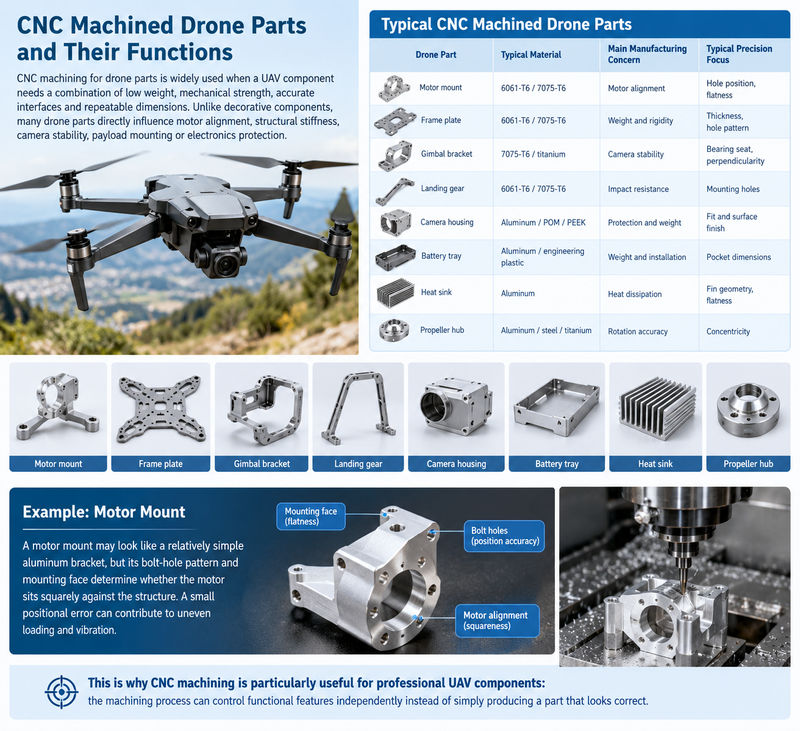
CNC machining for drone parts is widely used when a UAV component needs a combination of low weight, mechanical strength, accurate interfaces and repeatable dimensions. Unlike decorative components, many drone parts directly influence motor alignment, structural stiffness, camera stability, payload mounting or electronics protection.
Typical CNC machined drone parts include frame plates, motor mounts, arm connectors, propeller adapters, landing gear brackets, gimbal housings, camera mounts, battery trays, heat sinks, sensor brackets and electronic enclosures.
| Drone Part | Typical Material | Main Manufacturing Concern | Typical Precision Focus |
|---|---|---|---|
| Motor mount | 6061-T6 / 7075-T6 | Motor alignment | Hole position, flatness |
| Frame plate | 6061-T6 / 7075-T6 | Weight and rigidity | Thickness, hole pattern |
| Gimbal bracket | 7075-T6 / titanium | Camera stability | Bearing seat, perpendicularity |
| Landing gear | 6061-T6 / 7075-T6 | Impact resistance | Mounting holes |
| Camera housing | Aluminum / POM / PEEK | Protection and weight | Fit and surface finish |
| Battery tray | Aluminum / engineering plastic | Weight and installation | Pocket dimensions |
| Heat sink | Aluminum | Heat dissipation | Fin geometry, flatness |
| Propeller hub | Aluminum / steel / titanium | Rotation accuracy | Concentricity |
For example, a motor mount may look like a relatively simple aluminum bracket, but its bolt-hole pattern and mounting face determine whether the motor sits squarely against the structure. A small positional error can contribute to uneven loading and vibration.
This is why CNC machining is particularly useful for professional UAV components: the machining process can control functional features independently instead of simply producing a part that looks correct.
2. Choosing the Right Material for CNC Drone Parts
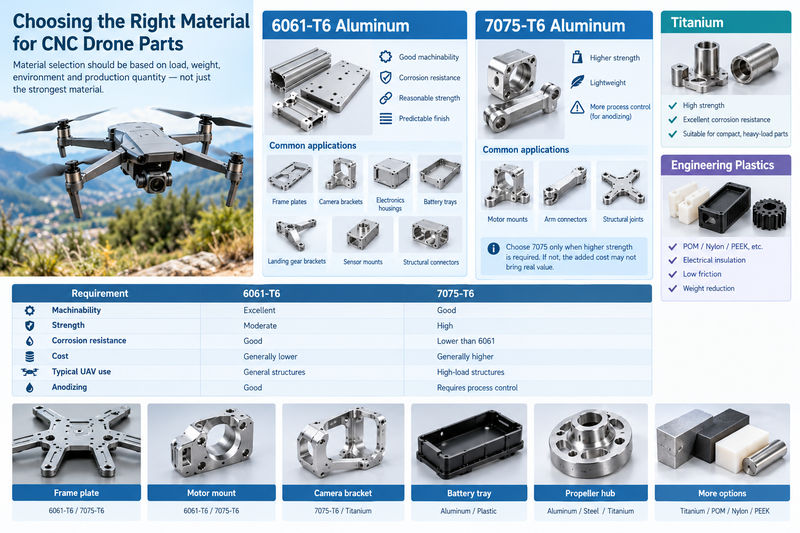
Material selection should begin with the actual load, weight, operating environment and production quantity rather than simply choosing the strongest material available.
6061-T6 Aluminum
6061-T6 is one of the most practical materials for CNC machined drone components. It offers good machinability, corrosion resistance, reasonable strength and relatively predictable finishing behavior.
It is suitable for:
- Frame plates
- Camera brackets
- Electronics housings
- Battery trays
- Landing gear brackets
- Sensor mounts
- Structural connectors
For prototypes and medium-load applications, 6061-T6 can provide an excellent balance between machining cost and mechanical performance.
7075-T6 Aluminum
7075-T6 is more appropriate when strength-to-weight performance becomes a major design requirement. It is frequently considered for highly loaded motor mounts, arm connectors, structural joints and other performance-oriented UAV components.
The important point is that 7075 should not automatically replace 6061. If the part does not require the additional strength, the higher material and processing cost may provide little practical benefit.
| Requirement | 6061-T6 | 7075-T6 |
|---|---|---|
| Machinability | Excellent | Good |
| Strength | Moderate | High |
| Corrosion resistance | Good | Lower than 6061 |
| Cost | Generally lower | Generally higher |
| Typical UAV use | General structures | High-load structures |
| Anodizing | Good | Requires process control |
Titanium can be considered for compact, heavily loaded components where strength and corrosion resistance justify its higher material and machining cost. POM, nylon, PEEK and other engineering plastics can also be useful where electrical insulation, low friction or weight reduction is more important than maximum structural stiffness.
3. Tolerances and GD&T for Drone Components
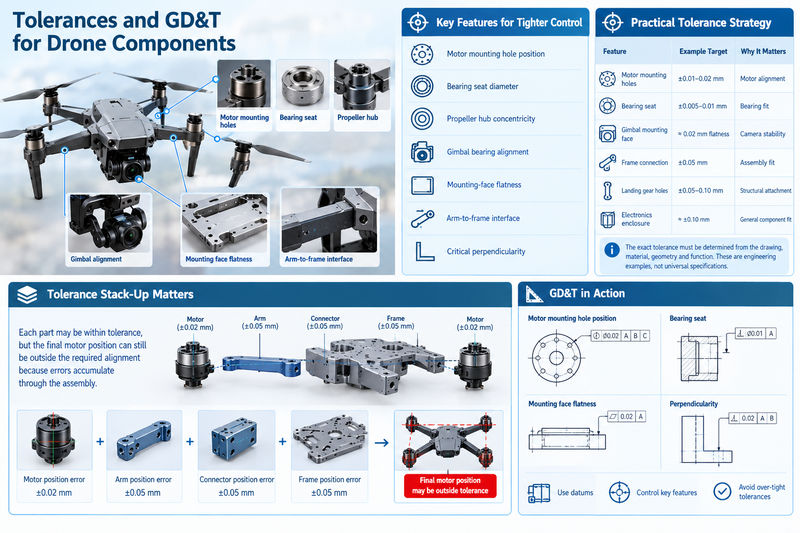
One of the most common mistakes in CNC drone part design is specifying an extremely tight tolerance on every dimension.
A better approach is to identify the features that actually affect flight performance and assembly.
For example, the following features may deserve tighter control:
- Motor mounting hole position
- Bearing seat diameter
- Propeller hub concentricity
- Gimbal bearing alignment
- Mounting-face flatness
- Arm-to-frame interface
- Critical perpendicularity
A practical tolerance strategy could look like this:
| Feature | Example Target | Why It Matters |
|---|---|---|
| Motor mounting holes | ±0.01–0.02 mm | Motor alignment |
| Bearing seat | ±0.005–0.01 mm | Bearing fit |
| Gimbal mounting face | Around 0.02 mm flatness | Camera stability |
| Frame connection | ±0.05 mm | Assembly fit |
| Landing gear holes | ±0.05–0.10 mm | Structural attachment |
| Electronics enclosure | Around ±0.10 mm | General component fit |
The exact tolerance must always be determined from the drawing, material, geometry and function. These figures should be treated as engineering examples rather than universal specifications.
Tolerance Stack-Up Matters
Suppose a drone arm connects to a central frame using an aluminum connector. The connector may be within tolerance, the frame may be within tolerance and the motor mount may also be within tolerance. Yet the final motor position can still be outside the required alignment because each positional error accumulates through the assembly.
For this reason, professional drone designs should identify datums and control the critical interfaces using appropriate GD&T rather than simply placing ±0.01 mm on every dimension.
4. Lightweight and Thin-Wall CNC Machining
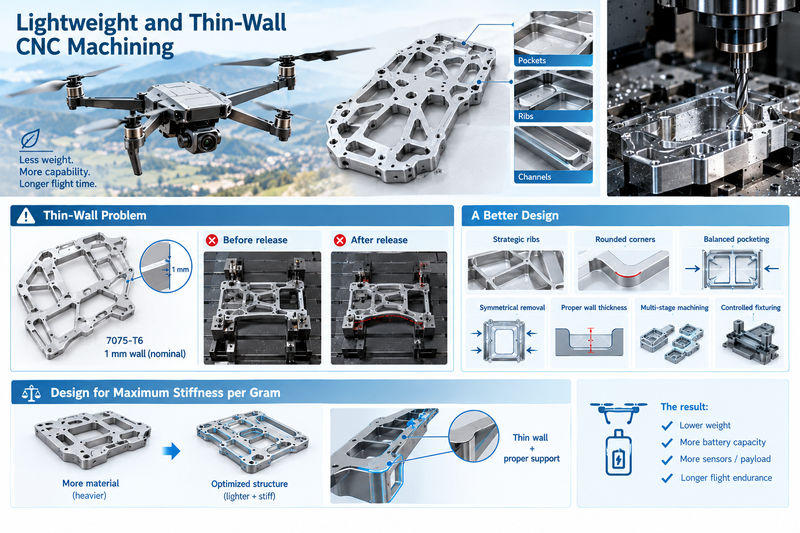
Every gram matters in a flying platform. Removing unnecessary material can create room for additional battery capacity, sensors or payload while potentially improving flight endurance.
CNC machining is particularly useful because material can be removed selectively through pockets, ribs, channels and optimized wall structures.
However, making a part thinner is not the same as making it better.
A thin aluminum wall can deform during machining because the cutting force is no longer supported by enough surrounding material. The part may measure correctly while clamped and then move after it is released.
Example of a Thin-Wall Problem
Consider a 7075-T6 frame plate with a nominal wall thickness of 1 mm. If large pockets are machined around the perimeter without sufficient ribs, the remaining structure may spring after unclamping.
A better design may use:
- Strategic ribs
- Rounded internal corners
- Balanced pocketing
- Symmetrical material removal
- Appropriate wall thickness
- Multiple machining stages
- Controlled fixturing
For complex UAV structures, the objective should be maximum stiffness per gram, not simply minimum material volume.
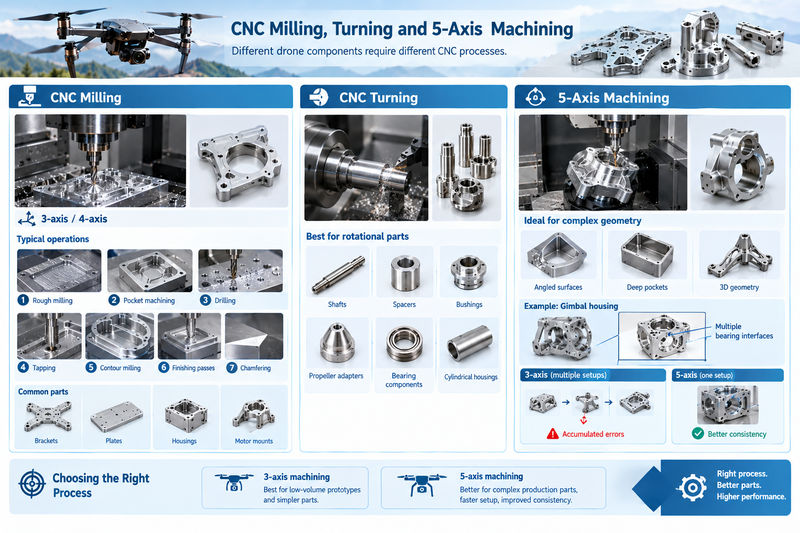
5. CNC Milling, Turning and 5-Axis Machining
Different drone components require different CNC processes.
CNC Milling
3-axis and 4-axis milling are suitable for many brackets, plates, housings, motor mounts and structural components.
Typical operations include:
- Rough milling
- Pocket machining
- Drilling
- Tapping
- Contour milling
- Finishing passes
- Chamfering
CNC Turning
Turning becomes important when the component is rotational, such as:
- Shafts
- Spacers
- Bushings
- Propeller adapters
- Bearing components
- Cylindrical housings
5-Axis CNC Machining
5-axis machining becomes valuable when the drone part contains multiple angled surfaces, deep pockets or complex three-dimensional geometry.
For example, a gimbal housing may require several angular bearing interfaces. Producing these features through multiple 3-axis setups can introduce accumulated fixture errors. A 5-axis process can reduce the number of setups and maintain relationships between critical features.
For low-volume prototypes, 3-axis machining may be the most economical option. For complex production components, 5-axis machining can reduce setup time and improve geometric consistency.
6. Surface Finishing for CNC Drone Parts
Surface finishing affects more than appearance.
For aluminum UAV parts, anodizing can improve surface protection and provide a controlled appearance. Hard anodizing can be considered for components exposed to repeated contact or wear.
Common finishes include:
| Finish | Main Purpose | Typical Application |
|---|---|---|
| Type II anodizing | Corrosion protection and appearance | Frames, brackets |
| Type III hard anodizing | Wear resistance | Motor mounts, interfaces |
| Bead blasting | Uniform matte appearance | Housings, visible parts |
| Polishing | Smooth appearance | Selected cosmetic components |
| Passivation | Corrosion protection for stainless steel | Stainless components |
| Electroless nickel | Wear/corrosion protection | Precision mechanical parts |
Finish thickness also needs to be considered during design. If a tight hole or bearing seat is anodized without accounting for coating buildup, the final fit may change.
For critical fits, the machining allowance and finishing process should therefore be considered together rather than treating surface treatment as a completely separate operation.
7. Vibration, Alignment and Thermal Management
A drone operates in an environment where vibration is unavoidable. The engineering goal is to prevent manufacturing errors from adding unnecessary vibration.
Motor mounts are particularly important because the motor rotates at high speed. A mounting surface that is not sufficiently flat or a hole pattern that is not correctly positioned can influence motor alignment.
Propeller hubs require even greater attention to concentricity because rotational imbalance can generate vibration continuously.
Gimbal components present another challenge. A camera may be perfectly calibrated electronically, but mechanical misalignment can still affect the final image.
Thermal Management
Electronics, motors and power systems also generate heat.
Aluminum CNC machining allows manufacturers to integrate cooling features directly into the component. A heat sink can include thin fins, mounting surfaces and optimized channels in one machined component.
For example, an aluminum electronics housing can simultaneously function as:
- Protective enclosure
- Structural component
- Heat spreader
- Mounting platform
This multifunctional approach can reduce the number of separate components and save weight.
8. Inspection and Quality Control
A CNC-machined drone component should not be judged only by whether it visually matches the 3D model.
Inspection should focus on functional characteristics.
Common inspection equipment includes:
- CMM
- Height gauge
- Micrometer
- Vernier caliper
- Bore gauge
- Pin gauges
- Optical measurement equipment
- Surface roughness tester
A CMM is especially useful when a component contains multiple datums and positional relationships.
For example, a motor mount may require verification of:
- Overall dimensions
- Mounting face flatness
- Hole diameter
- Hole position
- Hole-to-face relationship
- Perpendicularity
- Critical thickness
For production orders, first-article inspection is useful before releasing the complete batch. This allows manufacturing problems to be discovered while only a small number of parts have been produced.
Batch consistency is equally important. A prototype that works perfectly does not automatically guarantee that 500 production parts will have identical dimensional performance.
9. CNC Drone Part Cost, Prototypes and Production
The price of a CNC drone component is determined by more than the raw material.
The major cost factors usually include:
| Cost Factor | Influence on Price |
|---|---|
| Material | Aluminum is generally economical; titanium costs substantially more |
| Machining time | More pockets and complex geometry increase cycle time |
| Number of setups | Multiple setups increase labor and alignment requirements |
| Tolerance | Tight tolerances require slower machining and more inspection |
| Surface finish | Additional processing adds cost |
| Inspection | CMM and detailed reports increase inspection time |
| Quantity | Larger batches distribute programming and setup costs |
| Material removal | Large billet-to-part ratios increase material waste |
A prototype may require only 5–10 pieces, while production quantities may reach hundreds or thousands.
For example, if a frame plate requires extensive pocketing from a large billet, the raw material utilization can become an important cost factor. Redesigning the blank size or changing the manufacturing approach may reduce total cost without changing the final function.
The best RFQ therefore does not simply ask, “What is your price?” It should ask the manufacturer to identify opportunities to reduce machining time while maintaining the required performance.
10. DFM and Choosing a CNC Manufacturer for Drone Parts
Good CNC drone manufacturing starts before the machine is turned on.
A supplier should review the design for manufacturability and identify problems such as:
- Extremely thin walls
- Deep narrow pockets
- Sharp internal corners
- Unnecessary ultra-tight tolerances
- Difficult tool access
- Poor datum selection
- Uncontrolled coating thickness
- Difficult inspection features
For example, if a pocket has a very small internal radius, a small cutting tool may be required. That can dramatically increase machining time compared with using a larger tool and modifying the radius slightly.
A simple DFM change can therefore have a meaningful impact on both price and lead time.
What to Include in an RFQ
A professional CNC drone parts RFQ should ideally include:
- 2D engineering drawing
- 3D CAD model
- Material grade
- Quantity
- Critical tolerances
- GD&T requirements
- Surface finish
- Anodizing or coating requirements
- Inspection requirements
- Packaging requirements
- Delivery target
If a component has a critical feature, identify it clearly instead of expecting the supplier to guess which dimensions are important.
Why Choose Xavier for CNC Machining for Drone Parts?
For UAV manufacturers, the objective is not simply to purchase a machined aluminum part. The real objective is to obtain a component that fits correctly, maintains its geometry during assembly and performs consistently after repeated flight cycles.
Xavier provides custom CNC machining for drone and UAV components, supporting aluminum, stainless steel, titanium, brass, engineering plastics and other production materials. Our machining capabilities can be applied to motor mounts, drone frames, gimbal brackets, landing gear, camera mounts, sensor housings, battery trays, heat sinks and other custom components.
For projects where weight, strength and dimensional accuracy must be balanced, our engineering team can review the drawing before production and recommend practical changes to material, tolerances, machining strategy or surface treatment.
Whether you need a few prototype components or repeat production quantities, the most efficient way to begin is to provide your 3D CAD model, 2D drawing, material and quantity. Xavier can then evaluate the design, machining process and inspection requirements before quotation.
If you are looking for reliable CNC machining for drone parts, send your drawings to Xavier and let our engineering team help turn your UAV design into production-ready components.
We are an integrated CNC machining manufacturer and trading company specializing in CNC machining services, with a primary focus on CNC contract manufacturing and precision machining of various metal parts. We also provide professional CNC anodizing surface finishing, CNC electroless nickel surface finishing, and CNC electrogalvanizing surface finishing to meet different performance and appearance requirements.
We are a CNC anodizing surface finishing manufacturer offering reliable CNC electroless nickel surface finishing services. Contact us to discuss your CNC electrogalvanizing surface finishing pricing and project requirements.
Some of the images and text in this article are collected and compiled from the internet. If there is anything inappropriate, please contact us for processing.