
10 key points from this article:
Aluminium vs Titanium: Basic Material Differences
Density, Weight and Strength-to-Weight Ratio
Tensile Strength, Yield Strength and Stiffness
Thermal Conductivity and Temperature Performance
Corrosion Resistance and Chemical Environment
CNC Machinability and Cutting Behavior
Tool Wear, Coolant and Surface Finish
Material and CNC Machining Cost
Aluminium vs Titanium Applications
How to Choose the Right Material for CNC Machined Parts
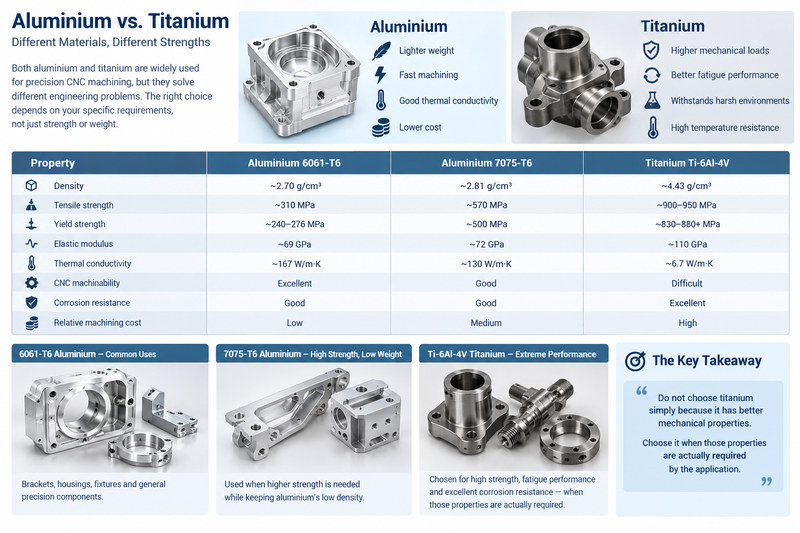
When engineers compare aluminium and titanium for a machined component, the decision is rarely as simple as asking which metal is stronger or lighter. Both are widely used for precision CNC machining, but they solve different engineering problems.
Aluminium is generally selected when low weight, fast machining, good thermal conductivity and reasonable cost are important. Titanium is selected when the component must withstand higher mechanical loads, fatigue, aggressive environments or elevated temperatures.
For CNC machining, three materials are particularly useful for a practical comparison: 6061-T6 aluminium, 7075-T6 aluminium and Ti-6Al-4V titanium.
| Property | Aluminium 6061-T6 | Aluminium 7075-T6 | Titanium Ti-6Al-4V |
|---|---|---|---|
| Density | ~2.70 g/cm³ | ~2.81 g/cm³ | ~4.43 g/cm³ |
| Tensile strength | ~310 MPa | ~570 MPa | ~900–950 MPa |
| Yield strength | ~240–276 MPa | ~500 MPa | ~830–880+ MPa |
| Elastic modulus | ~69 GPa | ~72 GPa | ~110 GPa |
| Thermal conductivity | ~167 W/m·K | ~130 W/m·K | ~6.7 W/m·K |
| CNC machinability | Excellent | Good | Difficult |
| Corrosion resistance | Good | Good | Excellent |
| Relative machining cost | Low | Medium | High |
These figures explain why the materials are used differently. 6061-T6 is often the practical choice for brackets, housings, fixtures and general precision components. 7075-T6 provides a significant strength increase while retaining aluminium’s low density. Ti-6Al-4V goes further in strength, fatigue performance and corrosion resistance, but with considerably higher machining difficulty and cost.
A useful rule is therefore: do not choose titanium simply because it has better mechanical properties. Choose it when those properties are actually required by the application.
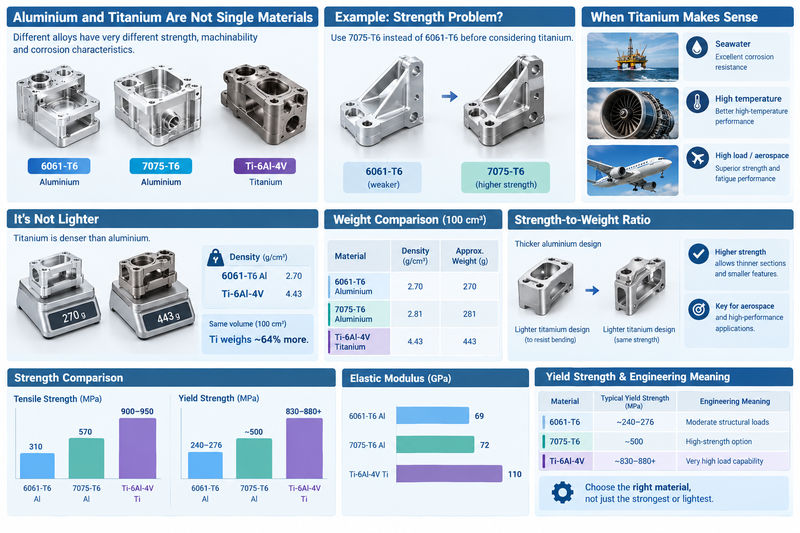
“Aluminium” is not one material, and “titanium” is not one material either. A drawing specifying only “aluminium” or “titanium” may be insufficient for production because different alloys can have substantially different strength, machinability and corrosion characteristics.
For example, replacing 6061-T6 with 7075-T6 may solve a strength problem without requiring a switch to titanium. Conversely, if a part operates in seawater, high-temperature environments or highly loaded aerospace structures, Ti-6Al-4V may provide advantages that aluminium cannot economically reproduce through simple geometry changes.
One of the most common misunderstandings is that titanium is lighter than aluminium. It is not.
Titanium has a density of approximately 4.43 g/cm³, while 6061-T6 aluminium is approximately 2.70 g/cm³. In an identical geometry, the titanium component will therefore weigh roughly 64% more.
For example, imagine a simple CNC-machined bracket with a finished volume of 100 cm³:
| Material | Approximate Density | Approximate Part Weight |
|---|---|---|
| 6061-T6 Aluminium | 2.70 g/cm³ | 270 g |
| 7075-T6 Aluminium | 2.81 g/cm³ | 281 g |
| Ti-6Al-4V | 4.43 g/cm³ | 443 g |
So why is titanium considered a lightweight engineering material?
The answer is strength-to-weight ratio.
If a component needs to carry a very high load, the designer may reduce the cross-sectional area of a titanium component while maintaining the required strength. The final titanium design can therefore become competitive in weight even though titanium itself is denser.
This distinction is extremely important in aerospace and high-performance applications.
Suppose an aluminium mounting bracket requires a relatively thick section to resist bending. An engineer might consider 7075-T6 instead of 6061-T6 before moving to titanium.
If the required load is still too high, a Ti-6Al-4V design may allow thinner load-bearing sections or smaller structural features.
However, this only makes sense if the structural requirement justifies the additional machining and material cost. For a lightly loaded enclosure bracket, using titanium would usually add cost without providing a useful engineering benefit.
Strength is one of the clearest areas where titanium outperforms conventional aluminium alloys.
Typical Ti-6Al-4V tensile strength is around 900–950 MPa, while 6061-T6 is around 310 MPa and 7075-T6 is around 570 MPa. The exact value depends on material specification, heat treatment and product form.
Yield strength is equally important because it tells the engineer approximately how much stress the material can withstand before permanent deformation begins.
| Material | Typical Yield Strength | Engineering Meaning |
|---|---|---|
| 6061-T6 | ~240–276 MPa | Suitable for moderate structural loads |
| 7075-T6 | ~500 MPa | High-strength aluminium option |
| Ti-6Al-4V | ~830–880+ MPa | Very high load capability |
Titanium also has a significantly higher elastic modulus, around 110 GPa, compared with approximately 69–72 GPa for common aluminium alloys.
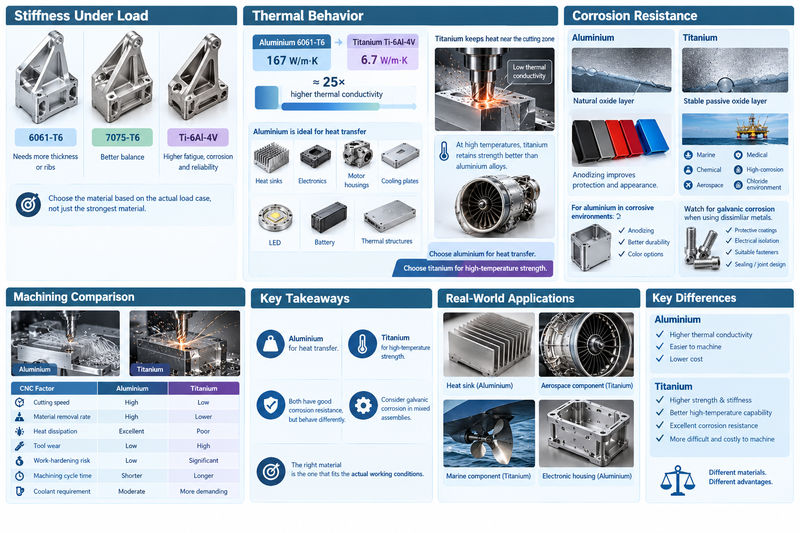
That means titanium is stiffer under the same loading condition.
Consider a CNC-machined aerospace mounting component subjected to repeated vibration and high mechanical loads. A 6061-T6 design may require additional material thickness, ribs or reinforcement.
Switching to 7075-T6 may provide a better balance.
If the part also requires exceptional fatigue performance, corrosion resistance and high structural reliability, Ti-6Al-4V becomes more attractive.
The important point is that the material should be selected according to the actual load case, rather than simply selecting the strongest material available.
Thermal behavior creates one of the biggest differences between aluminium and titanium.
6061-T6 aluminium has thermal conductivity around 167 W/m·K, while Ti-6Al-4V is only around 6.7 W/m·K. In other words, aluminium can conduct heat roughly 25 times more effectively.
This makes aluminium an excellent material for components that must transfer or dissipate heat.
Typical examples include:
- Heat sinks
- Electronic housings
- Motor housings
- Cooling plates
- LED components
- Battery components
- Thermal management structures
Titanium behaves very differently.
Its low thermal conductivity means that heat generated during CNC cutting tends to remain concentrated near the cutting zone instead of quickly moving through the workpiece.
The advantage changes when the component itself operates at elevated temperatures.
Aluminium alloys lose mechanical performance as temperature rises, whereas titanium alloys can retain useful strength at significantly higher temperatures.
For example, an aerospace component exposed to sustained elevated temperatures may exceed the practical operating range of a conventional aluminium alloy. In that situation, titanium’s higher-temperature capability can justify its additional cost.
Therefore:
Choose aluminium for heat transfer. Choose titanium when structural performance at elevated temperature is more important than heat dissipation.
Both aluminium and titanium have good corrosion resistance, but their behavior is not identical.
Aluminium naturally develops a thin oxide layer that protects the underlying metal. Anodizing can further improve surface protection, hardness and appearance.
Titanium forms a highly stable passive oxide layer and is particularly resistant to many aggressive environments.
This makes titanium attractive for:
- Marine components
- Chemical processing equipment
- Aerospace components
- Medical components
- High-corrosion environments
- Components exposed to chloride-containing environments
However, aluminium should not automatically be considered unsuitable for corrosive applications. Alloy selection and surface treatment can make a major difference.
For example, a CNC-machined 6061 aluminium enclosure can be anodized to provide improved surface durability and corrosion protection while also giving the customer options for black, natural, red, blue and other finishes.
When aluminium and titanium are assembled together, engineers should also consider galvanic corrosion.
If two dissimilar conductive metals are electrically connected in the presence of an electrolyte such as saltwater or condensation, galvanic effects can occur.
The solution may involve:
- Protective coatings
- Electrical isolation
- Suitable fasteners
- Controlled joint design
- Environmental sealing
This becomes particularly important in marine and aerospace assemblies.
For CNC manufacturers, this is where aluminium and titanium become dramatically different.
Aluminium is relatively easy to machine because it has high thermal conductivity, relatively low hardness and generally allows high cutting speeds.
Titanium is much more demanding.
Its low thermal conductivity concentrates cutting heat near the tool. It also has a relatively low elastic modulus compared with many steels, which can contribute to deflection and vibration under unsuitable machining conditions.
Titanium can also work-harden if the cutting tool rubs instead of cutting properly. A worn tool or an incorrect feed can therefore make the next machining pass more difficult.
| CNC Factor | Aluminium | Titanium |
|---|---|---|
| Cutting speed | High | Low |
| Material removal rate | High | Lower |
| Heat dissipation | Excellent | Poor |
| Tool wear | Relatively low | High |
| Work-hardening risk | Low | Significant |
| Machining cycle time | Shorter | Longer |
| Coolant requirement | Moderate | More demanding |
Recent CNC machining comparisons commonly report several-times-longer machining cycles for titanium compared with aluminium, although the actual difference depends heavily on geometry, tooling, machine capability and tolerances.
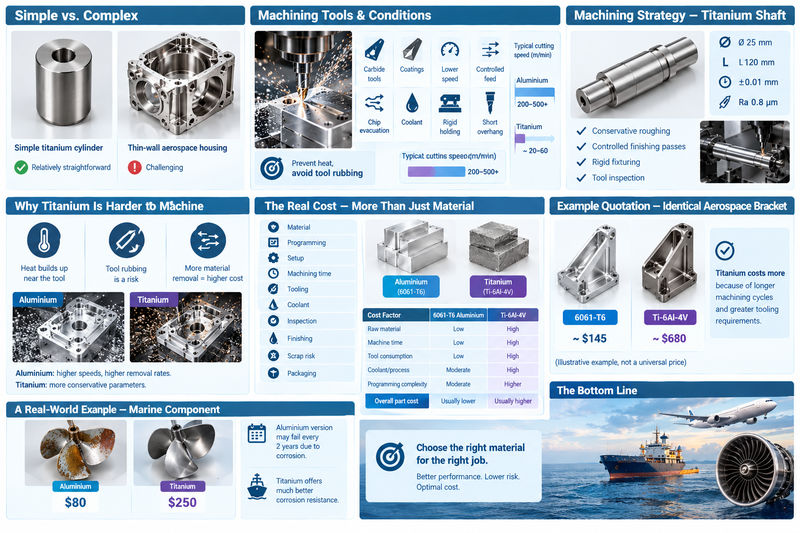
A simple titanium cylinder may be relatively straightforward to machine.
A thin-wall aerospace housing with deep pockets, small internal radii and tight positional tolerances is a completely different job.
The more material that must be removed, the more titanium’s poor machinability affects the final price.
For this reason, titanium parts benefit significantly from manufacturability-oriented design.
Titanium machining requires much more attention to cutting conditions than aluminium machining.
The primary objective is to prevent excessive heat and avoid tool rubbing.
In titanium machining, manufacturers commonly use:
- Carbide cutting tools
- Appropriate tool coatings
- Lower cutting speeds
- Controlled feed rates
- Strong chip evacuation
- High-performance coolant delivery
- Rigid workholding
- Short tool overhangs
Published machining comparisons show titanium cutting speeds can be dramatically lower than those used for aluminium, with some references reporting titanium around tens of metres per minute versus several hundred metres per minute or more for aluminium under suitable conditions. Actual parameters must always be determined from the specific alloy, tool manufacturer and machine.
Suppose a customer requests a titanium shaft with:
- Diameter: 25 mm
- Length: 120 mm
- Tolerance: ±0.01 mm
- Surface roughness: Ra 0.8 μm
The machining strategy cannot simply copy the process used for a 6061 aluminium shaft.
The titanium part may require more conservative roughing, controlled finishing passes, rigid fixturing and careful tool inspection.
For aluminium, the same geometry may be completed much faster because the machine can generally operate at higher cutting speeds and material removal rates.
Cost is usually where the aluminium-versus-titanium decision becomes very practical.
Titanium can be substantially more expensive than aluminium as raw material, but raw material is only part of the total CNC cost.
The final quotation can include:
Material + programming + setup + machining time + tooling + coolant + inspection + finishing + scrap risk + packaging
Titanium increases several of these costs simultaneously.
A recent CNC comparison gives an example of an identical aerospace bracket costing approximately $145 in 6061-T6 aluminium versus $680 in Ti-6Al-4V, mainly because of the longer machining cycle and greater tooling requirements. This should be treated as an illustrative manufacturing example rather than a universal price.
A simplified comparison can look like this:
| Cost Factor | 6061-T6 Aluminium | Ti-6Al-4V |
|---|---|---|
| Raw material | Low | High |
| Machine time | Low | High |
| Tool consumption | Low | High |
| Coolant/process requirements | Moderate | High |
| Programming complexity | Moderate | Higher |
| Overall part cost | Usually lower | Usually higher |
Imagine a marine component that fails every two years because of corrosion.
An aluminium version may initially cost $80 per component, while a titanium version costs $250.
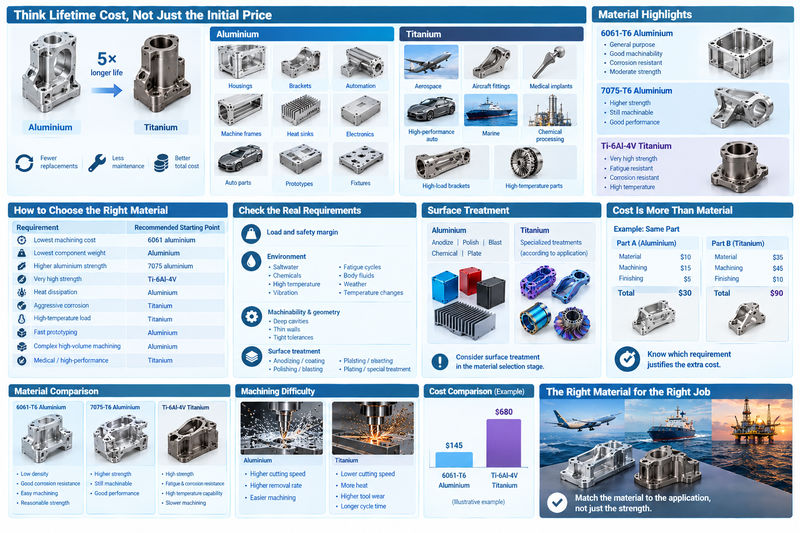
If the titanium component lasts five times longer and eliminates frequent replacement and maintenance, its higher purchase price may become economically reasonable.
This is why engineers should evaluate lifetime cost, not only the initial CNC quotation.
The application often gives the clearest answer.
Aluminium is particularly suitable for:
- CNC housings
- Robotics brackets
- Automation components
- Machine frames
- Heat sinks
- Electronic enclosures
- Automotive components
- Prototypes
- Fixtures and tooling
- Lightweight structural parts
6061-T6 is a particularly useful general-purpose CNC material because it combines availability, machinability, corrosion resistance and moderate strength.
7075-T6 becomes more attractive when higher strength is required without moving to titanium.
Titanium is more commonly justified for:
- Aerospace structural components
- Aircraft fittings
- Medical implants and surgical components
- High-performance automotive components
- Marine components
- Chemical processing components
- High-load brackets
- High-temperature structural parts
The common factor is that these applications often need a combination of strength, corrosion resistance, fatigue performance, temperature resistance or biocompatibility.
The best material is not automatically the strongest material.
A practical CNC material-selection process should start with the part’s operating requirements.
| Requirement | Recommended Starting Point |
|---|---|
| Lowest machining cost | 6061 aluminium |
| Lowest component weight | Aluminium |
| Higher aluminium strength | 7075 aluminium |
| Very high strength | Ti-6Al-4V |
| Heat dissipation | Aluminium |
| Aggressive corrosion | Titanium |
| High-temperature structural load | Titanium |
| Fast prototyping | Aluminium |
| Complex high-volume machining | Aluminium |
| Medical/high-performance applications | Titanium, depending on specification |
Calculate or estimate tensile, compressive, bending and fatigue loads.
If 6061-T6 already provides sufficient safety margin, there may be little reason to upgrade to titanium.
If the design is approaching the limits of 6061, consider 7075-T6 before automatically moving to titanium.
Ask whether the component will encounter:
- Saltwater
- Chemicals
- High temperature
- Repeated vibration
- High fatigue cycles
- Body-fluid exposure
- Outdoor weather
- Large temperature changes
These environmental conditions can significantly change the material decision.
A material that looks perfect on a datasheet can become expensive when the geometry is difficult to machine.
For example, a titanium component with deep cavities, thin walls and tight tolerances may require multiple setups and extended finishing operations.
If an aluminium alternative can meet the mechanical requirements, it may provide substantially better production economics.
Aluminium can be anodized, polished, blasted, chemically treated or plated depending on the required appearance and performance.
Titanium can also receive specialized surface treatments, but the selection depends heavily on the application.
The surface treatment should therefore be considered during material selection rather than added at the end of the design process.
The cheapest raw material does not always create the cheapest finished component.
For example:
Part A: $10 aluminium material + $15 machining + $5 finishing = $30
Part B: $35 titanium material + $45 machining + $10 finishing = $90
Even if titanium provides superior performance, the customer should be able to identify exactly which requirement justifies the additional $60.
That is the correct way to approach aluminium versus titanium selection.
For most general CNC machined parts, aluminium is the more economical starting point. 6061-T6 provides an excellent combination of low density, good corrosion resistance, easy machining and reasonable strength, while 7075-T6 is a stronger alternative when the application demands more mechanical performance.
Titanium, especially Ti-6Al-4V, becomes valuable when the component requires substantially higher strength, fatigue resistance, corrosion resistance or temperature capability. Its higher material price and slower machining speed should be accepted only when these properties provide a genuine engineering advantage. Current industry comparisons consistently show that titanium’s premium comes not only from material cost but also from machining time, tooling consumption and thermal-management requirements.
At Xavier, material selection is considered together with part geometry, tolerance, machining process, surface finish, production quantity and application requirements. Whether you need CNC aluminum parts, 6061-T6 or 7075-T6 components, titanium CNC machining, precision turned parts, milled components or complex multi-axis parts, the goal is not simply to manufacture the strongest possible component. The goal is to produce the right material and the right machining process at a practical cost while meeting the required dimensional and performance specifications.
If you are comparing aluminium and titanium for a new CNC component, providing the 3D CAD model, 2D drawing, material requirement, quantity, tolerance and surface finish allows the manufacturing team to evaluate the most suitable production route before machining begins.
We are an integrated CNC machining manufacturer and trading company specializing in CNC outsourcing and the machining of various metal and plastic components. We support CNC machining PEEK, CNC machining aluminum, and CNC machining stainless steel, as well as a wide range of other materials, including alloy steel, brass, bronze, copper, Inconel, Invar 36, mild steel, titanium, tool steel, ABS, FR4, G-10, nylon, PEI, PET, PMMA (acrylic), polycarbonate, polyethylene, polypropylene, POM (acetal), PPSU, PTFE, and PVC. Our CNC machining capabilities are suitable for producing robotics components, aerospace parts, marine components, automotive parts, medical components, and other precision-machined parts.
As a CNC PEEK machining manufacturer, we provide CNC machining aluminum services for different production requirements. If you need a quotation, please contact us to discuss CNC machining stainless steel pricing and your specific project requirements.
Some of the images and text in this article are collected and compiled from the internet. If there is anything inappropriate, please contact us for processing.