
Different Types of Fasteners: A Practical Guide to Fastener Types, Materials, Applications, and Selection
Fasteners are small components, but they have a major influence on the strength, reliability, serviceability, and manufacturing cost of a mechanical assembly. In CNC machining, fasteners are not limited to standard bolts and screws. Depending on the joint design, engineers may use nuts, washers, studs, rivets, pins, threaded inserts, retaining components, or custom-machined fastening hardware.
The most useful way to understand the different types of fasteners is to classify them according to how they create a joint, whether the joint is removable, what loads the fastener must withstand, and how the fastener interacts with the mating components. Common industrial references consistently identify bolts, screws, nuts, washers, rivets, pins, and anchors as major fastener categories, while more specialized systems include studs, threaded inserts, spacers, and retaining hardware.
Five Key Topics for Understanding Different Types of Fasteners
1. Fastener Classification: Bolts, Screws, Nuts, Washers, Rivets, Pins, and More
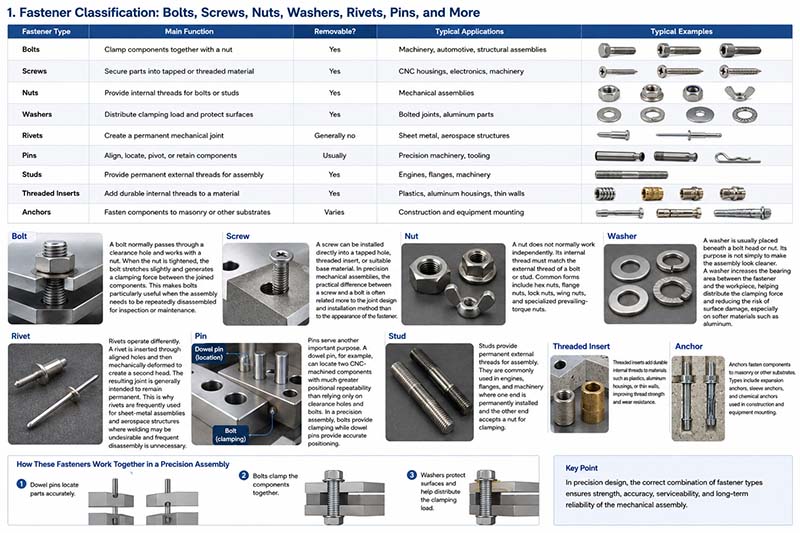
Fasteners can first be divided according to their basic mechanical function. This classification is more useful for engineering than simply grouping parts by appearance.
| Fastener Type | Main Function | Removable? | Typical Applications |
|---|---|---|---|
| Bolts | Clamp components together with a nut | Yes | Machinery, automotive, structural assemblies |
| Screws | Secure parts into tapped or threaded material | Yes | CNC housings, electronics, machinery |
| Nuts | Provide internal threads for bolts or studs | Yes | Mechanical assemblies |
| Washers | Distribute clamping load and protect surfaces | Yes | Bolted joints, aluminum parts |
| Rivets | Create a permanent mechanical joint | Generally no | Sheet metal, aerospace structures |
| Pins | Align, locate, pivot, or retain components | Usually | Precision machinery, tooling |
| Studs | Provide permanent external threads for assembly | Yes | Engines, flanges, machinery |
| Threaded Inserts | Add durable internal threads to a material | Yes | Plastics, aluminum housings, thin walls |
| Anchors | Fasten components to masonry or other substrates | Varies | Construction and equipment mounting |
A bolt normally passes through a clearance hole and works with a nut. When the nut is tightened, the bolt stretches slightly and generates a clamping force between the joined components. This makes bolts particularly useful when the assembly needs to be repeatedly disassembled for inspection or maintenance.
A screw can be installed directly into a tapped hole, threaded insert, or suitable base material. In precision mechanical assemblies, the practical difference between a screw and a bolt is often related more to the joint design and installation method than to the appearance of the fastener. Engineering references commonly describe bolts as fasteners used with nuts, while screws can engage threads in the mating component.
A nut does not normally work independently. Its internal thread must match the external thread of a bolt or stud. Common forms include hex nuts, flange nuts, lock nuts, wing nuts, and specialized prevailing-torque nuts.
A washer is usually placed beneath a bolt head or nut. Its purpose is not simply to make the assembly look cleaner. A washer increases the bearing area between the fastener and the workpiece, helping distribute the clamping force and reducing the risk of surface damage. This becomes particularly important when fastening softer materials such as aluminum.
Rivets operate differently. A rivet is inserted through aligned holes and then mechanically deformed to create a second head. The resulting joint is generally intended to remain permanent. This is why rivets are frequently used for sheet-metal assemblies and aerospace structures where welding may be undesirable and frequent disassembly is unnecessary.
Pins serve another important purpose. A dowel pin, for example, can locate two CNC-machined components with much greater positional repeatability than relying only on clearance holes and bolts. In a precision assembly, bolts provide clamping while dowel pins provide accurate positioning.
2. Bolts vs. Screws vs. Studs: Choosing the Right Threaded Fastener
Threaded fasteners are among the most frequently used components in CNC-machined assemblies. Although bolts, screws, and studs may look similar, their mechanical roles can be substantially different.
Bolts
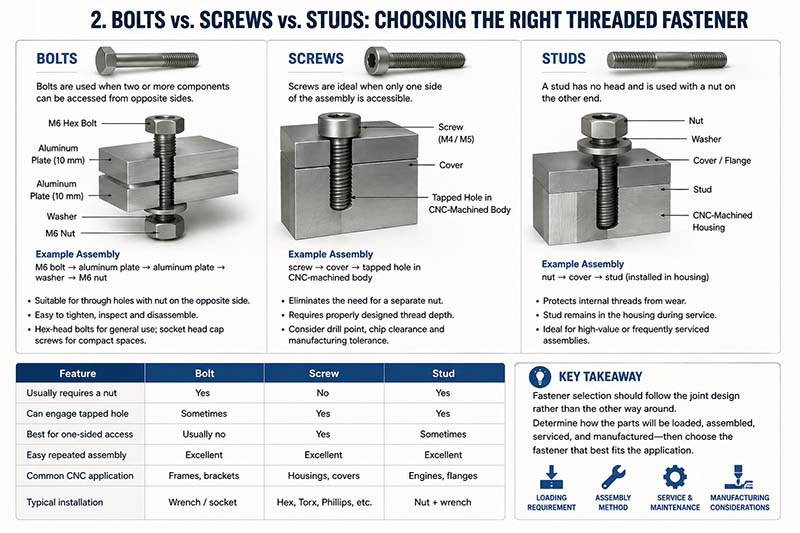
Bolts are particularly useful when two or more components can be accessed from opposite sides.
For example, imagine two CNC-machined aluminum plates, each 10 mm thick, that need to be assembled into a rigid frame. A typical design could use an M6 bolt passing through a clearance hole in the first plate and a nut on the opposite side.
A simplified joint might look like:
M6 bolt → aluminum plate → aluminum plate → washer → M6 nut
The advantage is straightforward: the joint can be tightened, inspected, and disassembled without damaging the machined components.
Hex-head bolts are convenient when sufficient wrench clearance is available. Socket head cap screws are often better when the assembly is compact because the hexagonal socket allows the tool to access the fastener from a relatively small area.
Screws
Screws are especially useful when only one side of the assembly is accessible.
Consider a CNC-machined enclosure made from 6061 aluminum. Instead of drilling completely through the enclosure and installing nuts, the designer can machine M4 or M5 tapped holes directly into one component.
The assembly becomes:
screw → cover → tapped hole in CNC-machined body
This eliminates the separate nut and can reduce assembly space.
For CNC machining, thread depth is an important design consideration. If an M6 × 1.0 screw is used, the designer should not assume that making the hole only slightly deeper than the screw engagement is sufficient. Additional depth may be required for the drill point, chip clearance, and manufacturing tolerance.
Studs
A stud has external threads but no conventional head. One end can remain installed in a component while a nut is used on the other end.
Studs are valuable when repeated assembly and disassembly could otherwise damage the internal threads of an expensive component.
For example, an aluminum housing may use steel studs. The stud remains installed while the cover is removed repeatedly using a nut. This can protect the aluminum housing from repeated thread wear.
Practical Comparison
| Feature | Bolt | Screw | Stud |
|---|---|---|---|
| Usually requires a nut | Yes | No | Yes |
| Can engage tapped hole | Sometimes | Yes | Yes |
| Best for one-sided access | Usually no | Yes | Sometimes |
| Easy repeated assembly | Excellent | Excellent | Excellent |
| Common CNC application | Frames, brackets | Housings, covers | Engines, flanges |
| Typical installation | Wrench/socket | Hex, Torx, Phillips, etc. | Nut + wrench |
The key point is that fastener selection should follow the joint design rather than the other way around. A designer should first determine how the parts will be loaded, assembled, serviced, and manufactured.
3. Nuts, Washers, Rivets, Pins, and Inserts: Supporting Fasteners That Solve Specific Problems
Not every fastening problem can be solved with a conventional bolt and nut. Supporting fasteners often determine whether a joint remains reliable after thousands of assembly cycles.
Nuts and Locking Methods
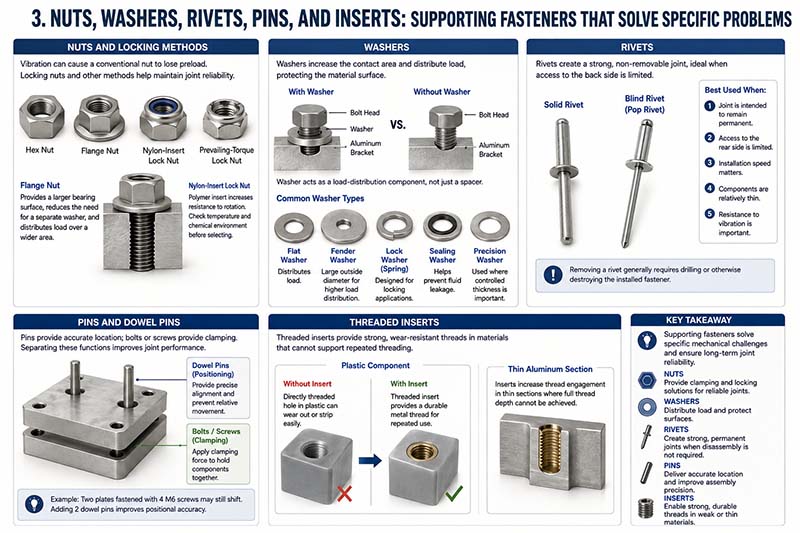
A standard hex nut is appropriate for many general-purpose assemblies, but vibration can cause a conventional nut to lose preload if the joint is not properly designed.
For vibration-sensitive applications, engineers may select lock nuts, prevailing-torque nuts, flange nuts, or other locking systems.
A flange nut incorporates a larger bearing surface beneath the nut. This can reduce the need for a separate washer and distribute the load over a wider area.
A nylon-insert lock nut uses a polymer insert to increase resistance to rotation. However, the temperature and chemical environment must be checked before selecting this type because the polymer component does not have the same temperature resistance as an all-metal fastener.
Washers
Washers are often underestimated during fastener selection.
Suppose an M8 bolt is tightened against a relatively soft aluminum surface. The bolt head has a limited bearing area. Concentrated contact pressure can mark or deform the aluminum.
Adding a suitable washer increases the contact area.
For example:
Bolt head → washer → aluminum bracket
instead of:
Bolt head → aluminum bracket
The washer therefore acts as a load-distribution component rather than simply as a spacer.
Different washer designs serve different purposes:
- Flat washers distribute load.
- Fender washers provide a particularly large outside diameter.
- Lock washers are designed for specific locking applications.
- Sealing washers can help prevent fluid leakage.
- Precision washers can be used where controlled thickness is important.
Rivets
Rivets are a strong option when the joint does not need routine disassembly.
For example, two sheet-metal panels may be joined using aluminum or steel blind rivets. A blind rivet is especially useful when the installer cannot reach the back side of the joint.
The major difference from a bolt is serviceability. Removing a rivet generally requires drilling or otherwise destroying the installed fastener.
This makes rivets particularly suitable for applications where:
- The joint is intended to remain permanent.
- Access to the rear side is limited.
- Installation speed matters.
- The components are relatively thin.
- Resistance to vibration is important.
Pins and Dowel Pins
Pins are especially important in CNC machining because they can provide accurate component location.
Imagine two machined plates that are fastened with four M6 screws. The screws clamp the plates together, but the clearance between the screws and holes may allow some positional movement.
Adding two precision dowel pins changes the function of the joint:
Dowel pins → positioning
Bolts/screws → clamping
This separation of functions is a common and effective mechanical design approach.
Threaded Inserts
Threaded inserts are particularly useful when the base material cannot reliably support repeated threading.
A common example is a plastic CNC-machined component. Cutting an M4 thread directly into a thin plastic wall may result in poor thread durability. A threaded insert can provide a stronger and more wear-resistant internal thread.
Inserts are also useful in thin aluminum sections where sufficient thread engagement cannot be achieved.
4. Fastener Materials, Strength, Corrosion Resistance, and Surface Finishes
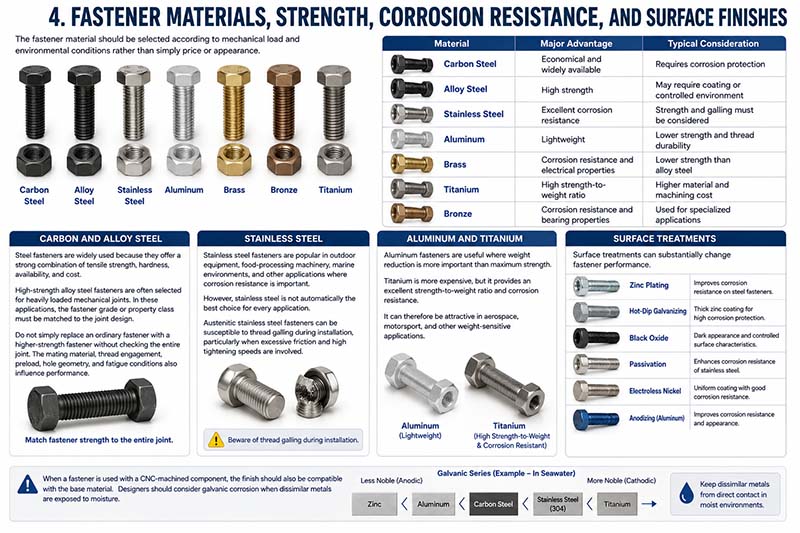
The fastener material should be selected according to mechanical load and environmental conditions rather than simply price or appearance.
Common fastener materials include carbon steel, alloy steel, stainless steel, aluminum, brass, bronze, and titanium. Specialized industrial fasteners can also be produced from nickel-based alloys and other high-performance materials.
| Material | Major Advantage | Typical Consideration |
|---|---|---|
| Carbon Steel | Economical and widely available | Requires corrosion protection |
| Alloy Steel | High strength | May require coating or controlled environment |
| Stainless Steel | Excellent corrosion resistance | Strength and galling must be considered |
| Aluminum | Lightweight | Lower strength and thread durability |
| Brass | Corrosion resistance and electrical properties | Lower strength than alloy steel |
| Titanium | High strength-to-weight ratio | Higher material and machining cost |
| Bronze | Corrosion resistance and bearing properties | Used for specialized applications |
Carbon and Alloy Steel
Steel fasteners are widely used because they offer a strong combination of tensile strength, hardness, availability, and cost.
High-strength alloy steel fasteners are often selected for heavily loaded mechanical joints. In these applications, the fastener grade or property class must be matched to the joint design.
For example, a designer should not simply replace an ordinary fastener with a higher-strength fastener without checking the entire joint. The mating material, thread engagement, preload, hole geometry, and fatigue conditions also influence performance.
Stainless Steel
Stainless steel fasteners are popular in outdoor equipment, food-processing machinery, marine environments, and other applications where corrosion resistance is important.
However, stainless steel is not automatically the best choice for every application. Austenitic stainless steel fasteners can be susceptible to thread galling during installation, particularly when excessive friction and high tightening speeds are involved.
Aluminum and Titanium
Aluminum fasteners are useful where weight reduction is more important than maximum strength.
Titanium is more expensive, but it provides an excellent strength-to-weight ratio and corrosion resistance. It can therefore be attractive in aerospace, motorsport, and other weight-sensitive applications.
Surface Treatments
Surface treatments can substantially change fastener performance.
Common finishes include:
- Zinc plating
- Hot-dip galvanizing
- Black oxide
- Passivation
- Electroless nickel
- Anodizing for suitable aluminum fasteners
For example, zinc coatings can improve corrosion resistance on steel fasteners. Black oxide is often selected where a dark appearance and controlled surface characteristics are desired, although additional corrosion protection may be necessary depending on the environment.
When a fastener is used with a CNC-machined component, the finish should also be compatible with the base material. Designers should consider galvanic corrosion when dissimilar metals are exposed to moisture.
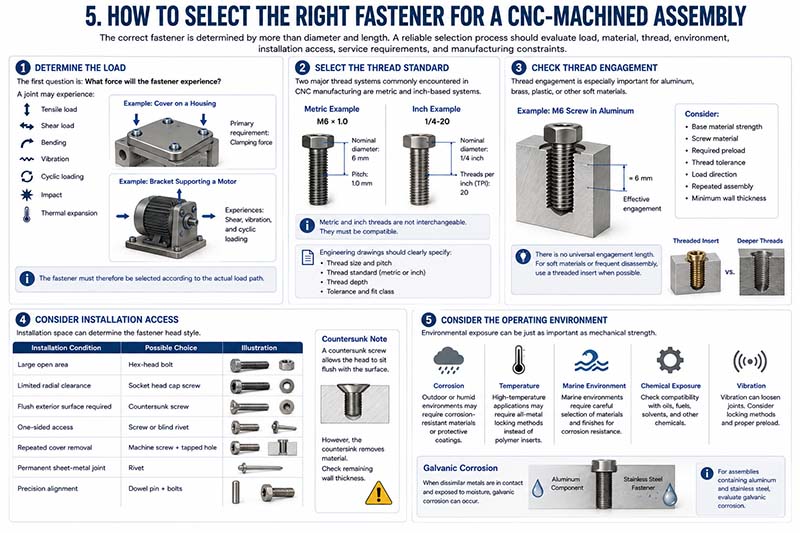
5. How to Select the Right Fastener for a CNC-Machined Assembly
The correct fastener is determined by more than diameter and length. A reliable selection process should evaluate load, material, thread, environment, installation access, service requirements, and manufacturing constraints.
Step 1: Determine the Load
The first question is: What force will the fastener experience?
A joint may experience:
- Tensile load
- Shear load
- Bending
- Vibration
- Cyclic loading
- Impact
- Thermal expansion
For example, a cover held against a housing may primarily require clamping force, while a bracket supporting a motor may experience significant shear and cyclic loading.
The fastener must therefore be selected according to the actual load path.
Step 2: Select the Thread Standard
Two major thread systems commonly encountered in CNC manufacturing are metric and inch-based systems.
Examples include:
M6 × 1.0
This indicates a nominal diameter of 6 mm and a thread pitch of 1.0 mm.
An inch example could be:
1/4-20
This indicates a nominal diameter of 1/4 inch and 20 threads per inch.
The mating components must use compatible thread specifications. A metric screw cannot simply be substituted for a similar-looking inch screw.
For CNC-machined parts, the engineering drawing should clearly specify the thread size, pitch, depth, tolerance, and thread standard when necessary.
Step 3: Check Thread Engagement
Thread engagement is especially important when the tapped component is made from aluminum, brass, plastic, or another relatively soft material.
As a simplified design example, an M6 screw with approximately 6 mm of effective engagement might be acceptable for one application, while a highly loaded joint may require a different design. There is no universal engagement length that works for every material and load condition.
The designer should consider:
- Base material strength
- Screw material
- Required preload
- Thread tolerance
- Load direction
- Repeated assembly
- Minimum wall thickness
For soft materials or frequent disassembly, a threaded insert may be preferable to simply increasing thread depth.
Step 4: Consider Installation Access
Installation space can determine the fastener head style.
| Installation Condition | Possible Choice |
|---|---|
| Large open area | Hex-head bolt |
| Limited radial clearance | Socket head cap screw |
| Flush exterior surface required | Countersunk screw |
| One-sided access | Screw or blind rivet |
| Repeated cover removal | Machine screw + tapped hole |
| Permanent sheet-metal joint | Rivet |
| Precision alignment | Dowel pin + bolts |
A countersunk screw is useful when the head must sit flush with the surrounding surface. However, the countersink removes material from the component, so the remaining wall thickness must be checked.
Step 5: Consider the Operating Environment
Environmental exposure can be just as important as mechanical strength.
A fastener used outdoors may require corrosion protection. A fastener in a high-temperature machine may need an all-metal locking method instead of a polymer-based locking component. A fastener installed in a marine environment requires particularly careful consideration of corrosion and material compatibility.
For assemblies containing aluminum and stainless steel, designers should also evaluate galvanic corrosion.
A Practical CNC Example
Consider a CNC-machined aluminum enclosure used for industrial electronics.
The enclosure has:
- 6061 aluminum body
- 4 mm aluminum cover
- Frequent maintenance access
- Moderate vibration
- Indoor industrial environment
- Eight mounting screws
A reasonable fastening strategy could be:
M4 socket head or low-profile machine screws + tapped holes + suitable washers where required
If the cover is repeatedly removed, the designer should pay particular attention to thread durability in the aluminum body. If the wall is too thin to provide adequate thread engagement, a threaded insert may be more appropriate.
If the enclosure is exposed to outdoor moisture, the designer may additionally consider stainless steel fasteners and the potential for galvanic interaction with the aluminum enclosure.
This example demonstrates why selecting a fastener is really a joint-design problem, not simply a hardware-shopping problem.
Common Fastener Selection Mistakes
Several seemingly minor mistakes can create major assembly problems.
Using the Wrong Thread Standard
An M6 × 1.0 thread and a 1/4-20 thread may appear similar at a glance, but they are not interchangeable.
Choosing a Fastener Only by Tensile Strength
A high-strength bolt does not automatically make a joint stronger. The tapped material, thread engagement, joint stiffness, preload, and failure mode must also be considered.
Ignoring the Base Material
A steel screw installed into soft aluminum can create a joint with very different behavior from a steel screw installed into a steel component.
Forgetting Installation Clearance
A fastener may technically fit the hole but still be impossible to install because a wrench, socket, or hex key cannot reach the head.
Using Permanent Fasteners Where Maintenance Is Required
Rivets can be excellent for permanent sheet-metal assemblies, but they are inconvenient if the component must be opened regularly.
Treating Washers as Optional in Every Application
A washer can significantly change bearing pressure and surface loading. This is particularly important for softer materials and larger clamping forces.
Final Thoughts
There is no single “best” fastener for every mechanical assembly. Bolts are excellent for strong, removable joints; screws simplify assemblies where tapped holes are available; nuts and washers support controlled clamping; rivets provide permanent joints; pins improve alignment and positioning; studs are valuable for repeated assembly; and threaded inserts can make otherwise weak materials suitable for repeated fastening.
For CNC-machined parts, fastener selection should be considered together with material, hole size, thread geometry, wall thickness, tolerance, surface finish, operating environment, and assembly method. This integrated approach can prevent stripped threads, loose joints, damaged surfaces, corrosion, and unnecessary manufacturing costs.
For projects requiring custom CNC machined fasteners, precision threaded components, special nuts, pins, spacers, inserts, or other customized metal parts, Xavier can help translate your drawings, CAD files, material requirements, thread specifications, and application requirements into manufacturable components. By considering both the fastening function and CNC manufacturing process from the beginning, Xavier can help you achieve accurate dimensions, reliable threads, appropriate surface finishes, and consistent production quality.
We are an integrated CNC machining manufacturer specializing in custom CNC machining and the production of various metal parts. We also support CNC anodizing surface finishing, CNC electrogalvanizing surface finishing, and CNC chemical conversion coating surface finishing.
As a CNC anodizing surface finishing manufacturer, we provide CNC electrogalvanizing surface finishing services in batches. Feel free to contact us for CNC chemical conversion coating surface finishing prices.
Some of the images and text in this article are collected and compiled from the internet. If there is anything inappropriate, please contact us for processing.