Tapped Holes in Machining: Definition, Tapping Process, Types, and Applications
Creating tapped holes is a fundamental machining operation used to form secure threaded connections between mechanical components. By cutting internal threads into a previously drilled hole, manufacturers can fasten parts with screws or bolts without requiring a separate nut. This technique, commonly known as thread tapping, is widely used in automotive, aerospace, electronics, machinery, and other manufacturing industries where reliable and accurate fastening is essential.
A machined workpiece with a drilled hole serves as the starting point for creating an internally threaded hole.
Learning how to tap a hole requires more than simply inserting a tap into a drilled opening. Machinists need to select the correct tap drill size, choose suitable thread tapping tools, prepare the hole properly, and use the correct tapping technique. Material type, hole depth, thread specifications, cutting speed, and lubrication can all affect the final result.
This guide explains what a tapped hole is, how to tap holes step by step, the advantages and disadvantages of tapped holes, their industrial applications, and important considerations for producing accurate and durable threads.
What Is a Tapped Hole in Engineering and Manufacturing?
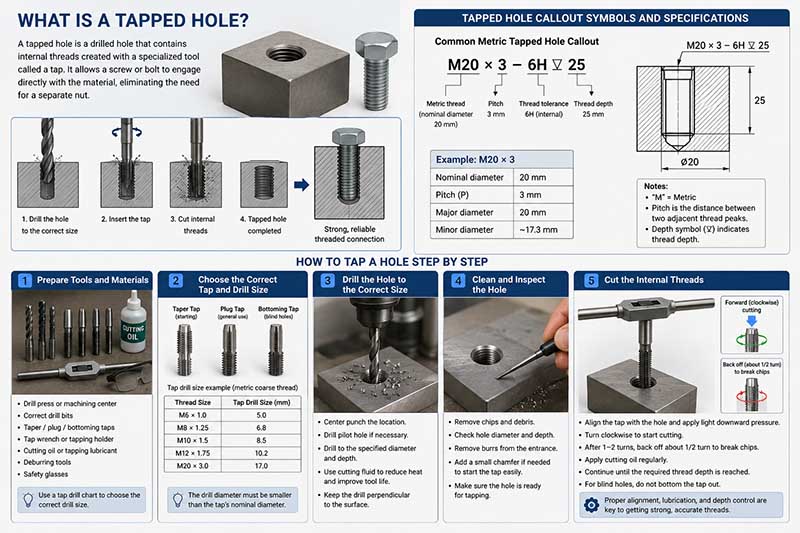
A tapped hole is a drilled hole that contains internal threads created with a specialized cutting or forming tool called a tap. The basic process starts by drilling a hole to the required diameter. A tap is then inserted into the opening to cut threads into the inner wall, creating a threaded connection for a screw or bolt.
Unlike a simple drilled hole, a tapped hole allows a fastener to engage directly with the material. This eliminates the need for a separate nut and can provide a compact and dependable fastening solution.
The tool used to create the threads is known as a tap. A typical tap resembles a hardened screw and contains straight or spiral flutes with cutting edges. As the tap rotates inside the prepared hole, these cutting edges gradually form the required thread profile.
Depending on the application, tapping can be performed manually with a tap wrench or with equipment such as a drill press, tapping machine, or CNC machining center.
Accuracy is especially important when machining tapped holes. A correctly produced thread must engage smoothly with the mating fastener while providing enough strength to withstand the forces generated during operation. Proper tap selection, accurate drilling, suitable cutting conditions, correct alignment, and sufficient lubrication all contribute to clean and reliable threads.
Tapped Hole Callout Symbols and Specifications
Engineering drawings use standardized callouts to communicate the size and specifications of a tapped hole. These symbols allow machinists and manufacturers to understand exactly how the hole should be produced.
Metric thread specifications are commonly used in engineering drawings. A typical metric callout begins with the letter “M,” followed by the nominal thread diameter and pitch. Additional information may indicate thread tolerance, hole depth, or other manufacturing requirements.
For example, M20 × 3 identifies a metric thread with a nominal diameter of 20 mm and a pitch of 3 mm. The pitch represents the distance between two adjacent thread peaks.
A properly defined tapped-hole callout removes ambiguity during manufacturing and helps ensure that the finished hole matches the intended screw or bolt. Accurate specifications are particularly important for CNC production, where even small dimensional errors can affect assembly.
How to Tap a Hole Step by Step
Creating a threaded hole requires careful preparation and controlled machining. Whether the operation is performed manually or with CNC equipment, following a systematic process helps minimize cross-threading, tap breakage, oversized holes, and other common problems.
Step 1: Prepare the Required Tools and Materials
Before beginning the tapping operation, gather all necessary equipment. Having the correct tools available prevents interruptions and helps maintain consistent machining quality.
Typical equipment includes:
- A hand drill, drill press, or machining center
- Correctly sized drill bits
- Taper, plug, or bottoming taps
- A tap wrench or suitable tapping holder
- Cutting oil or tapping lubricant
- Deburring equipment
- Safety glasses and appropriate protective equipment
A tap drill chart is useful for identifying the correct drill diameter for a particular thread specification. Choosing the right drill size is one of the most important steps in producing strong and accurate internal threads.
Step 2: Choose the Correct Tap and Drill Size
Selecting the correct tap and drill bit directly affects thread quality. Different tap designs are intended for different stages and applications.
A taper tap has a relatively long and gradual lead, making it easier to introduce into a hole and align correctly. It is often useful for starting a thread, especially in through holes.
A plug tap has a shorter taper and is commonly used as a general-purpose tapping tool. It provides a balance between easy starting and the ability to cut threads deeper into the hole.
A bottoming tap has only a short lead and is designed to produce threads close to the bottom of a blind hole.
The drill diameter must be smaller than the tap’s nominal diameter so that sufficient material remains for the tap to form the internal threads. Using an incorrect tap drill size can result in weak threads, excessive cutting force, or tap failure.
Step 3: Drill the Hole to the Correct Size
Accurate drilling provides the foundation for a successful tapping operation. Begin by identifying the exact location of the hole. A center punch can be used to create a small indentation that helps prevent the drill bit from wandering.
For larger holes, drilling a smaller pilot hole first can improve accuracy and make it easier for the larger drill to follow the intended centerline.
Select the drill diameter according to the required thread specification. When machining a blind hole, make sure the drilled depth is sufficient for the required thread length and allows enough clearance for chips and the end of the tap.
Cutting fluid can be applied during drilling to reduce heat, lower friction, and improve tool life. The drill should remain perpendicular to the workpiece surface unless the design specifically requires an angled hole.
Step 4: Clean and Inspect the Hole
After drilling, inspect the hole before beginning the tapping operation. Remove chips, debris, and loose material from inside the hole.
Check the hole diameter and depth to make sure they match the design requirements. Burrs around the opening can interfere with tap alignment, so they should be removed when necessary.
A small chamfer around the entrance of the hole can also make it easier to start the tap and reduce the likelihood of damaging the first thread.
Step 5: Cut the Internal Threads
Secure the tap firmly in a tap wrench or tapping holder. Position the tap directly above the hole and make sure it is properly aligned with the hole axis.
Apply light downward pressure while slowly turning the tap clockwise to begin cutting. Maintaining alignment at this stage is critical because a tilted tap can produce cross-threading or damage the workpiece.
Apply suitable tapping lubricant to reduce friction and heat. After approximately one or two complete turns, rotate the tap backward by about half a turn. This helps break the chips produced during cutting and allows them to escape through the tap flutes.
Continue this forward-and-reverse movement until the required thread depth is reached. When tapping a blind hole, monitor the depth carefully to prevent the tap from contacting the bottom of the hole.
Advantages and Disadvantages of Tapped Holes
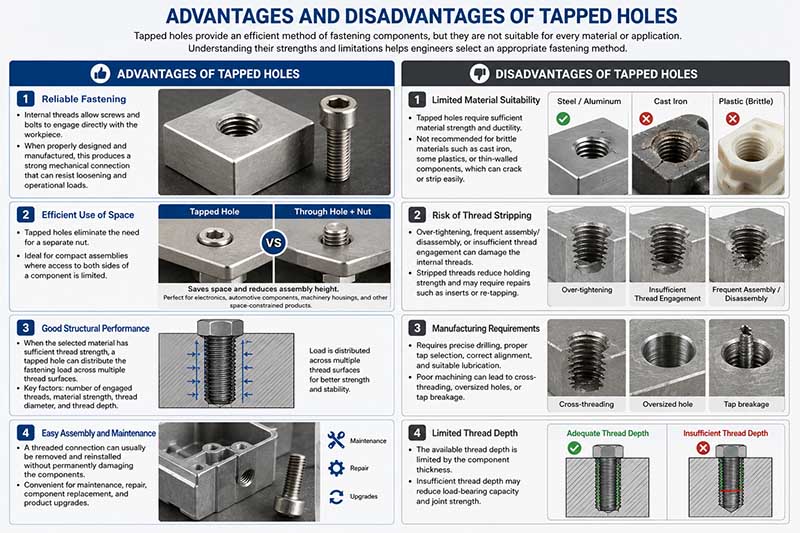
Tapped holes provide an efficient method of fastening components, but they are not suitable for every material or application. Understanding their strengths and limitations helps engineers select an appropriate fastening method.
Advantages of Tapped Holes
1. Reliable Fastening
Internal threads allow screws and bolts to engage directly with the workpiece. When properly designed and manufactured, this produces a strong mechanical connection that can resist loosening and operational loads.
2. Efficient Use of Space
One major benefit of tapped holes is that they eliminate the need for a separate nut. This makes them especially useful in compact assemblies where access to both sides of a component is limited.
Electronics, automotive components, machinery housings, and other space-constrained products can benefit from this design.
3. Good Structural Performance
When the selected material has sufficient thread strength, a tapped hole can distribute the fastening load across multiple thread surfaces. This can provide good structural integrity and reduce localized stress.
The number of engaged threads, material strength, thread diameter, and thread depth should all be considered when designing a threaded connection.
4. Easy Assembly and Maintenance
A threaded connection can usually be removed and reinstalled without permanently damaging the components. This makes tapped holes convenient for maintenance, repair, component replacement, and product upgrades.
Disadvantages of Tapped Holes
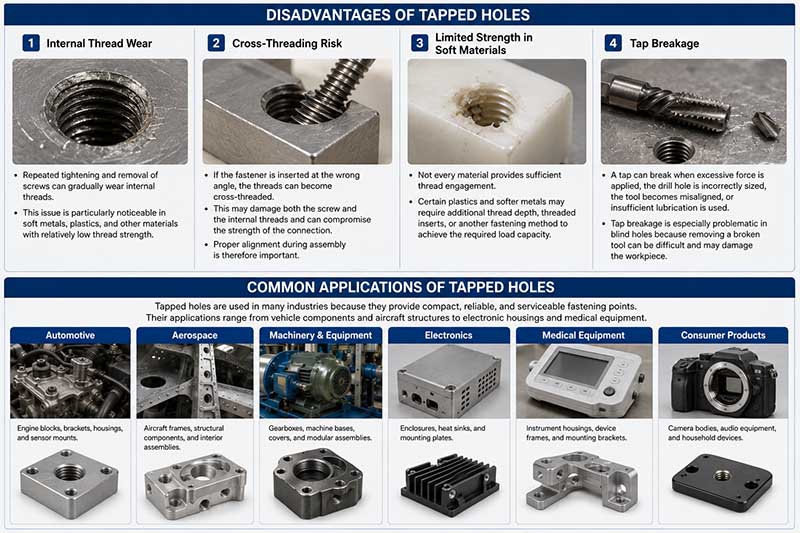
1. Internal Thread Wear
Repeated tightening and removal of screws can gradually wear internal threads. This issue is particularly noticeable in soft metals, plastics, and other materials with relatively low thread strength.
2. Cross-Threading Risk
If the fastener is inserted at the wrong angle, the threads can become cross-threaded. This may damage both the screw and the internal threads and can compromise the strength of the connection.
Proper alignment during assembly is therefore important.
3. Limited Strength in Soft Materials
Not every material provides sufficient thread engagement. Certain plastics and softer metals may require additional thread depth, threaded inserts, or another fastening method to achieve the required load capacity.
4. Tap Breakage
A tap can break when excessive force is applied, the drill hole is incorrectly sized, the tool becomes misaligned, or insufficient lubrication is used. Tap breakage is especially problematic in blind holes because removing a broken tool can be difficult and may damage the workpiece.
Common Applications of Tapped Holes
Tapped holes are used in many industries because they provide compact, reliable, and serviceable fastening points. Their applications range from vehicle components and aircraft structures to electronic housings and medical equipment.
Automotive Manufacturing
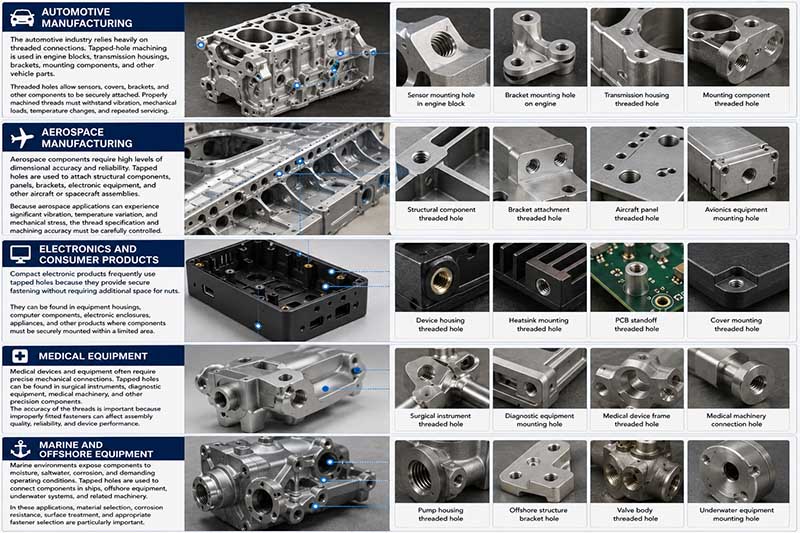
The automotive industry relies heavily on threaded connections. Tapped-hole machining is used in engine blocks, transmission housings, brackets, mounting components, and other vehicle parts.
Threaded holes allow sensors, covers, brackets, and other components to be securely attached. Properly machined threads must withstand vibration, mechanical loads, temperature changes, and repeated servicing.
Aerospace Manufacturing
Aerospace components require high levels of dimensional accuracy and reliability. Tapped holes are used to attach structural components, panels, brackets, electronic equipment, and other aircraft or spacecraft assemblies.
Because aerospace applications can experience significant vibration, temperature variation, and mechanical stress, the thread specification and machining accuracy must be carefully controlled.
Electronics and Consumer Products
Compact electronic products frequently use tapped holes because they provide secure fastening without requiring additional space for nuts.
They can be found in equipment housings, computer components, electronic enclosures, appliances, and other products where components must be securely mounted within a limited area.
Medical Equipment
Medical devices and equipment often require precise mechanical connections. Tapped holes can be found in surgical instruments, diagnostic equipment, medical machinery, and other precision components.
The accuracy of the threads is important because improperly fitted fasteners can affect assembly quality, reliability, and device performance.
Marine and Offshore Equipment
Marine environments expose components to moisture, saltwater, corrosion, and demanding operating conditions. Tapped holes are used to connect components in ships, offshore equipment, underwater systems, and related machinery.
In these applications, material selection, corrosion resistance, surface treatment, and appropriate fastener selection are particularly important.
Important Considerations and Tips for Machining Tapped Holes
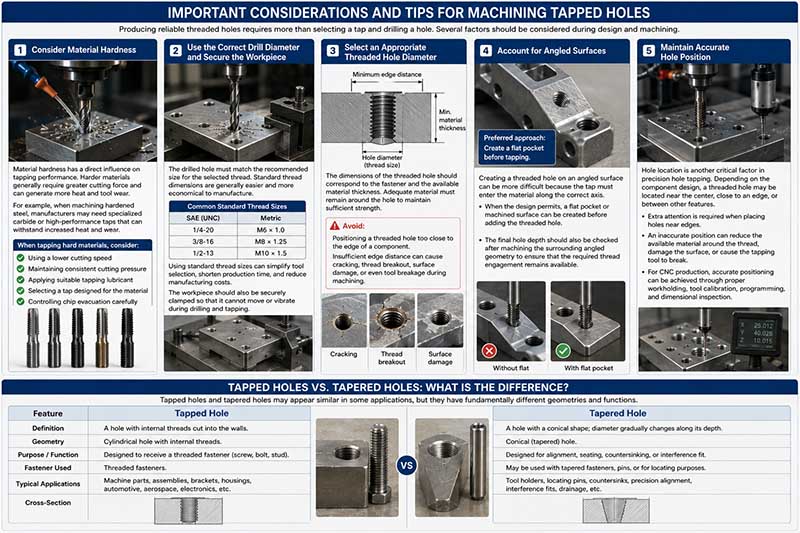
Producing reliable threaded holes requires more than selecting a tap and drilling a hole. Several factors should be considered during design and machining.
Consider Material Hardness
Material hardness has a direct influence on tapping performance. Harder materials generally require greater cutting force and can generate more heat and tool wear.
For example, when machining hardened steel, manufacturers may need specialized carbide or high-performance taps that can withstand increased heat and wear.
When tapping hard materials, consider:
- Using a lower cutting speed
- Maintaining consistent cutting pressure
- Applying suitable tapping lubricant
- Selecting a tap designed for the material
- Controlling chip evacuation carefully
Use the Correct Drill Diameter and Secure the Workpiece
The drilled hole must match the recommended size for the selected thread. Standard thread dimensions are generally easier and more economical to manufacture.
Common examples include 1/4-20, 3/8-16, M6 × 1.0, M8 × 1.25, and M10 × 1.5.
Using standard thread sizes can simplify tool selection, shorten production time, and reduce manufacturing costs. The workpiece should also be securely clamped so that it cannot move or vibrate during drilling and tapping.
Select an Appropriate Threaded Hole Diameter
The dimensions of the threaded hole should correspond to the fastener and the available material thickness. Adequate material must remain around the hole to maintain sufficient strength.
Avoid positioning a threaded hole too close to the edge of a component. Insufficient edge distance can cause cracking, thread breakout, surface damage, or even tool breakage during machining.
Account for Angled Surfaces
Creating a threaded hole on an angled surface can be more difficult because the tap must enter the material along the correct axis.
When the design permits, a flat pocket or machined surface can be created before adding the threaded hole. This provides a stable surface for drilling and tapping.
The final hole depth should also be checked after machining the surrounding angled geometry to ensure that the required thread engagement remains available.
Maintain Accurate Hole Position
Hole location is another critical factor in precision hole tapping. Depending on the component design, a threaded hole may be located near the center, close to an edge, or between other features.
Extra attention is required when placing holes near edges. An inaccurate position can reduce the available material around the thread, damage the surface, or cause the tapping tool to break.
For CNC production, accurate positioning can be achieved through proper workholding, tool calibration, programming, and dimensional inspection.
Tapped Holes vs. Tapered Holes: What Is the Difference?
Tapped holes and tapered holes may appear similar in some applications, but they have fundamentally different geometries and functions.
A tapped hole contains internal threads and is designed to receive a threaded fastener. A tapered hole, on the other hand, has a conical shape in which the diameter gradually changes along its depth.
Definition
A tapped hole is a cylindrical opening with internal threads designed for screws or bolts. A tapered hole has a gradually changing diameter and is generally intended for tapered pins, tools, or other components.
Shape
Tapped holes normally maintain a consistent cylindrical diameter while the internal thread profile extends through the required depth.
Tapered holes have a conical geometry, meaning the diameter gradually becomes smaller or larger along the hole axis.
Manufacturing Method
To create a tapped hole, a cylindrical hole is first drilled and then threaded with a suitable tap.
Tapered holes are generally produced using tapered drills, reamers, or other specialized cutting tools designed to generate the required conical geometry.
Applications
Tapped holes are primarily used for mechanical fastening. They are common in machinery, automotive components, electronics, aerospace assemblies, and CNC-machined parts.
Tapered holes are often selected when precise positioning, alignment, or self-locking is required. They are commonly used for tapered pins, machine tools, and specialized tooling connections.
| Aspect | Tapped Holes | Tapered Holes |
|---|---|---|
| Definition | Cylindrical holes containing internal threads | Conical holes with a gradually changing diameter |
| Shape | Cylindrical with internal thread geometry | Conical or tapered |
| Creation | Drilled and then threaded with a tap | Produced with tapered drills or reamers |
| Main Purpose | Fastening screws and bolts | Alignment, positioning, and tapered fitting |
| Common Uses | Machinery, electronics, automotive, aerospace | Tooling, machinery, tapered pins |
Common Types of Holes in Machining
Machining operations can produce many different hole types, each designed for a particular assembly or functional requirement. Selecting the correct hole geometry is important for achieving the desired fit, fastening method, and dimensional accuracy.
Through Holes
A through hole extends completely through the workpiece from one surface to another. Fasteners can pass entirely through the component, making these holes suitable for applications where a bolt or screw needs access to both sides.
Through holes can also be tapped when an internally threaded connection is required.
Blind Holes
A blind hole extends only to a specified depth and does not pass through the entire workpiece. The bottom remains closed.
Blind holes are useful when the opposite side of a component must remain intact or when the design requires a clean external surface. Tapping blind holes requires particular attention to drilling depth, chip evacuation, and tap selection.
Counterbore Holes
A counterbore hole includes a larger cylindrical recess around the main opening. This recess allows the head of a screw or bolt to sit flush with or below the surrounding surface.
Counterbores are frequently used when a smooth exterior surface is desired or when the fastener head must be recessed within the component.
Reamed Holes
A reamed hole is first drilled slightly below the final required diameter and then finished with a reamer. The reaming operation improves dimensional accuracy and surface finish.
Reamed holes are commonly used when tight tolerances are required, including applications involving shafts, bearings, precision locating features, and other components requiring accurate fits.
Conclusion
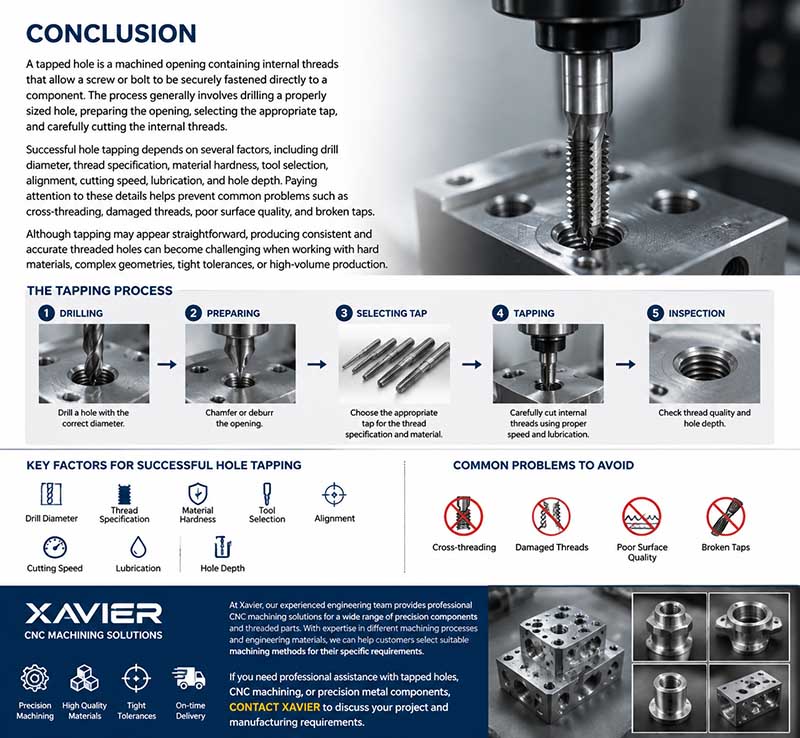
A tapped hole is a machined opening containing internal threads that allow a screw or bolt to be securely fastened directly to a component. The process generally involves drilling a properly sized hole, preparing the opening, selecting the appropriate tap, and carefully cutting the internal threads.
Successful hole tapping depends on several factors, including drill diameter, thread specification, material hardness, tool selection, alignment, cutting speed, lubrication, and hole depth. Paying attention to these details helps prevent common problems such as cross-threading, damaged threads, poor surface quality, and broken taps.
Although tapping may appear straightforward, producing consistent and accurate threaded holes can become challenging when working with hard materials, complex geometries, tight tolerances, or high-volume production.
At Xavier, our experienced engineering team provides professional CNC machining solutions for a wide range of precision components and threaded parts. With expertise in different machining processes and engineering materials, we can help customers select suitable machining methods for their specific requirements.
If you need professional assistance with tapped holes, CNC machining, or precision metal components, contact Xavier to discuss your project and manufacturing requirements.
FAQs
What Does “Tapped” Mean in Machining?
In machining, “tapped” means that internal threads have been created inside a previously drilled hole using a tool called a tap. The resulting threaded hole allows screws or bolts to engage directly with the workpiece, creating a secure mechanical connection.
Which Tap Is Normally Used to Start a Hole?
A taper tap is commonly used when starting a tapping operation. Its longer and more gradual lead helps the tool enter the drilled hole smoothly and maintain proper alignment.
This design makes it easier to begin cutting threads and can reduce the possibility of cross-threading, especially during manual tapping.
Why Is Lubrication Important During Tapping?
Lubrication reduces friction between the tap and the workpiece, helping control heat and cutting forces. It can also improve chip evacuation, reduce tool wear, extend tap life, and produce cleaner internal threads.
The correct lubricant should be selected according to the workpiece material and tapping application.
We are an integrated manufacturing and trading company specializing in CNC machining services, with a strong focus on custom CNC machining and the production of various metal components. Our capabilities include CNC machining PEEK, CNC machining brass, and CNC machining titanium, as well as a broad selection of other metals and engineering plastics. We serve applications ranging from robotics, aerospace, marine, and automotive components to medical parts and other precision-engineered components.
We are an experienced CNC machining PEEK manufacturer, offering CNC machining brass services for volume production and competitive CNC machining titanium pricing. Contact us to discuss your project requirements and find the right machining solution for your precision components.
Some of the images and text in this article are collected and compiled from the internet. If there is anything inappropriate, please contact us for processing.