CNC vs. 3D Printing: Choosing the Right Manufacturing Method for Your Part
Introduction
Advancements in 3D printing materials have pushed manufacturers across multiple industries to seriously evaluate CNC vs 3D printing as viable production options. Stronger polymers and composite materials now allow 3D printing to produce functional parts that were once exclusively made through CNC machining. As a result, manufacturers can reduce both lead time and cost while still meeting industrial production standards.
By adopting 3D printing, companies can use advanced software to prototype and manufacture parts within a single day, often at a fraction of the cost associated with traditional CNC machining. That said, CNC machining remains the preferred solution in several critical scenarios. Choosing between these two technologies requires a balanced look at both physical and economic factors.
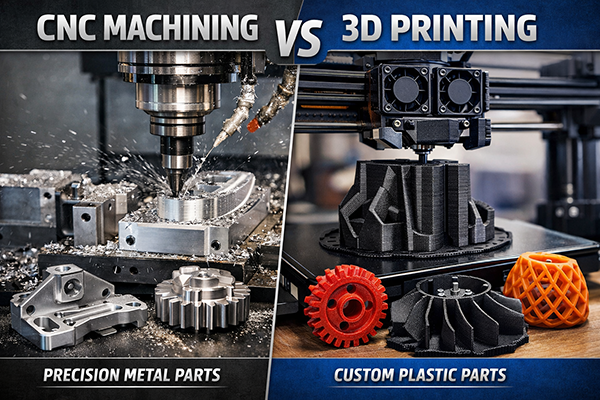
Below, we break down the most important considerations to help you decide between CNC vs 3D printing for your next project.
Physical Considerations
Geometry and Design Constraints
Feature Size
Both CNC machining and 3D printing are limited by tooling dimensions. In CNC machining, the cutting tool diameter determines the smallest internal (negative) feature that can be produced. For 3D printing, nozzle diameter defines the smallest external (positive) feature.
Extrusion-based 3D printers typically use nozzles ranging from 0.25 mm to 0.8 mm. Since minimum feature size is generally about four times the nozzle diameter, achievable feature sizes usually fall between 1.0 mm and 3.2 mm. This limitation can influence whether 3D printing or CNC machining is better suited for intricate designs.
Surface Finish
When surface quality is critical, CNC machining has a clear advantage. With proper tooling, CNC machines can produce exceptionally smooth surfaces suitable for mating with high-precision components. While 3D printing can achieve acceptable fit and finish for many applications, parts requiring tight cosmetic or functional surface requirements often benefit from CNC machining services.
Tolerances
High-end composite 3D printers can achieve tolerances as tight as ±0.005 inches and often provide compliant surfaces ideal for press fits. Tight-tolerance features can also be post-machined after printing. However, depending on part geometry, machining the entire component via CNC machining may be more efficient and consistent. Final accuracy depends heavily on material selection, machine capability, and design complexity.
Structural Loading
Non-structural components are excellent candidates for standard 3D printing. Structural parts exposed to high loads, however, often require either continuous fiber reinforcement or CNC machining.
Although fiber-reinforced printed parts offer improved strength, they are anisotropic—stronger in the X and Y axes than in the Z axis—unlike metal parts produced via CNC machining, which exhibit isotropic properties. This distinction can significantly impact part orientation and performance.
Environmental Considerations
Both 3D printing and CNC machining can produce parts from metals and polymers, so material behavior in the operating environment becomes a key differentiator.
Temperature Resistance
Metals produced via CNC machining generally withstand higher service temperatures than printed polymers. Pure metals typically lose strength at around half their melting temperature (on an absolute scale), while alloys may remain functional up to 65% of their melting point.
In contrast, 3D printed composites and polymers have lower thermal limits. Many composite materials should not be exposed to continuous temperatures above 150 °C, making CNC machining the safer option for high-temperature environments.
Moisture Exposure
Some polymer filaments used in 3D printing absorb moisture, which can degrade mechanical strength over time. Protective coatings may be required. Metals such as aluminum are largely unaffected by moisture, while steel components produced via CNC machining may require corrosion protection.
Chemical Resistance
When chemical exposure is expected, material compatibility must be carefully evaluated. Many metals produced through CNC machining perform well in chemically aggressive environments. Certain nylon-based 3D printing materials offer strong resistance to petrochemicals but are unsuitable for strong acids or bases.
Economic Considerations
Lead Time Requirements
In-House Machining
If a part is needed immediately and machines, operators, and materials are available, CNC machining is often the fastest route. However, when production urgency is lower, 3D printing can deliver parts within a day while freeing skilled operators for higher-priority tasks.
Material removal in CNC machining is typically faster than material deposition in 3D printing, especially when significant stock removal is required. Conversely, if a part has a low part-to-stock volume ratio, 3D printing may be more efficient.
Outsourced Machining
Outsourcing to CNC machining services can introduce delays due to quoting, drawings, purchasing approvals, and shipping. In these cases, 3D printing is often used to validate fit and function while waiting for the final machined part.
Production Volume
For low-volume production, CNC machining costs are largely driven by programming and setup time. As volume increases, per-unit cost drops significantly, making CNC machining economical for hundreds or even thousands of parts per month.
With 3D printing, setup time is minimal and complexity has little impact on programming. However, per-unit costs remain relatively constant regardless of volume. Scaling production usually requires additional printers rather than efficiency gains.
Equipment and Labor Investment
CNC machines often require skilled operators, programmers, and costly maintenance plans. While they can run unattended, expertise is essential for consistent output.
3D printers, on the other hand, require minimal training, are easy to program, and generally have lower maintenance costs. The upfront investment for 3D printing equipment is typically much lower than for CNC machinery.
CNC vs. 3D Printing: Finding the Right Balance
The decision between CNC vs 3D printing is rarely a simple one-to-one replacement. 3D printing excels in low-volume applications such as prototyping, tooling, and rapid iteration due to its low upfront and operating costs. However, as production volumes increase, subtractive manufacturing methods like CNC machining become more cost-effective and scalable.
In practice, many manufacturers—including Xavier—use a hybrid approach, combining additive manufacturing for speed and flexibility with CNC machining for precision, durability, and volume production.
Cost Comparison: CNC Machining vs. 3D Printing
When evaluating CNC vs 3D printing, cost is often the deciding factor. However, cost is not a single number—it is composed of setup cost, material cost, labor, machine time, and production volume. Below is a practical cost comparison based on typical industry scenarios.(This is not the actual price and is for reference only.)
Typical Cost Breakdown by Process
| Cost Item | CNC Machining | 3D Printing |
|---|---|---|
| Initial setup & programming | $150 – $500 per job | $0 – $50 (slicing & setup) |
| Material cost (per part) | $5 – $50 (metal stock, waste included) | $2 – $20 (polymer or composite filament) |
| Machine hourly rate | $60 – $120 / hour | $5 – $15 / hour |
| Labor cost | Skilled operator required | Minimal supervision |
| Post-processing | Often required (deburring, finishing) | Often required (support removal, surface finish) |
| Typical lead time | 2–7 days (in-house or outsourced) | Same day to 1 day |
From a single-part or prototype cost perspective, 3D printing is usually significantly cheaper due to minimal setup and lower labor requirements.
Cost per Unit at Different Production Volumes
| Production Quantity | CNC Machining Cost / Unit | 3D Printing Cost / Unit |
|---|---|---|
| 1–5 units | $120 – $300 | $15 – $50 |
| 10–50 units | $40 – $90 | $20 – $45 |
| 100–500 units | $12 – $35 | $18 – $40 |
| 1,000+ units | $5 – $15 | $15 – $35 |
This table highlights a key economic reality:
- 3D printing is cost-effective for low-volume production, where setup and tooling costs dominate.
- CNC machining becomes more economical as volume increases, thanks to amortized setup costs and faster material removal rates.
Hidden Cost Factors to Consider
Material Waste
CNC machining is a subtractive process, meaning excess material is removed and discarded. Depending on part geometry, material waste can reach 30–70% of the original stock.
3D printing, as an additive process, uses only the material required to build the part, resulting in significantly lower material waste and more predictable material costs.
Design Changes and Iteration Cost
Design changes in CNC machining often require reprogramming, new fixtures, or even new tooling, increasing cost and lead time.
With 3D printing, design revisions usually involve only updating the digital model and reprinting, keeping iteration costs extremely low.
Cost-Driven Decision Summary
- Choose 3D printing when:
- Production volume is low (typically under 100 units)
- Rapid prototyping or design iteration is required
- Budget constraints favor low upfront investment
- Choose CNC machining when:
- Parts require tight tolerances, superior surface finish, or metal materials
- Structural strength and isotropic properties are critical
- Production volume reaches hundreds or thousands of units
Manufacturers such as Xavier often integrate both processes—using 3D printing to minimize early-stage cost and development time, then transitioning to CNC machining for cost-efficient, high-quality production at scale.
Xavier is a professional manufacturer providing cnc machining service for custom metal parts. We support CNC machining aluminum, CNC machining stainless steel, CNC machining magnesium alloy, CNC machining acrylic, and CNC machining ABS with high accuracy and stable quality. Our cnc machining service is widely used in CNC aerospace parts machining, CNC automotive parts machining, and medical parts machining, delivering fast lead times and strong part compatibility. We offer 5 axis milling, CNC milling services, CNC turning services, and Swiss turning services, with optional finishing such as anodizing and electroless nickel plating. As a global cnc machining service provider, Xavier supports batch production. Contact us for CNC machining service pricing.
Some of the images and text in this article are collected and compiled from the internet. If there is anything inappropriate, please contact us for processing.