
Racing is one of the most demanding engineering environments. Every component must balance weight, strength, heat resistance, and precision. CNC machining has become the backbone of racing parts manufacturing due to its unmatched ability to produce complex geometries with micron-level accuracy. Racing Parts Machining
Why CNC Machining is Critical in Motorsports
Motorsport environments involve extreme vibration, temperature, and stress. CNC machining ensures:
- Tolerances as tight as ±0.01 mm
- High repeatability for consistent lap performance
- Complex geometries impossible with traditional machining
According to industry data, CNC-machined racing parts offer higher dimensional stability and fatigue resistance, critical for competitive performance.
Common CNC Machined Racing Components
Below is a breakdown of typical racing parts and their machining requirements:
| Component | Material | Tolerance | Key Requirement |
|---|---|---|---|
| Pistons | Aluminum / Steel | ±0.010 mm | Heat resistance |
| Connecting Rods | Steel / Titanium | ±0.015 mm | Fatigue strength |
| Gear Shafts | Hardened Steel | ±0.010 mm | Precision meshing |
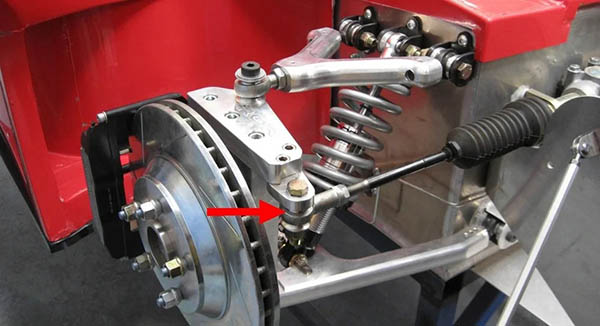
| Suspension Arms | Aluminum | ±0.025 mm | Load resistance |
| Brake Components | Stainless Steel | ±0.020 mm | Thermal stability |
These components require extreme precision and durability to withstand racing conditions.
Materials Used in Racing Parts Machining
Material selection directly impacts performance.
| Material | Key Properties | Application |
|---|---|---|
| 7075 Aluminum | High strength, lightweight | Structural parts |
| Titanium | High strength, corrosion resistance | Engine, aerospace-grade parts |
| Stainless Steel 316 | Corrosion resistance | Brake systems |
| 4140 Steel | High fatigue strength | Shafts, drivetrain |
| Carbon Fiber (Hybrid) | Ultra-lightweight | Aerodynamic components |
Aluminum alloys like 6061 and 7075 are widely used due to their excellent strength-to-weight ratio.
Precision Tolerances & Surface Finish
In racing machining:
- Typical tolerance: ±0.01 mm to ±0.05 mm
- High-precision parts: ±0.005 mm or tighter
- Surface roughness: Ra 0.4–0.8 µm
High-end machines can achieve even tighter tolerances down to ±0.005 mm, especially for critical aerodynamic or engine components.
3/4/5 Axis Machining in Motorsport
Multi-axis machining is essential for complex racing geometries:
- 3 Axis: Basic structural parts
- 4 Axis: Indexed features and angled drilling
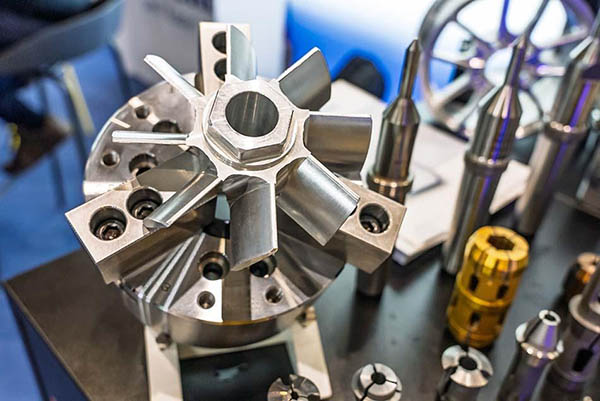
- 5 Axis: Complex surfaces, impellers, aerodynamic parts
5-axis machining enables:
- Single-setup production
- Reduced error accumulation
- Improved surface quality
This is crucial for components like F1 suspension rockers and aerodynamic systems.
Lightweight Design & Performance Optimization
Weight reduction directly improves:
- Acceleration
- Fuel efficiency
- Cornering performance
CNC allows:
- Thin-wall machining
- Topology optimization
- Internal cavities for weight reduction
Racing teams often reduce component weight while maintaining strength using advanced CAD/CAM strategies.
Rapid Prototyping in Racing Development
Speed is everything in motorsports.
CNC machining enables:
- Prototype turnaround in days
- Quick iteration cycles
- Immediate testing and validation
Racing teams often move from design to track-ready parts within extremely short timelines, improving competitiveness.
Surface Finishing for Racing Parts
Surface treatments improve both performance and durability:
| Finish Type | Benefit |
|---|---|
| Anodizing | Corrosion resistance |
| Hard Anodizing | Wear resistance |
| Powder Coating | Durability |
| Polishing | Reduced friction |
| Sandblasting | Surface uniformity |
Advanced finishing also enhances aerodynamics and thermal efficiency.
Quality Control & Certifications
Racing parts require strict quality control:
- ISO 9001 certification
- Material traceability
- CMM inspection
- First Article Inspection (FAI)
Traceability ensures every part meets performance and safety standards, especially in competitive motorsports.
Cost vs Performance Trade-Off
In racing machining:
- Higher precision = higher cost
- Exotic materials (Titanium, Inconel) increase machining complexity
- Multi-axis machining reduces assembly but increases machine cost
However, performance gains often justify the investment, especially in professional racing environments.
Why Choose Xavier for Racing Parts Machining
When performance, precision, and reliability matter, Xavier stands out as a trusted CNC machining partner.
- Advanced 3/4/5 Axis machining capabilities
- Expertise in aluminum, titanium, and high-strength alloys
- Proven ability to achieve ±0.005 mm precision
- Fast turnaround for prototyping and production
- Strict quality control with full traceability
Whether you’re developing high-performance automotive parts or motorsport components, Xavier delivers race-ready machining solutions that help you stay ahead of the competition.
Some of the images and text in this article are collected and compiled from the internet. If there is anything inappropriate, please contact us for processing.