Delrin vs PTFE: Material Differences, Properties, and CNC Machining Applications
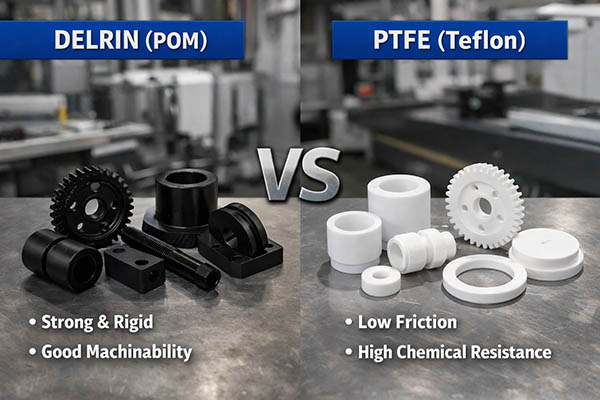
Engineering plastics have replaced metal in many precision components, especially in industries requiring lightweight, corrosion-resistant, and low-friction materials. Two of the most commonly compared materials are Delrin (POM homopolymer) and PTFE (Polytetrafluoroethylene, commonly known as Teflon).
Delrin is known for high mechanical strength, stiffness, and dimensional stability, while PTFE is famous for its extreme chemical resistance, low friction, and high temperature capability.
Although both plastics are used in mechanical and industrial environments, they serve very different engineering purposes. Understanding the differences between Delrin and PTFE is essential for selecting the right material for CNC machining, sealing systems, sliding components, or chemical processing equipment.
Below are 10 key knowledge areas engineers typically analyze when comparing Delrin vs PTFE.
Material Overview: What Are Delrin and PTFE?
Delrin (Acetal Homopolymer)
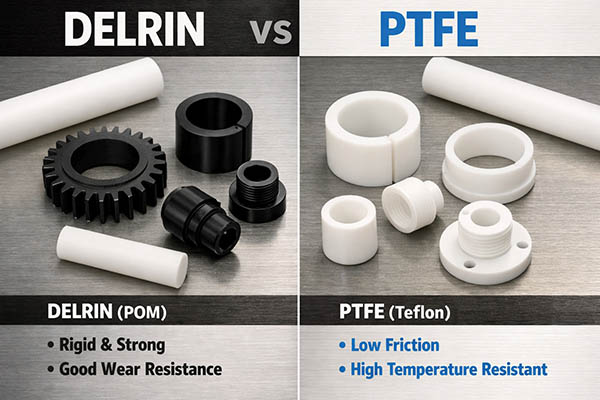
Delrin is a polyoxymethylene (POM) engineering plastic originally developed by DuPont. It is a semicrystalline thermoplastic known for its high stiffness, fatigue resistance, and low friction. delrin vs ptfe
Because of its high crystallinity, Delrin provides superior mechanical strength and structural stability, making it suitable for precision mechanical components. delrin vs ptfe
Typical Delrin applications include:
- gears and sprockets
- bushings and bearings
- automotive components
- pump housings
- electrical connectors
PTFE (Teflon)
PTFE is a fluoropolymer composed of carbon and fluorine atoms, giving it extraordinary chemical stability.
It is famous for:
- extreme chemical inertness
- extremely low friction
- non-stick properties
- high temperature tolerance
PTFE is widely used in:
- seals and gaskets
- chemical processing equipment
- semiconductor manufacturing
- valve seats
- non-stick coatings
Chemical Structure and Polymer Composition
The molecular structure of these materials explains their performance differences.
| Material | Chemical Structure | Polymer Type |
|---|---|---|
| Delrin | (CH2O)n repeating chain | Acetal homopolymer |
| PTFE | (C2F4)n repeating chain | Fluoropolymer |
PTFE’s carbon backbone is completely surrounded by fluorine atoms. This protective shell prevents chemical reactions, giving PTFE its exceptional chemical resistance. delrin vs ptfe
Delrin, on the other hand, has a highly crystalline structure that enhances mechanical strength and stiffness.
This structural difference is the foundation of their performance gap.
Mechanical Strength and Structural Performance
One of the most important differences between Delrin and PTFE is mechanical strength.
Mechanical Property Comparison
| Property | Delrin (POM) | PTFE |
|---|---|---|
| Tensile strength | ~60–70 MPa | 20–35 MPa |
| Stiffness | High | Low |
| Hardness | High | Moderate |
| Creep resistance | Good | Poor |
PTFE is a relatively soft material and may deform under load, especially at high temperatures.
Delrin, however, behaves more like a lightweight metal substitute due to its higher rigidity and fatigue resistance.
Example:
- Delrin gear → suitable for torque transmission
- PTFE seal → ideal for chemical sealing applications
Friction and Wear Resistance
Both materials are known for low friction, but PTFE dominates in this category.
Friction Comparison
| Material | Typical Coefficient of Friction |
|---|---|
| PTFE | 0.05 – 0.10 |
| Delrin | ~0.20 |
PTFE has one of the lowest friction coefficients of any solid material, making it extremely effective in sliding surfaces and non-stick applications. delrin vs ptfe
However, PTFE wears faster under mechanical load, while Delrin offers better wear resistance in structural sliding components.
Engineering insight:
- PTFE → sliding seals, bearings without lubrication
- Delrin → gears and mechanical guides
Temperature Resistance and Thermal Stability
Temperature resistance is another major difference.
| Property | Delrin | PTFE |
|---|---|---|
| Operating temperature | −40°C to ~120°C | −200°C to 260°C |
| Melting point | ~175°C | ~327°C |
PTFE can withstand temperatures up to 260°C in continuous service, making it suitable for extreme industrial environments.
Delrin has good thermal resistance but is generally limited to about 100–120°C for continuous use.
Example:
- high-temperature valve seals → PTFE
- mechanical components near engines → Delrin
Chemical Resistance and Environmental Stability
PTFE is widely considered one of the most chemically inert materials available.
| Chemical Resistance | Delrin | PTFE |
|---|---|---|
| Strong acids | Moderate | Excellent |
| Solvents | Good | Excellent |
| Alkalis | Good | Excellent |
| Weathering | Good | Excellent |
PTFE can resist almost all chemicals except extremely reactive substances.
Delrin is resistant to many chemicals but can degrade in strong acids or oxidizing environments.
Therefore:
- chemical processing → PTFE
- mechanical industrial parts → Delrin
Machinability in CNC Manufacturing
From a CNC machining perspective, Delrin is significantly easier to machine.
Machining Behavior Comparison
| Factor | Delrin | PTFE |
|---|---|---|
| Chip formation | Clean chips | Soft chips |
| Dimensional stability | Excellent | Poor |
| Tolerance capability | ±0.01 mm | ±0.05 mm |
| Surface finish | Excellent | Moderate |
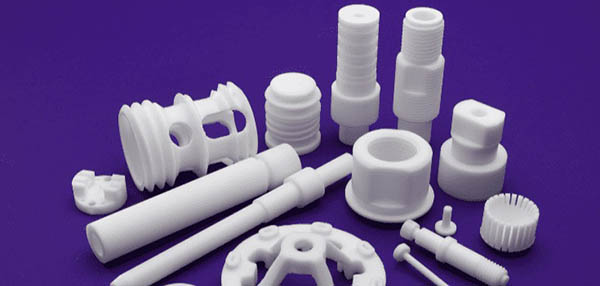
Delrin cuts cleanly and behaves similarly to free-machining brass, allowing faster machining speeds and high precision parts.
PTFE is softer and more flexible, which can cause deformation during machining and reduce dimensional accuracy. delrin vs ptfe
Typical Industrial Applications
Different material strengths lead to different industrial uses.
Delrin Applications
| Industry | Components |
|---|---|
| Automotive | fuel system parts |
| Machinery | gears, rollers |
| Electronics | connectors |
| Robotics | sliding rails |
PTFE Applications
| Industry | Components |
|---|---|
| Chemical processing | valve seats |
| Medical | tubing |
| Semiconductor | wafer handling |
| Food equipment | non-stick components |
PTFE is especially popular in corrosive or sterile environments.
Cost Comparison and Manufacturing Considerations
Material cost also affects engineering decisions.
| Factor | Delrin | PTFE |
|---|---|---|
| Raw material cost | Moderate | High |
| Machining cost | Low | Higher |
| Tool wear | Low | Low |
| Production speed | Fast | Slower |
PTFE often costs more due to complex processing methods such as compression molding and sintering rather than traditional melt processing. delrin vs ptfe
Delrin, by contrast, is widely available and easier to process in both machining and molding operations.
When to Choose Delrin vs PTFE
Choose Delrin When
- mechanical strength is required
- tight tolerances are needed
- structural components are involved
- gears or load-bearing parts are used
Choose PTFE When
- chemical resistance is critical
- extremely low friction is needed
- high temperatures are present
- sealing and insulation are required
In many engineering systems, both materials are used together—for example:
- Delrin gears + PTFE bushings
This combination provides both structural strength and low friction performance.
Why Xavier Is a Trusted CNC Machining Partner for Delrin and PTFE Parts
When manufacturing precision plastic components, selecting the right CNC machining partner is as important as choosing the right material. delrin vs ptfe
Xavier CNC Machining provides advanced manufacturing services for high-performance plastics including:
- Delrin (POM)
- PTFE (Teflon)
- Nylon
- PEEK
- UHMW
With advanced CNC milling and turning centers, Xavier can produce:
- precision Delrin gears and mechanical components
- PTFE seals and chemical-resistant parts
- custom plastic prototypes
- high-volume production components
Whether your application requires high mechanical strength (Delrin) or extreme chemical resistance (PTFE), Xavier’s engineering team can help optimize material selection and machining strategy for your project. delrin vs ptfe
Some of the images and text in this article are collected and compiled from the internet. If there is anything inappropriate, please contact us for processing.