
What a CNC Metal Parts Manufacturer Does
A CNC metal parts manufacturer produces precision metal components using computer numerical control (CNC) machining systems. These machines follow programmed instructions to cut, mill, drill, and shape metal into highly accurate components.
Unlike traditional machining, CNC machining is controlled by CAD/CAM software that converts 3D models into machine tool paths. This allows manufacturers to produce complex parts with high repeatability and minimal human error.
Typical operations used in CNC metal part manufacturing include:
| Process | Function |
|---|---|
| CNC Milling | Removes material using rotating cutting tools |
| CNC Turning | Produces cylindrical parts using a lathe |
| Drilling | Creates holes with precise diameters |
| Boring | Enlarges and refines holes |
| Threading | Produces internal or external threads |
CNC machining is widely used because it can manufacture complex parts without molds, which reduces tooling cost and production time.
Typical production stages include:
- CAD design creation
- CAM programming
- CNC machining
- Surface finishing
- Inspection and quality verification
This workflow enables manufacturers to produce custom metal parts ranging from prototypes to mass production batches.
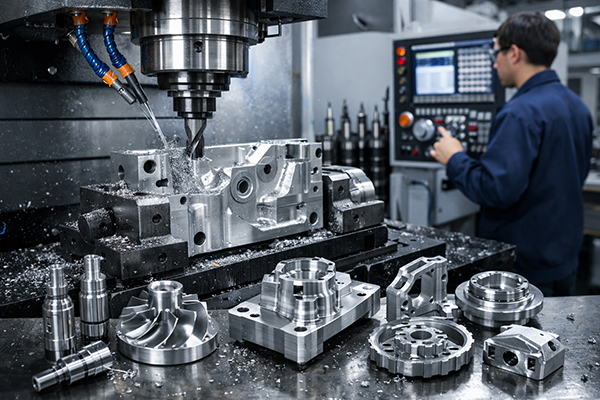
Core CNC Machining Processes Used for Metal Parts
A professional CNC metal parts manufacturer normally offers multiple machining processes to support different part geometries.
CNC Milling
CNC milling is used for parts with complex 3D geometry. The cutting tool rotates while the workpiece remains stationary.
Typical applications:
- mechanical housings
- brackets
- engine components
CNC Turning
CNC turning is ideal for cylindrical parts.
Examples:
- shafts
- bushings
- connectors
- threaded components
Multi-Axis Machining
Modern manufacturers use 3-axis, 4-axis, and 5-axis CNC machines.
| Machine Type | Capability |
|---|---|
| 3-Axis | Basic prismatic machining |
| 4-Axis | Rotational machining for curved parts |
| 5-Axis | Complex aerospace components |
Multi-axis machining reduces setups and increases precision.
Common Metals Used in CNC Machining Manufacturing
Material selection affects machining speed, durability, and cost.
Professional CNC metal parts manufacturers typically support a wide range of metals.
| Metal Material | Key Properties | Typical Applications |
|---|---|---|
| Aluminum (6061, 7075) | Lightweight, excellent machinability | Aerospace, electronics |
| Stainless Steel (304, 316) | Corrosion resistant | Medical, food equipment |
| Carbon Steel (1018, 1045) | Strong and cost-effective | Mechanical components |
| Brass | Low friction, good conductivity | Fittings, connectors |
| Copper | Excellent electrical conductivity | Electrical contacts |
| Titanium | High strength-to-weight ratio | Aerospace, implants |
For example, titanium alloys such as Ti-6Al-4V are widely used in aerospace and medical devices due to their strength and corrosion resistance.
Brass and copper are commonly used in electrical and plumbing applications because of their excellent conductivity and corrosion resistance.
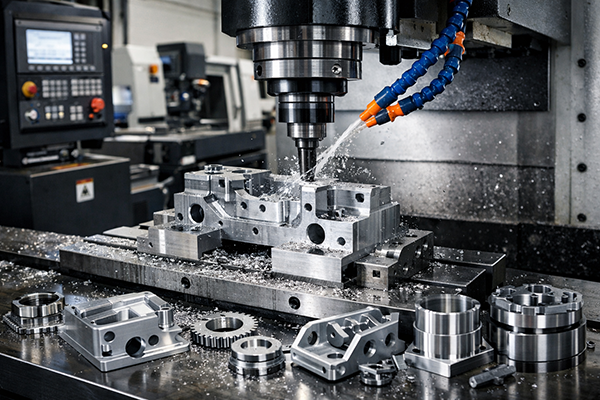
CNC Machining Tolerances and Precision Standards
One of the defining capabilities of a CNC metal parts manufacturer is precision control.
Typical CNC machining tolerances include:
| Precision Level | Tolerance Range |
|---|---|
| General machining | ±0.1 mm |
| Standard CNC machining | ±0.05 mm |
| Precision CNC machining | ±0.01 mm |
| Ultra precision machining | ±0.005 mm |
Standard CNC machining tolerances for metal parts are often around ±0.025 mm (±0.001 inch) depending on geometry and material.
Many professional machining companies also follow international tolerance standards such as:
- ISO 2768
- DIN ISO 2768
- GD&T (Geometric Dimensioning & Tolerancing)
In high-precision industries like aerospace or medical devices, tolerances can reach ±0.0005 inches (≈12.7 µm).
Typical CNC Metal Part Sizes and Machining Capabilities
CNC metal parts manufacturers can produce components ranging from micro parts to large industrial structures.
Typical machining capability ranges:
| Capability | Typical Range |
|---|---|
| Minimum feature size | 0.5 mm |
| Minimum drill size | 0.5 mm |
| Maximum milling size | 3000 × 1600 × 1000 mm |
| Turning diameter | up to 200 mm |
| Turning length | up to 1000 mm |
These parameters depend on machine type and tooling.
Example CNC metal parts include:
- gearbox housings
- automotive engine brackets
- hydraulic valves
- robotic arm components
Surface Finishing and Post-Processing for Metal Parts
After machining, most CNC metal parts require surface finishing to improve performance and appearance.
Common finishing methods include:
| Surface Treatment | Purpose |
|---|---|
| Anodizing | Corrosion resistance for aluminum |
| Powder coating | Durable protective coating |
| Passivation | Improves corrosion resistance for stainless steel |
| Electroplating | Decorative and protective finish |
| Bead blasting | Matte texture |
| Black oxide | Anti-corrosion treatment |
For example:
| Finish | Roughness (Ra) |
|---|---|
| As-machined | 3.2 μm |
| Fine machining | 1.6 μm |
| Polished | 0.8 μm |
Surface finishing is particularly important for automotive, aerospace, and medical components where durability and appearance matter.
Quality Control and Inspection in CNC Manufacturing
Quality control is a critical part of CNC metal part manufacturing.
Professional manufacturers use advanced inspection equipment:
| Inspection Tool | Function |
|---|---|
| CMM (Coordinate Measuring Machine) | 3D dimensional inspection |
| Micrometer | Diameter measurement |
| Height gauge | Vertical measurement |
| Optical projector | Profile verification |
| Surface roughness tester | Surface finish measurement |
Inspection levels depend on tolerance requirements.
Example inspection plan:
| Production Volume | Inspection Strategy |
|---|---|
| Prototype | 100% inspection |
| Small batch | Random sampling |
| Mass production | Statistical process control |
This ensures consistent product quality and compliance with engineering drawings.
Design for Manufacturability in CNC Metal Parts
A skilled CNC metal parts manufacturer will review part designs to ensure they can be produced efficiently.
Key DFM considerations include:
Avoid unnecessary tight tolerances
Over-specifying tolerances significantly increases machining cost.
Maintain tool accessibility
Features that are too deep or narrow are difficult to machine.
Standardize thread specifications
Using common thread sizes reduces tooling complexity.
Example DFM guidelines:
| Design Feature | Recommendation |
|---|---|
| Minimum wall thickness | ≥0.5 mm (metal) |
| Hole depth | ≤5× diameter |
| Thread depth | 3–6× diameter |
Applying DFM principles helps reduce production cost and lead time.
Production Cost Structure of CNC Machined Metal Components
Understanding manufacturing costs helps buyers choose the right CNC metal parts manufacturer.
Typical cost breakdown:
| Cost Element | Percentage |
|---|---|
| Raw material | 20–40% |
| Machining time | 30–50% |
| Surface finishing | 10–20% |
| Inspection & packaging | 5–10% |
Key cost drivers include:
- material type
- machining complexity
- tolerance requirements
- batch size
For example:
| Production Volume | Cost per Part |
|---|---|
| Prototype (1–10 pcs) | High |
| Small batch (50–500 pcs) | Medium |
| Mass production (1000+) | Low |
CNC machining is particularly efficient for low-volume production and custom components.
Industries That Depend on CNC Metal Parts Manufacturers
CNC metal parts manufacturers serve a wide range of industries.
| Industry | Example Components |
|---|---|
| Automotive | engine blocks, transmission parts |
| Aerospace | turbine housings, brackets |
| Medical | surgical instruments |
| Electronics | heat sinks, connectors |
| Energy | valve bodies, pump parts |
These industries require high precision and strict quality control standards.
For example:
- aerospace parts require extremely tight tolerances
- medical devices require biocompatible materials
Why Xavier Is a Reliable CNC Metal Parts Manufacturer
If you are searching for a professional CNC metal parts manufacturer, Xavier offers comprehensive CNC machining solutions for global industries.
Xavier specializes in:
- CNC milling and turning services
- custom metal component manufacturing
- 3/4/5 axis machining
- precision tolerance machining
- full surface finishing solutions
Our experienced engineering team supports:
- rapid prototyping
- small-batch production
- large-scale OEM manufacturing
With advanced machining equipment and strict quality control processes, Xavier delivers high-precision CNC metal parts for aerospace, automotive, electronics, and industrial applications.
Whether you need complex prototypes or high-volume production, Xavier provides reliable manufacturing support, competitive pricing, and consistent quality.
Frequently Asked Questions About CNC Metal Parts Manufacturers
What does a CNC metal parts manufacturer do?
A CNC metal parts manufacturer produces precision metal components using computer-controlled machining equipment such as CNC milling machines and CNC lathes. These manufacturers convert CAD designs into machine tool paths and manufacture parts from metals like aluminum, stainless steel, brass, titanium, and copper. CNC machining allows high accuracy, repeatability, and complex geometry without the need for molds.
What metals can a CNC metal parts manufacturer machine?
Most CNC metal parts manufacturers work with a wide range of metals, including aluminum, stainless steel, carbon steel, brass, copper, and titanium. Aluminum is commonly used for lightweight structural parts, while stainless steel is preferred for corrosion-resistant applications. Titanium is often used in aerospace and medical industries due to its high strength-to-weight ratio.
| Metal | Common Grade | Typical Application |
|---|---|---|
| Aluminum | 6061 / 7075 | Aerospace & electronics |
| Stainless Steel | 304 / 316 | Medical & industrial |
| Brass | C360 | Connectors & fittings |
| Titanium | Ti-6Al-4V | Aerospace components |
What tolerance can CNC machining achieve?
A professional CNC metal parts manufacturer typically achieves machining tolerances between ±0.01 mm and ±0.05 mm. For ultra-precision parts, tolerances can reach ±0.005 mm depending on material and part geometry. Industries such as aerospace, medical devices, and robotics often require extremely tight tolerances for safety and performance.
What is the difference between CNC milling and CNC turning?
CNC milling and CNC turning are the two most common processes used by CNC metal parts manufacturers.
| Process | Best For | Machine Type |
|---|---|---|
| CNC Milling | Complex 3D shapes | CNC milling machine |
| CNC Turning | Cylindrical parts | CNC lathe |
CNC turning rotates the workpiece while cutting tools shape the part, making it ideal for shafts, bushings, and threaded components. CNC milling is better suited for flat surfaces and complex geometries.
How much does CNC metal part manufacturing cost?
The cost of CNC metal parts depends on several factors including material type, machining time, tolerance requirements, and production volume.
| Cost Factor | Impact |
|---|---|
| Material cost | 20–40% |
| Machining time | 30–50% |
| Surface finishing | 10–20% |
| Inspection & packaging | 5–10% |
Prototype parts are typically more expensive per unit because setup costs are spread across fewer parts.
What industries use CNC metal parts manufacturers?
CNC metal parts manufacturers serve many high-precision industries where accuracy and reliability are critical.
| Industry | Example CNC Parts |
|---|---|
| Automotive | engine components, shafts |
| Aerospace | brackets, turbine parts |
| Medical | surgical tools |
| Electronics | heat sinks |
| Energy | valve bodies |
These industries rely on CNC machining for its ability to produce complex components with consistent quality.
How long does it take to manufacture CNC metal parts?
Lead time depends on part complexity and order quantity. Prototype CNC metal parts can often be produced in 3–7 days, while larger production batches may take 2–4 weeks. Factors such as material availability, surface finishing, and inspection requirements also influence manufacturing time.
How do I choose a reliable CNC metal parts manufacturer?
When selecting a CNC metal parts manufacturer, consider the following factors:
| Selection Factor | Why It Matters |
|---|---|
| Machining capability | Determines part complexity |
| Quality certifications | Ensures reliability |
| Inspection equipment | Verifies accuracy |
| Engineering support | Improves manufacturability |
Choosing a manufacturer with strong engineering experience and advanced machining equipment ensures better product quality and faster delivery.
Some of the images and text in this article are collected and compiled from the internet. If there is anything inappropriate, please contact us for processing.