
Brass Precision Turned Components: Engineering Principles, Material Behavior, and Production-Grade Manufacturing
Brass precision turned components are widely used in applications where dimensional stability, repeatability, and machinability are more important than brute mechanical strength.
In real manufacturing environments, these components are rarely produced as one-off parts. They are designed for batch consistency, often running tens of thousands or even millions of pieces with tight tolerance windows.
What differentiates true brass precision turned components from standard brass turned parts is not the material alone, but the process discipline behind turning strategy, tooling control, inspection logic, and long-term dimensional repeatability.
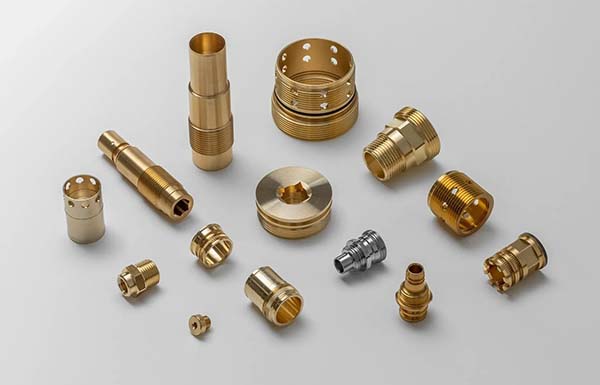
What Are Brass Precision Turned Components in Practical Manufacturing Terms
From an engineering standpoint, brass precision turned components are rotational parts manufactured from brass bar stock using CNC lathes or Swiss-type turning machines, where turning accuracy is repeatable across production runs.
Unlike general turned parts, precision turned components typically:
- Serve as functional interfaces (electrical contact, sealing, alignment)
- Must assemble without secondary fitting
- Operate in environments sensitive to dimensional drift
Common Forms Seen in Production
| Component Type | Functional Role | Typical Precision Requirement |
|---|---|---|
| Electrical pins | Conductivity + alignment | ±0.005 mm |
| Threaded inserts | Load distribution | Thread class controlled |
| Valve spools | Fluid control | Concentricity ≤ 0.01 mm |
| Bushings | Wear reduction | ID/OD consistency |
| Contact terminals | Electrical stability | Surface finish critical |
In procurement terms, buyers are usually not purchasing a “brass part,” but a dimensionally guaranteed interface that must work inside a larger system.
Brass Alloys Used for Precision Turned Components and Why They Matter
Material selection in brass precision turning is primarily about machinability stability, not just corrosion resistance or appearance.
Common Brass Grades and Machining Behavior
| Brass Grade | Machining Characteristics | Production Implication |
|---|---|---|
| C360 (Free-Cutting Brass) | Short chips, low tool wear | Ideal for high-volume Swiss turning |
| C260 (Cartridge Brass) | Ductile, cleaner finish | Better for formed + turned parts |
| C464 (Naval Brass) | Higher corrosion resistance | Lower cutting efficiency |
Why C360 dominates precision turning:
The lead content improves chip breakage, which reduces tool load variation. This directly improves dimensional repeatability over long production runs, especially in unattended machining.
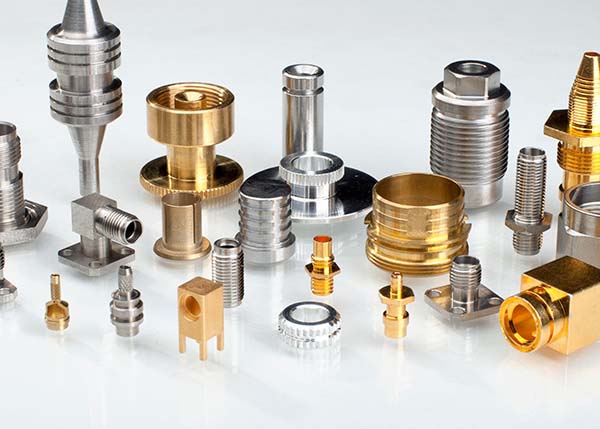
CNC Turning and Swiss Machining Processes for Brass Components
Precision brass turning is not a single process but a machine strategy decision based on part geometry and volume.
Process Comparison in Real Production
| Process | Strength | Limitation |
|---|---|---|
| Standard CNC turning | Flexible setups | Less stable for long slender parts |
| Swiss-type turning | Excellent concentricity | Higher setup complexity |
| Multi-spindle turning | Ultra-high output | Best for fixed designs |
Swiss-type turning is often chosen when:
- Length-to-diameter ratio exceeds 3:1
- Multiple cross-holes or slots are required
- Tolerances must remain stable across long runs
This is why electrical connectors and medical brass pins are almost always Swiss-machined.
Achievable Tolerances in Brass Precision Turned Components
Brass allows tighter tolerances than steel or stainless steel because cutting forces are lower and thermal deformation is minimal.
Typical Tolerance Capability
| Feature Type | Realistic Production Tolerance |
|---|---|
| Outer diameter | ±0.005 mm |
| Inner bore | ±0.005–0.008 mm |
| Thread concentricity | ≤ 0.01 mm |
| Part-to-part variation | ≤ 0.005 mm |
However, tolerance should be function-driven, not arbitrary. Over-defining tolerances increases:
- Cycle time
- Tool wear
- Inspection cost
- Scrap risk
Experienced suppliers often suggest tolerance optimization during DFM review.
Surface Finish Requirements and Functional Implications
Surface finish on brass precision turned components affects more than appearance.
Functional Impact of Surface Roughness
| Ra Value | Functional Effect |
|---|---|
| Ra 3.2 μm | Standard mechanical fit |
| Ra 1.6 μm | Stable electrical contact |
| Ra 0.8 μm | Fluid sealing surfaces |
| Ra 0.4 μm | Low-resistance interfaces |
Brass naturally achieves smoother finishes due to low friction cutting, often eliminating secondary polishing steps and reducing overall production cost.
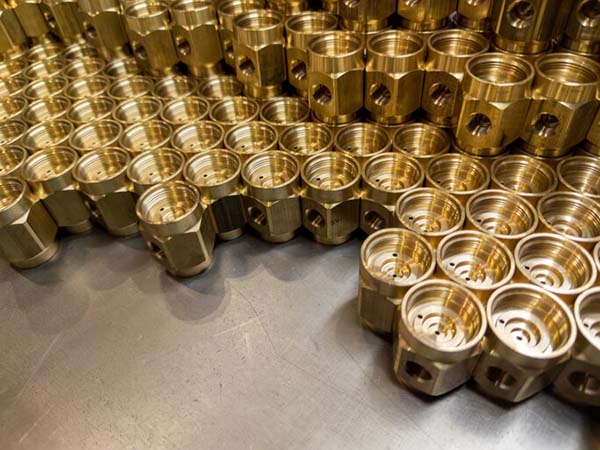
Tooling Strategy and Cutting Parameter Control
Tooling is where most dimensional variation originates if not properly controlled.
Typical Cutting Parameters for C360 Brass
| Operation | Speed Range | Feed Range |
|---|---|---|
| Rough turning | 3,000–5,000 rpm | 0.15–0.25 mm/rev |
| Finish turning | 5,000–8,000 rpm | 0.05–0.10 mm/rev |
Best practices include:
- Positive rake inserts for clean shearing
- Short tool overhang to reduce deflection
- Dedicated finishing tools separated from roughing
This separation significantly improves consistency across tool life cycles.
Threading Accuracy in Brass Precision Turned Components
Threads are one of the most failure-prone features in brass components if not controlled properly.
Threading Methods and Use Cases
| Method | When Used |
|---|---|
| Single-point threading | Tight tolerance, custom threads |
| Tapping | Standard threads, high volume |
| Thread rolling | Rare for brass, special cases |
Precision threading requires controlled depth, pitch diameter monitoring, and thread gauge verification to ensure assembly reliability.
Quality Inspection and Process Control
Precision turning without inspection is guesswork.
Inspection Tools Used in Production
| Tool | Role |
|---|---|
| Micrometers | OD verification |
| Bore gauges | ID stability |
| Thread gauges | Thread compliance |
| CMM | GD&T validation |
For large-volume orders, SPC charts are used to detect drift before parts go out of tolerance, reducing scrap and rework.
Industrial Applications of Brass Precision Turned Components
Brass precision turned components are chosen not for strength, but for predictable performance.
Key industries include:
- Electrical and power distribution
- Fluid and gas control systems
- Automotive electrical assemblies
- Industrial automation
- Consumer hardware
Each sector values brass for a different reason, but all rely on dimensional reliability.
Cost Structure of Brass Precision Turned Components
Precision comes with cost trade-offs.
Main Cost Drivers Explained
| Factor | Why It Matters |
|---|---|
| Material grade | Affects tool life and speed |
| Tolerance tightness | Directly impacts cycle time |
| Geometry complexity | Increases tooling and setup |
| Order volume | Drives per-part efficiency |
Smart design and volume planning can reduce unit cost by 20–40% without sacrificing performance.
Why Xavier Is Chosen for Brass Precision Turned Components
Xavier approaches brass precision turned components as engineering products, not commodity parts.
Xavier provides:
- Deep expertise in C360 and custom brass alloys
- Swiss and CNC turning for tight tolerance parts
- In-process inspection and SPC-based quality control
- Scalable production from prototypes to mass volume
For manufacturers seeking consistent, production-grade brass precision turned components, Xavier delivers reliability backed by process control.
Xavier is a professional CNC machining manufacturer specializing in brass precision turned components and custom metal parts production. We support CNC machining aluminum, CNC machining stainless steel, CNC machining magnesium alloy, CNC machining acrylic, and CNC machining ABS, delivering stable quality and high efficiency. Our brass precision turned components are widely used in CNC aerospace parts machining, CNC automotive parts machining, and medical parts machining, meeting strict precision and consistency requirements. We offer complete machining capabilities including 5 axis milling, CNC milling services, CNC turning services, and Swiss turning services. Surface finishing options for brass precision turned components include anodizing, electroless nickel plating, zinc plating, passivation, electropolishing, and chemical conversion coatings. As a global CNC machining service provider, Xavier supports batch production of brass precision turned components. For CNC machining service pricing, feel free to contact us.
Some of the images and text in this article are collected and compiled from the internet. If there is anything inappropriate, please contact us for processing.