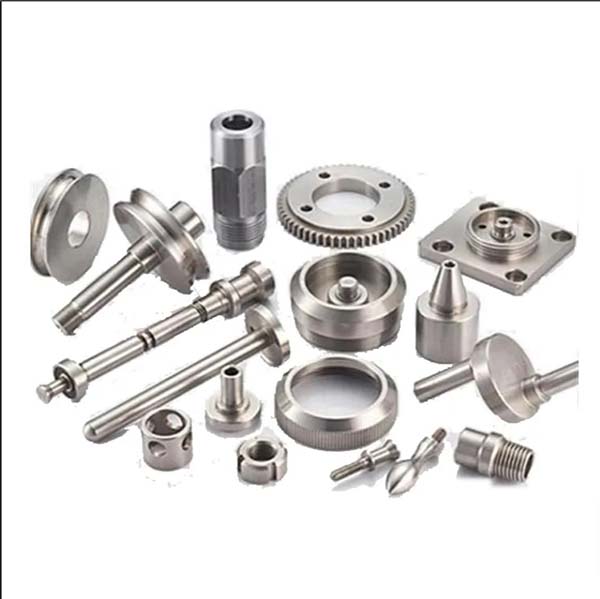
Stainless Steel Metal Fabrication: Processes, Materials, Tolerances, and Industrial Manufacturing Practices
Stainless steel metal fabrication is a core manufacturing capability for industries that require strength, corrosion resistance, hygiene, and long-term structural stability.
Unlike simple sheet metal work, stainless steel fabrication involves a controlled combination of cutting, forming, welding, machining, and surface treatment—each step affecting the final performance of the part or assembly.
This article explains stainless steel metal fabrication from a production-driven perspective, focusing on real fabrication decisions, material behavior, and quality control methods used by high-ranking manufacturers.
What Stainless Steel Metal Fabrication Means in Industrial Production
In practical manufacturing terms, stainless steel metal fabrication refers to the process of transforming stainless steel sheet, plate, or structural sections into finished components or assemblies through multiple controlled operations.
Typical fabrication workflows include:
- Material cutting and blanking
- Forming and bending
- Welding and joining
- Machining and finishing
- Surface treatment and inspection
Unlike aluminum or carbon steel, stainless steel fabrication demands stricter control due to its work hardening behavior, thermal sensitivity, and higher tooling loads.
Stainless Steel Grades Used in Metal Fabrication and Their Behavior
Material selection is one of the most critical decisions in stainless steel metal fabrication, directly influencing formability, weld quality, corrosion resistance, and cost.
Common Stainless Steel Grades in Fabrication
| Grade | Structure | Key Properties | Typical Applications |
|---|---|---|---|
| 304 | Austenitic | Good corrosion resistance | Enclosures, frames |
| 316 | Austenitic | Chloride resistance | Marine, medical |
| 430 | Ferritic | Magnetic, lower cost | Panels, appliances |
| 201 | Austenitic | High strength, lower Ni | Cost-sensitive parts |
Example:
316 stainless steel is often selected for food and pharmaceutical fabrication due to its resistance to cleaning chemicals and saline environments, even though it costs 15–25% more than 304.
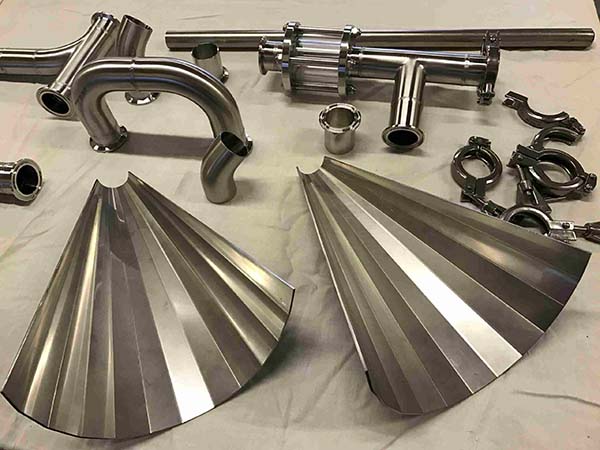
Cutting Processes in Stainless Steel Metal Fabrication
Cutting stainless steel requires balancing speed, edge quality, and heat control.
Common Cutting Methods Compared
| Cutting Method | Thickness Range | Advantages | Limitations |
|---|---|---|---|
| Laser cutting | ≤ 20 mm | High precision, clean edges | Heat-affected zone |
| Waterjet cutting | ≤ 100 mm | No thermal distortion | Slower, higher cost |
| Plasma cutting | ≥ 6 mm | Fast for thick plates | Lower edge accuracy |
| Mechanical shearing | Thin sheet | Cost-efficient | Limited geometry |
Laser cutting is the most common choice for precision stainless steel fabrication, especially when tight tolerances and repeatable edge quality are required.
Forming and Bending Characteristics of Stainless Steel
Stainless steel behaves differently from mild steel during forming due to its higher yield strength and work hardening rate.
Key Forming Considerations
- Higher springback compared to carbon steel
- Increased bending force requirements
- Tool wear acceleration
Typical Bending Parameters
| Material | Minimum Bend Radius | Springback Risk |
|---|---|---|
| 304 SS | 1.5× material thickness | Medium |
| 316 SS | 2× material thickness | High |
| 430 SS | 1× material thickness | Low |
Accurate bend allowance calculation and tooling compensation are essential for dimensional accuracy.
Welding Processes in Stainless Steel Fabrication
Welding quality often defines the structural integrity of stainless steel assemblies.
Common Welding Methods
| Welding Process | Strengths | Typical Use |
|---|---|---|
| TIG welding | Clean welds, precision | Thin sheet, visible joints |
| MIG welding | Faster deposition | Structural frames |
| Laser welding | Minimal distortion | Precision assemblies |
Stainless steel welding requires careful heat input control to prevent:
- Warping
- Sensitization
- Loss of corrosion resistance
Post-weld passivation is often necessary to restore surface integrity.
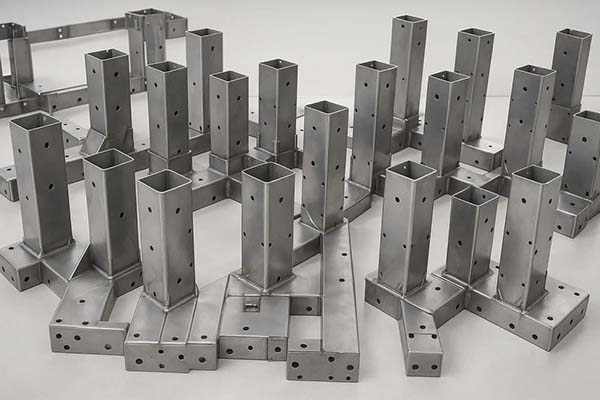
Machining Operations Within Fabricated Stainless Steel Assemblies
Many fabricated stainless steel parts require secondary machining to achieve functional tolerances.
Typical Machined Features
- Precision holes and slots
- Threaded interfaces
- Flatness-critical surfaces
| Operation | Typical Tolerance |
|---|---|
| Drilled holes | ±0.05 mm |
| CNC-milled slots | ±0.02 mm |
| Tapped threads | ISO 6H / 6g |
Machining is usually performed after welding to ensure final dimensional accuracy.
Surface Finishing Options in Stainless Steel Metal Fabrication
Surface finish affects corrosion resistance, hygiene, and appearance.
Common Surface Finishes
| Finish Type | Ra Range | Application |
|---|---|---|
| Mill finish | >3.2 μm | Structural parts |
| Brushed (No.4) | ~1.6 μm | Panels, enclosures |
| Polished | ≤0.8 μm | Food & medical |
| Electropolished | ≤0.4 μm | Pharmaceutical |
Electropolishing improves corrosion resistance by removing surface contaminants and micro-peaks.
Dimensional Tolerances in Stainless Steel Fabrication
Unlike CNC machining, fabrication tolerances depend on multiple cumulative processes.
Typical Fabrication Tolerances
| Feature | Typical Range |
|---|---|
| Laser cut profiles | ±0.1 mm |
| Bend angle | ±0.5° |
| Welded assemblies | ±0.5–1.0 mm |
| Machined interfaces | ±0.02 mm |
Clear tolerance allocation between fabrication and machining stages reduces cost and scrap.
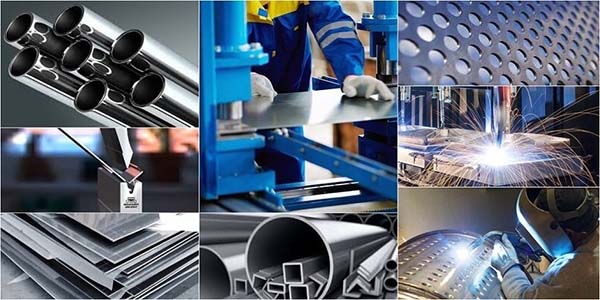
Quality Control and Inspection in Stainless Steel Fabrication
Quality control ensures fabricated components meet structural and functional requirements.
Common Inspection Methods
| Method | Purpose |
|---|---|
| Visual inspection | Weld integrity |
| Dimensional checks | Assembly fit |
| Dye penetrant testing | Surface cracks |
| CMM inspection | Precision interfaces |
For regulated industries, full material traceability and welding documentation are often mandatory.
Industries Relying on Stainless Steel Metal Fabrication
Stainless steel fabrication is essential where durability and cleanliness matter.
Key industries include:
- Food processing equipment
- Medical and pharmaceutical systems
- Industrial automation
- Energy and power generation
- Architectural and structural systems
Each industry applies different standards for finish, tolerance, and compliance.
Cost Drivers in Stainless Steel Metal Fabrication
Understanding cost structure helps buyers make better sourcing decisions.
Main Cost Contributors
| Factor | Cost Impact |
|---|---|
| Stainless grade | High |
| Thickness | Medium |
| Welding complexity | High |
| Surface finish | Medium to high |
| Volume | High (economies of scale) |
Design-for-fabrication (DFF) reduces unnecessary complexity and cost.
Why Manufacturers Choose Xavier for Stainless Steel Metal Fabrication
Xavier approaches stainless steel metal fabrication as an integrated manufacturing process rather than isolated operations.
Xavier offers:
- Expertise across 304, 316, and specialty stainless steels
- In-house cutting, forming, welding, and machining
- Controlled fabrication tolerances with secondary machining support
- Scalable production from prototypes to full assemblies
For manufacturers seeking reliable stainless steel metal fabrication with consistent quality and engineering support, Xavier provides production-ready solutions.
Xavier is a professional CNC machining manufacturer specializing in stainless steel metal fabrication and custom metal parts. We support CNC machining aluminum, CNC machining stainless steel, CNC machining magnesium alloy, CNC machining acrylic, and CNC machining ABS for high-precision applications. Our stainless steel metal fabrication solutions are widely used in CNC aerospace parts machining, CNC automotive parts machining, and medical parts machining, ensuring accuracy, efficiency, and stable quality. We offer 5 axis milling, CNC milling services, CNC turning services, and Swiss turning services, with finishing options such as anodizing and electroless nickel plating. As a global CNC machining service provider, Xavier supports batch production of stainless steel metal fabrication parts. Contact us for CNC machining service pricing.
Some of the images and text in this article are collected and compiled from the internet. If there is anything inappropriate, please contact us for processing.