Custom Brass CNC Machining: A Complete Guide for Precision Parts
Fundamentals of Custom Brass CNC Machining
Custom brass CNC machining is a subtractive manufacturing process where computer-controlled cutting tools precisely remove material from brass workpieces according to the digital design specifications in your CAD model. The CNC (Computer Numerical Control) system interprets G-code generated from CAM software to automate milling, turning, drilling, tapping, and other operations on brass parts. This automation produces parts with consistent geometry, repeatable quality, and minimal human error — ideal from one-off prototypes to mass volumes.
CNC machining of brass excels because the material responds predictably to controlled cutting paths. CNC mills and lathes handle turning and complex multi-axis movements that shape brass into functional parts with dimensional accuracy often measured in microns.
Why Brass Is an Excellent CNC Machining Material
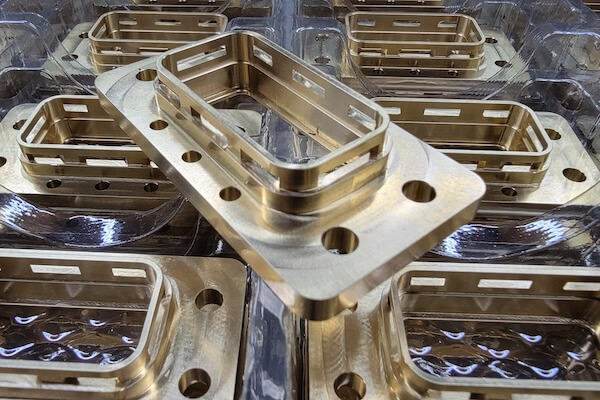
Brass is a copper-zinc alloy known for excellent machinability, meaning it cuts smoothly with minimal tool wear and can sustain high spindle speeds and feed rates compared with harder metals like steel. Its high thermal and electrical conductivity makes brass CNC machined parts ideal for electrical connectors and heat-related components. Additionally, brass naturally resists corrosion from water and many chemicals, increasing part longevity.
Brass also has aesthetic appeal: its golden color, combined with capabilities for polishing and plating, makes it desirable for decorative hardware and consumer products where appearance matters.
| Property | Advantage |
|---|---|
| Machinability | Increased productivity, lower tooling costs |
| Corrosion Resistance | Longer service life in harsh environments |
| Conductivity | Effective for electrical & thermal applications |
| Aesthetic Finish | Natural golden look, great for visible parts |
Common Brass Alloys Used in CNC Machining
Several brass grades are routinely machined, each with attributes suited to specific applications:
| Alloy | Key Features | Typical Uses |
|---|---|---|
| C360 Free-Cutting Brass | Excellent machinability, easy chip control | Connectors, fittings |
| C260 Cartridge Brass | Good corrosion resistance, decorative finish | Valves, terminals |
| C385 (Architectural Bronze) | Stronger and more durable | Gears, automotive parts |
Choosing the right alloy depends on required strength, surface finish, and environmental exposure, as these alloys vary in tensile strength, hardness, and ductility.
Tolerances and Precision in Brass Machining
Precision in brass CNC machining is often measured in terms of tolerance, which defines how closely the manufactured part must match the design. High-quality service providers can hold tolerances as fine as ±0.005 mm (±0.0002 in) or even tighter with advanced equipment.
For critical components such as electrical connectors or hydraulic fittings, maintaining tight tolerances ensures function, interchangeability, and consistent performance. Quality control systems including coordinate measuring machines (CMM) and laser scanning help verify dimensions throughout production.
| Tolerance Level | Typical Use |
|---|---|
| ±0.005 mm | Standard precision parts |
| ±0.002 mm | High-precision interfaces |
| ±0.0005 in | Ultra-precision components |
Processes and Techniques in Brass CNC Machining
Brass parts may require multiple machining methods. CNC turning shapes round features like shafts and threaded sections, while CNC milling creates slots, complex contours, pockets, and flat surfaces. Multi-axis machines like 4-axis and 5-axis centers handle intricate geometries and tilted faces in a single setup, improving accuracy and cutting efficiency.
More advanced approaches such as Swiss-type machining are used for long, slender parts requiring exceptional concentricity and surface quality — especially in connector pin and precision hardware production.
Efficient brass machining also includes strategic toolpath planning to control chip flow, reduce heat buildup, and preserve surface finish quality.
Surface Finishing and Post-Processing Options
After CNC machining, brass parts often undergo additional finishing to meet functional or aesthetic requirements:
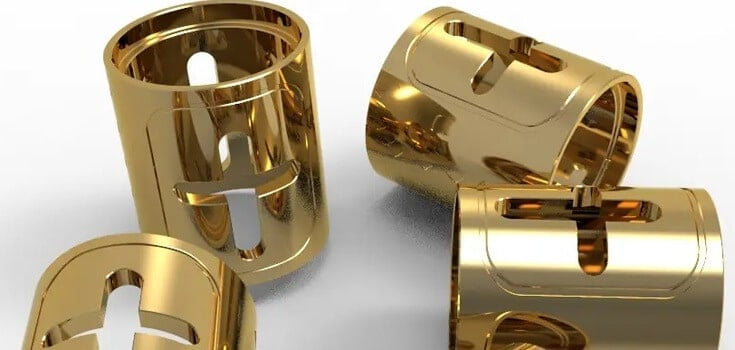
- Polishing and Buffing: Achieves mirror-like surfaces for luxury hardware.
- Electroplating: Nickel, chrome, gold plating for corrosion resistance and appearance.
- Brushing or Satin Finishes: Adds texture and reduces glare.
- Sand/Bead Blasting: Enhances uniform matte finish for industrial components.
These finishes not only elevate the appearance but also protect the brass from oxidation and wear, extending product life.
Design and Engineering Considerations
Designing parts for CNC machining requires attention to DFM (Design For Manufacturability) principles. Designers should aim to minimize unnecessary complex features that increase machining time and cost, include proper support for clamping and fixturing, and consider typical brass part behavior — such as minor thermal expansion and tool adhesion.
Ensuring hole sizes, wall thicknesses, and fillet radii align with standard tooling dimensions enhances both precision and cost-efficiency. Engineering teams often provide DFM feedback prior to production to reduce iterations and avoid expensive rework.
Industry Applications for Brass CNC Machined Parts
Brass CNC components are widely used across industries because of their functional and performance benefits:
| Industry | Typical Brass CNC Components |
|---|---|
| Plumbing & HVAC | Fittings, valves, connectors |
| Electronics | Terminals, connectors, switch parts |
| Automotive | Bushings, gears, meter fittings |
| Decorative Hardware | Handles, knobs, fixtures |
| Marine | Corrosion-resistant fasteners |
Due to its corrosion resistance and conductivity, brass is often chosen for parts that require both aesthetic appeal and functional reliability.
Mechanical Properties and Performance of Brass Components
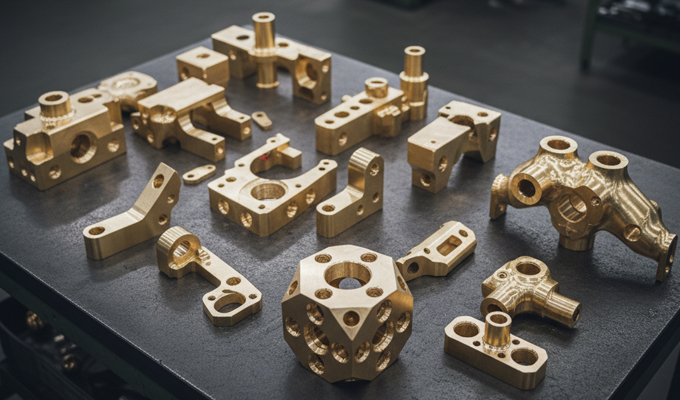
Brass combines moderate tensile strength with excellent durability and ductility. Its mechanical characteristics make it suitable for components that experience repetitive motion and wear, yet still maintain dimensional accuracy in assembly. While softer than steel, brass maintains stability at typical operational loads and offers superior resistance to environmental degradation.
Engineers also value brass’s conductivity for electrical and thermal functions, which is critical in connectors and heat exchangers.
Lead Times, Prototyping and Production Scale
Custom CNC machining services vary in turnaround based on complexity. Many providers offer rapid prototyping within 1-7 days for functional tests or pre-production validation. As volume increases, setups for mass production benefit from process optimization, reducing per-piece cost and time.
Flexible ordering options — from single prototypes to batches above 100,000 pieces — expand brass CNC machining viability across product lifecycle stages.
| Stage | Typical Lead Time |
|---|---|
| Rapid Prototype | 1–7 days |
| Small Batch | 3–14 days |
| Mass Production | Based on volume |
Why Choose Xavier for Custom Brass CNC Machining
At Xavier, we specialize in precision custom brass CNC machining backed by deep engineering expertise and cutting-edge 4-axis and 5-axis CNC machinery. Whether you need a one-off prototype or high-volume production, Xavier delivers consistent tolerances, surface finish quality, engineered DFM feedback, and on-time delivery. Our advanced inspection systems and surface finishing capabilities ensure that every brass part — from fluid connectors to decorative hardware — meets the highest expectations for performance and aesthetics. Trust Xavier to turn your design into precision brass parts that perform flawlessly in real-world applications.
Some of the images and text in this article are collected and compiled from the internet. If there is anything inappropriate, please contact us for processing.