
What Military-Grade CNC Machining Really Means
Military-grade CNC machining refers to precision computer numerical control manufacturing that meets defense-specific specifications and standards used to produce components for weapons systems, aerospace platforms, ground vehicles, naval systems, and mission-critical electronics. Unlike standard commercial machining, military-grade machining must withstand rigorous environmental stress, extreme temperatures, ballistic forces and prolonged mission use without failure. Parts must not only meet geometric and dimensional precision, but also comply with traceability, quality documentation, and defense industry compliance requirements.
In real terms, defense CNC machining often has tighter tolerances, stricter material control, and compliance with documented quality systems like AS9100 or ISO 9001, mandated by government contracts.
Materials Used in Military-Grade CNC Machining
Selecting the right material for defense CNC parts isn’t optional — it’s mission critical. Materials must survive extreme mechanical, thermal, and environmental conditions without degrading performance.
| Material | Key Properties | Typical Military Use |
|---|---|---|
| Titanium Alloys | High strength-to-weight ratio, corrosion resistance | Aircraft parts, missile structures |
| Inconel & Superalloys | Heat resistant (>1200°C), structural stability | Jet engines, exhaust systems |
| Aluminum Alloys | Lightweight, strong, corrosion resistant | UAV structures, housings |
| Stainless Steel (300/17-4 PH) | Corrosion & fatigue resistance | Ship systems, housings |
| Composites | High strength, low weight | Radar platforms, vehicle armor |
Defense machining frequently works with alloys that challenge machining tools due to hardness or toughness — yet these materials deliver performance crucial to defense systems’ safety and reliability.
Tolerance & Precision Standards for Military Components
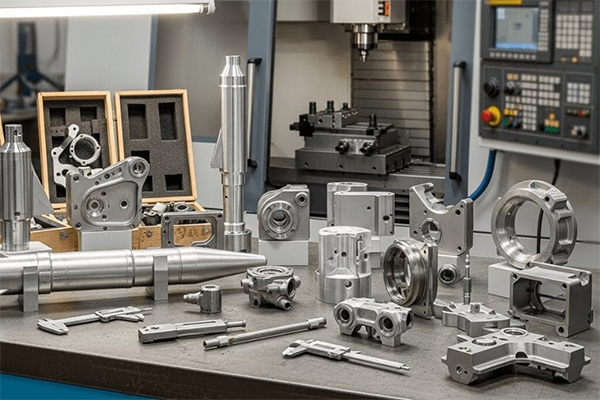
In military machining, precision is never an afterthought — it’s a requirement. Tolerance requirements are often dramatically tighter than in consumer or industrial machining:
| Tolerance Level | Metric | Application Example |
|---|---|---|
| Standard Defense Tolerance | ±0.010″ (±0.25 mm) | Support brackets, housings |
| Tight Tolerance | ±0.005″ (±0.13 mm) | Servo mountings, linkage interfaces |
| Ultra-Precision | ±0.0001″ (±0.0025 mm) | Missile guidance gears, aerospace thrust components |
Achieving tolerances as small as 0.0001″ means machining centers must be calibrated rigorously, and processes managed with strict quality controls. Ultra-precision CNC operations, such as 5-axis milling and Swiss turning, are common for these applications.
Surface finishes are also governed by defense surface standards — for example MIL-STD-10 surface finish criteria — ensuring parts don’t fail under stress or corrosion environments.
Quality Standards & Certifications
Not all machine shops can claim “military-grade.” Defense machining requires formal certification and quality systems that guarantee every part can be traced, inspected, and verified.
Key standards include:
| Standard / Compliance | Organization | Why It Matters |
|---|---|---|
| ISO 9001 | ISO | General quality system baseline |
| AS9100 / AS9100D | SAE | Specialized aerospace & defense quality requirements |
| AQAP | NATO | Allied defense quality assurance |
| ITAR / DFARS | U.S. DoD | Export control & defense data protection |
AS9100 expands ISO 9001 with specific process controls, risk management, and traceability required for defense industry products. ITAR and DFARS add compliance layers for export and security requirements for parts used in U.S. defense systems.

Advanced CNC Processes Used in Military Machining
Standard 3-axis milling and turning often aren’t enough for complex defense parts. Military machining uses advanced techniques that handle complex geometries, multi-surface finishes, and critical fitments:
- 5-Axis CNC Milling — Simultaneous multi-direction machining for complex aerospace geometries.
- Swiss-Style Turning — Exceptionally precise small components with micron-level tolerances.
- EDM (Electrical Discharge Machining) — For extremely hard materials and complex internal shapes.
- Multi-Spindle Bar Turning — Efficient production of small, high-precision hardware.
Swiss machines, for example, can maintain tolerances as tight as ±0.0001″ for small diameter components like missile guidance pins or aircraft connectors — far beyond what conventional turning alone can reliably produce.
Inspection Protocols & Traceability Requirements
Military CNC machining requires detailed inspection at multiple stages of production:
| Inspection Method | Purpose |
|---|---|
| Coordinate Measuring Machines (CMM) | Verify 3D geometry against CAD model |
| Optical Comparators | Profile, form, and angle verification |
| Microscopes & Calibrated Gauges | Micro-feature dimension checks |
| Full Documentation | Traceability from material batch to final part |
All inspection data and processes must be logged and linked to part serial numbers. This traceability ensures that if a part fails in service, its entire manufacturing history — including material certifications, inspection reports, and machining logs — can be reviewed.
Design for Defense CNC Machining
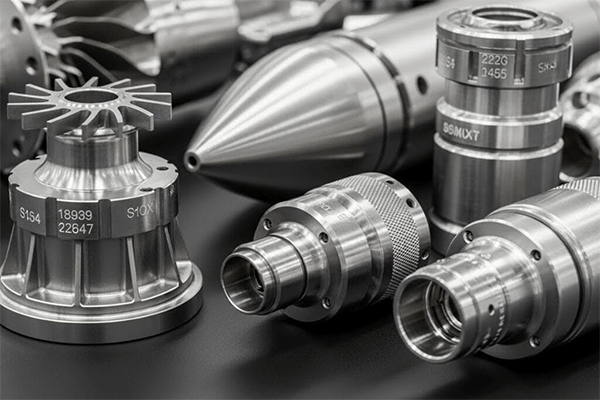
Design for Manufacturability (DFM) is even more critical in military applications because mistakes are costly and dangerous. Engineers use geometric dimensioning and tolerancing (GD&T), typically defined by ASME Y14.5 standards, to precisely communicate allowable variation on complex parts.
Important design considerations include:
- Avoiding unnecessary feature complexity that increases setup or machining passes.
- Choosing materials that balance performance with machinability.
- Including proper fixturing features on the part to improve clamp stability and reduce vibration during machining.
Poor DFM design decisions can add hours of machining time, extra tooling changes, and significant cost increases — all unacceptable in defense manufacturing.
Military CNC Machining Applications
Defense CNC machining is used across multiple systems where reliability and precision are mandatory:
| System Type | Example Components |
|---|---|
| Aerospace & Aviation | Turbine housings, flight control actuators |
| Ground Vehicles | Armor brackets, drivetrain gears |
| Weapon Systems | Barrel components, firing mechanisms |
| Naval Systems | Propeller shafts, stern tube housings |
| Electronics & Sensors | Radar mounts, sealed enclosures |
These applications often require parts to perform in extreme environments — desert heat, arctic cold, high pressure undersea — without degrading performance. CNC machining enables repeatable, exact geometry that ensures parts fit and function as intended.
Environmental & Operational Requirements
Military environments push components beyond everyday industrial conditions. Parts may face:
- Extreme temperature cycles
- Vibration and shock conditions
- Moisture, dust, and chemical exposure
- Mechanical loading beyond commercial standards
Standards like MIL-STD-810 test equipment resilience under various stresses such as shock, vibration, humidity, and altitude conditions — and machined components often must contribute to systems that meet these tests.
Benefits of Military-Grade CNC Machining Over Commercial CNC
Military-grade CNC machining offers advantages beyond precision alone:
- Higher repeatability and interchangeability due to stringent quality control.
- Superior durability because materials and finishes are chosen for long-term use in hostile conditions.
- Traceability and documentation required for regulated defense contracts.
- Design compliance with official standards ensuring seamless integration into larger defense systems.
Why Xavier Is Your Partner for Military-Grade CNC Machining
At Xavier, we deliver true military-grade CNC machining backed by robust quality systems, AS9100 and ISO-aligned processes, and advanced machining capabilities spanning 5-axis milling, Swiss turning, EDM and multi-axis precision operations. Whether you need mission-critical components for aerospace, defense vehicles, weapon systems, or naval platforms, our engineers ensure your designs are optimized for manufacturability, material integrity, and precise tolerancing.
With rigorous inspection protocols, full traceability, controlled documentation, and secure handling of defense-related data, Xavier reliably delivers parts that meet and exceed stringent military requirements — every time.
Partner with Xavier to bring precision, compliance, and performance to your next defense manufacturing program.
Some of the images and text in this article are collected and compiled from the internet. If there is anything inappropriate, please contact us for processing.